HOW TO READ A GIA DIAMOND DOSSIER
GIA issues the Diamond Dossier for loose natural diamonds between 0.15 and 1.99 carats in the D-to-Z color range. The Diamond Dossier is not issued for synthetics, simulants, mounted diamonds, diamonds that have undergone unstable treatments such as fracture filling or coating, or diamonds that have been HPHT processed. Any evidence of other treatment is prominently disclosed in the report.
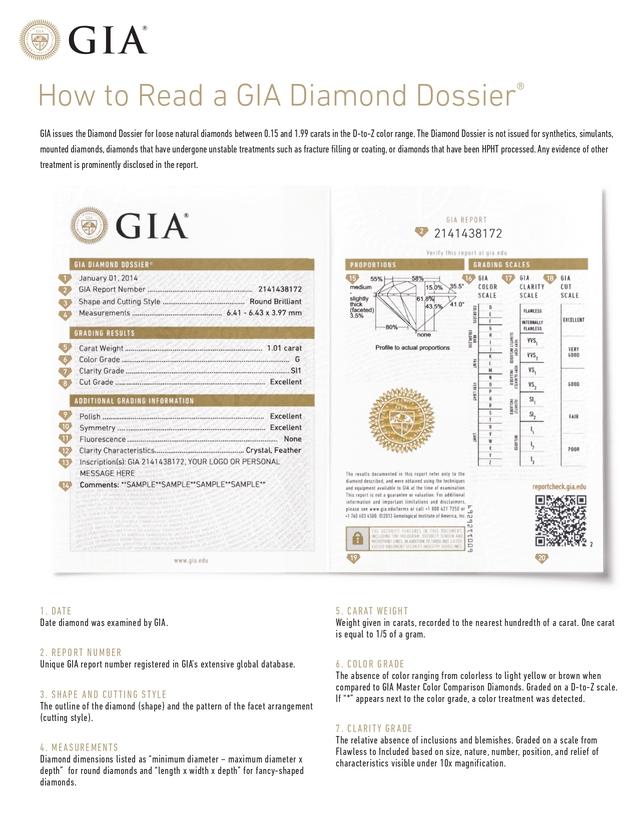
1. Date
The date diamond was examined by GIA.
2. Report number
Unique GIA report number registered in GIA’s extensive global database.
3. Shape and cutting style
The outline of the diamond (shape) and the pattern of the facet arrangement (cutting style).
4. MEASUREMENT
Diamond dimensions are listed as “minimum diameter – maximum diameter x depth” for round diamonds and “length x width x depth” for fancy-shaped diamonds.
5. CARAT WEIGHT
Weight given in carats, recorded to the nearest hundredth of a carat. One carat is equal to 1/5 of a gram.
6. COLOR GRADE
The absence of color ranges from colorless to light yellow or brown when compared to GIA Master Color Comparison Diamonds. Graded on a D-to-Z scale. If “*” appears next to the color grade, a color treatment is detected.
7. CLARITY GRADE
The relative absence of inclusions and blemishes. Graded on a scale from Flawless to Included based on size, nature, number, position, and relief of characteristics visible under 10x magnification.
8. CUT GRADE
For standard, D-to-Z color, round brilliant diamonds. Cut grade incorporates the aspects of face-up appearance, design, and craftsmanship. Graded on a scale from Excellent to Poor.
9. POLISH
The smoothness of the diamond’s surface is assessed on a scale ranging from Excellent to Poor.
10. SYMMETRY
The Exactness of the diamond’s outline, and the shape, placement, and alignment of its facets, are assessed on a scale ranging from Excellent to Poor.
11. FLUORESCENCE
Strength and color of the diamond when viewed under long-wave ultraviolet light. A fluorescence description of “none” represents a range of fluorescence from Indiscernible to Very Strong. Under an ultraviolet light, if fluorescence is detected, a color of blue or yellow will be emitted. Blue fluorescence is the most common while yellow fluorescence is the least desirable of the two. Used for identification purposes.
12. CLARITY CHARACTERISTICS
List of the most significant clarity characteristics present in the diamond that justifies the clarity grade; a maximum of four characteristics are listed.
13. INSCRIPTION (S)
Any text, symbols, logos, or a unique GIA report number inscribed on the diamond’s girdle.
14. COMMENTS
Additional identifying characteristics or features that are not otherwise represented in the report. If a treatment is detected, such as laser drilling, it would be described here.
15. PROPORTION DIAGRAM
Graphic profile representation of the diamond’s actual proportions.
16. Gia color scale
Illustrates the GIA Color grades and their relative positions in the GIA Diamond Color Grading System. As noted on the GIA grading report the color scale runs from d(white) - to z(yellow/off-color).
17. GIA CLARITY SCALE
Illustrates the GIA Clarity grades and their relative positions in the GIA Diamond Clarity Grading System. As noted on the GIA grading report the clarity scale runs from fl(flawless) - i3(highly imperfect).
18. GIA CUT SCALE
Illustrates the GIA Cut grades and their relative position in the GIA Diamond Cut Grading System. Available for standard round brilliant cut diamonds in the D-to-Z color range and flawless-to-I3 clarity range. As noted on the Gia grading report, the cut grade scale for round brilliant cut diamonds is from excellent(most desirable) - to poor(least desirable).
19. SECURITY FEATURES
Microprinting, security screens, watermarks, a two-dimensional barcode, a hologram, and sheet numbering safeguard report integrity and facilitate document authentication.
20. QR CODE
A two-dimensional barcode that, when scanned, verifies data on the report against the GIA database.
*Some links on our site may earn us a small commission at NO EXTRA cost to you, helping us keep our content free*