DIAMOND SYMMETRY
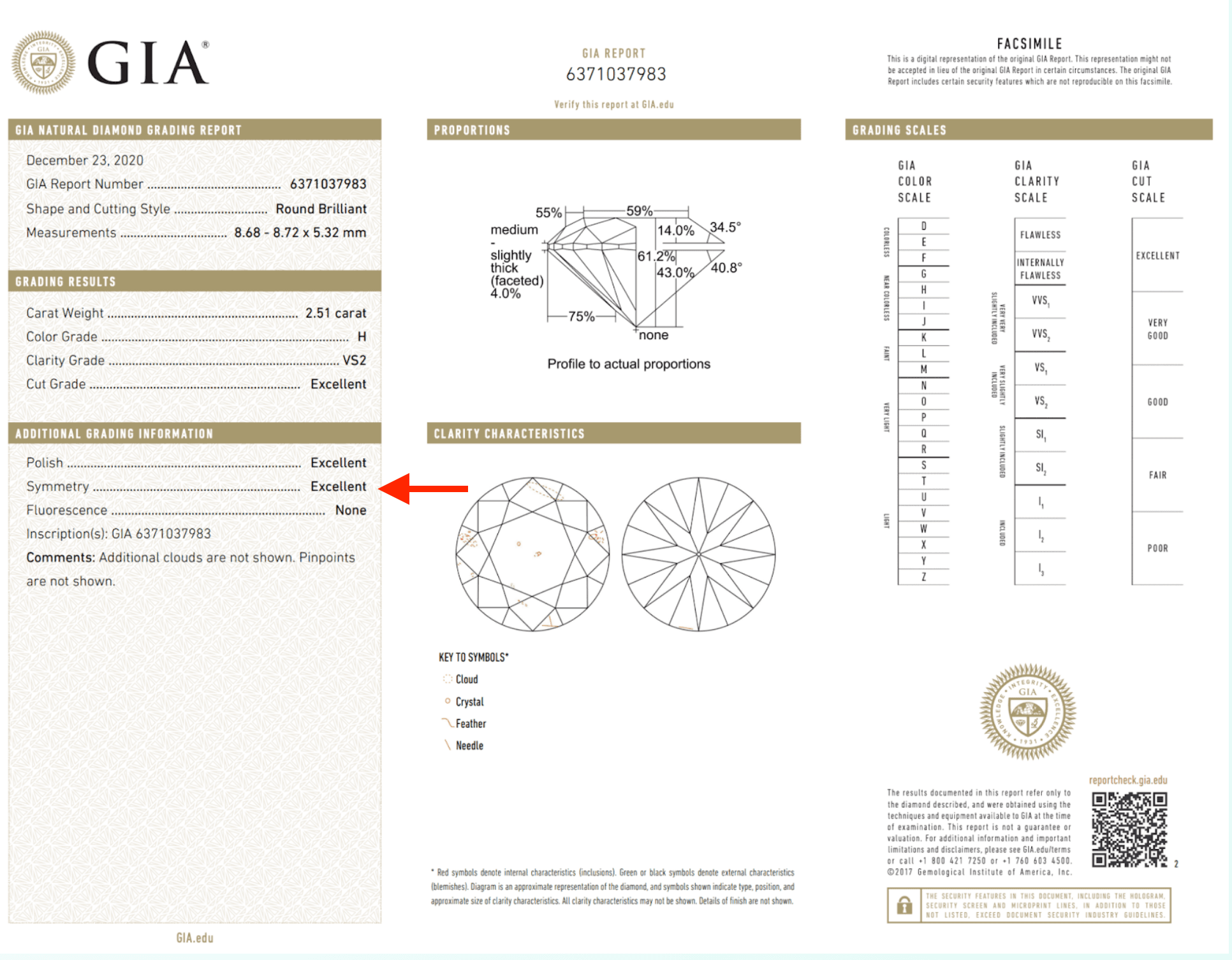
Diamond symmetry refers to the proportional and precise arrangement of a diamond’s facets. A diamond is said to have symmetry when the facets are evenly spaced, with all of the angles and proportions between them being consistent and precise. Diamonds with Very Good symmetry will sparkle and reflect light more effectively, making them appear brighter and more valuable. Poor symmetry can cause a diamond to appear dull and lifeless. Symmetry is graded on a scale from excellent, very good, good, fair, and poor. Diamonds with Excellent symmetry will have greater fire, sparkle, and scintillation. You will find a sample of this information on your grading report below:
The 10 symmetry parameters are calculated as follows:
1. Out-of-round: The difference between the maximum and minimum diameter, as a percentage of the average diameter.
2. Table off-center: The direct distance between the table center and the outline center projected into the table plane, as a percentage of the average diameter.
3. Culet off-center: The direct distance between the culet center and the outline center projected into any horizontal plane such as the table plane, as a percentage of the average diameter.
4. Table/culet alignment: The direct distance between the table center and the culet center projected into the table plane, as a percentage of the average diameter.
5. Crown height variation: The difference between the maximum and minimum crown height values, as a percentage of the average diameter.
6. Crown angle variation: The difference between the maximum and minimum crown angle values, in degrees.
7. Pavilion depth variation: The difference between the maximum and minimum pavilion depth values, as a percentage of the average diameter.
8. Pavilion angle variation: The difference between the maximum and minimum pavilion angle values, in degrees.
9. Girdle thickness variation: The difference between the maximum and minimum girdle thickness values, as a percentage of the average diameter, measured at the bezel-main junctions (see also features A1-A3 in figure 3)
10. Table size variation: The difference between the maximum and minimum table size values, as a percentage of the average diameter
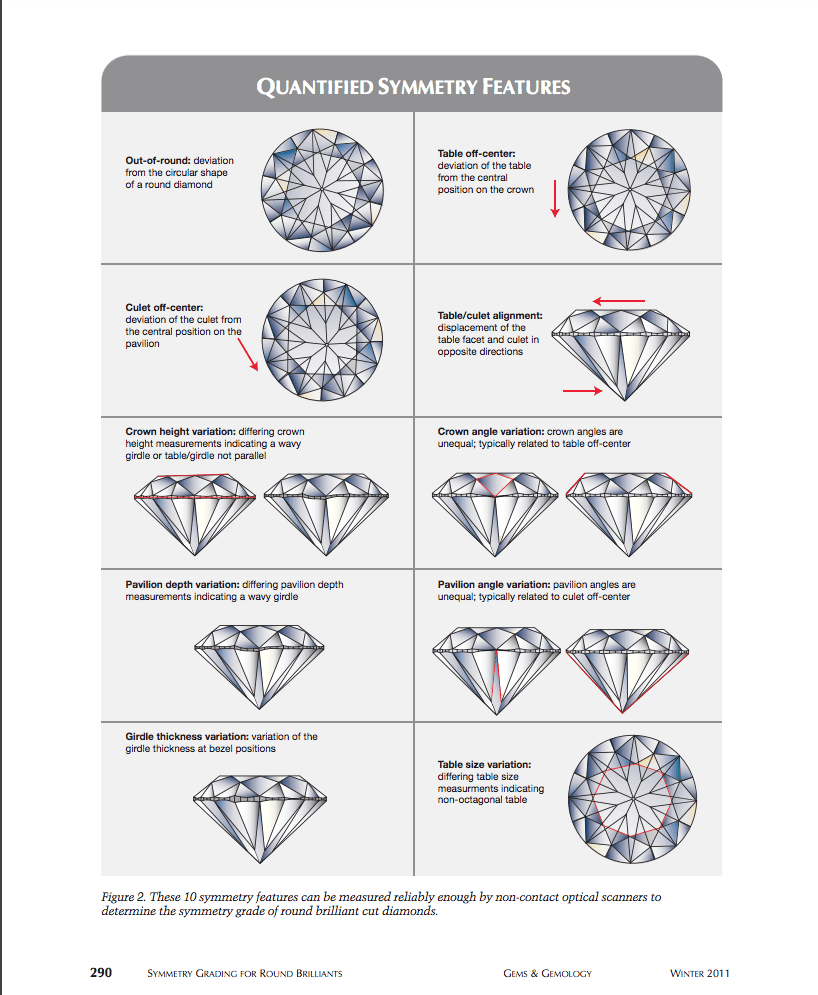
Symmetry can be measured by non-contact optical scanner technology(laser) or under 10x magnification(under a microscope) with sufficient measuring instruments.
*Some links on our site may earn us a small commission at NO EXTRA cost to you, helping us keep our content free*