HOW IS A DIAMOND FORMED IN THE EARTH
WHERE DO DIAMONDS COME FROM?
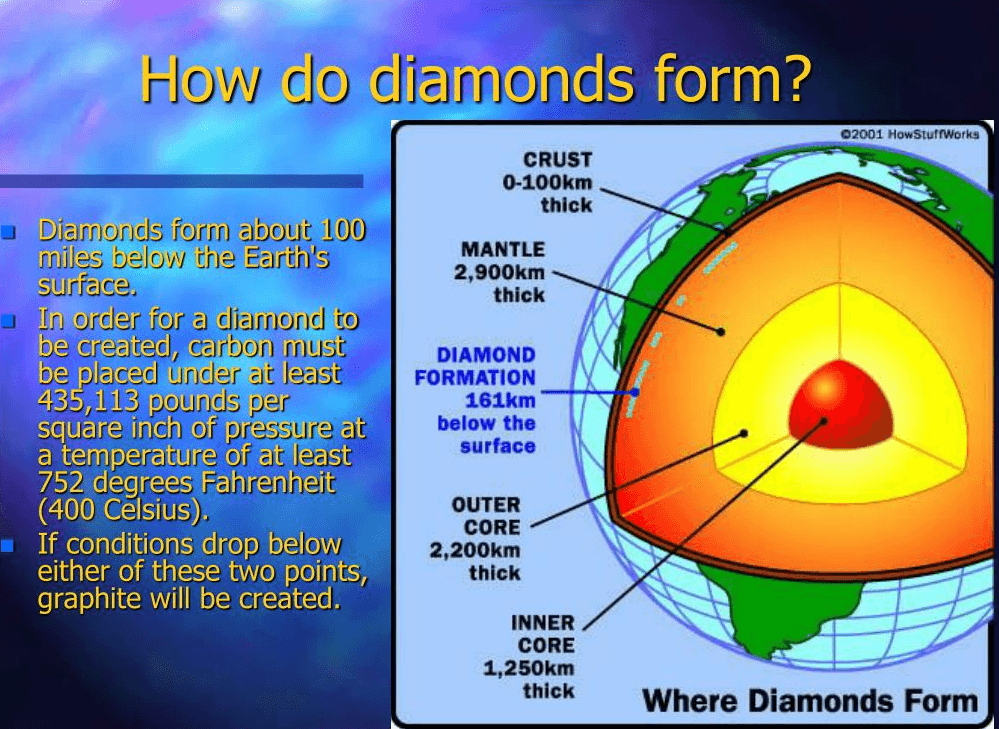
A simplified version of the formation of diamonds is below….though the process itself may take billions of years!
Diamonds are formed deep within the Earth's mantle, under high pressure and high temperature conditions(2,500 degrees Fahrenheit and 825,000 pounds per square inch in pressure!). Contrary to popular belief, diamonds ARE NOT MADE FROM COAL! The process of diamond formation starts when carbon atoms are subjected to intense heat and pressure, causing them to bond together in a crystal lattice structure 150 to 200KLM below the earth's surface(generally formed over 1 billion to 3 billion years).
There are two main types of diamond formation: the first is called the "kimberlite" process, which occurs in the mantle, and the second is called the "lamproite" process, which occurs in the Earth's crust.
In the kimberlite process, diamonds form in vertical volcanic pipes known as kimberlite pipes, which bring magma and other materials from deep within the Earth to the surface through vertical volcanic eruptions. As the magma rises, it cools and crystallizes, forming rocks known as kimberlite or lamproite. Diamonds are found within these rocks, often in small deposits or "pockets".
In the lamproite process, diamonds are formed in the Earth's crust by volcanic activity. The magma from these volcanoes can contain diamonds, which are brought to the surface through volcanic eruptions. Diamonds formed by the lamproite process are typically found in smaller deposits and are often smaller in size than those formed by the kimberlite process.
Once diamonds are formed, they may remain in the Earth's mantle for millions or even billions of years before being brought to the surface by natural geological processes such as volcanic activity or erosion. Again, the journey to the surface can take thousands of years, and many diamonds are lost or destroyed along the way. The diamonds that do make it to the surface are often found in areas with unique geological features that make diamond formation and preservation possible.
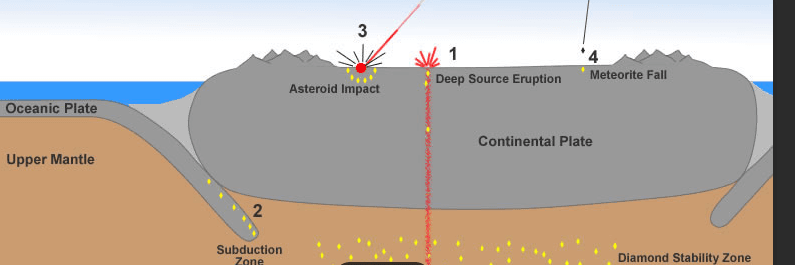
Yellow dots are diamonds | Credit picture to slidserve.com
Diamonds can also be found in riverbeds, which are delivered to the surface via alluvial pipes. An alluvial pipe is a deposit of diamonds that forms in a river or stream bed from eroded kimberlite pipes.
Diamonds do not form in a river, but they may be transported by there water from their original source. This happens when water erodes away the rock that contains diamonds and carries them downstream. The diamonds settle at the bottom of the river or stream where they form deposits called placer deposits.
To find diamonds in a river, you need to scan the surface, sift the soil, and then sift the soil in water. You might also find other minerals such as gold or garnet along with diamonds.
3 PARTS OF THE EARTH EXPLAINED FOR DIAMOND GROWTH
- - Asthenosphere
- The asthenosphere is a semi-fluid layer of the Earth's mantle located about 100 to 200 kilometers below the surface, beneath the lithosphere. Composed mainly of partially molten peridotite, it has ductile properties due to high temperatures and pressures. This layer is crucial for plate tectonics, as its slow, convective flow facilitates the movement of tectonic plates, leading to earthquakes, volcanic activity, and continental drift. The asthenosphere's behavior also affects seismic wave propagation, helping scientists study the Earth's interior.
- - Ocean Crust
- The ocean crust is the outermost layer of the Earth's lithosphere that underlies the ocean basins. It is primarily composed of basalt, a dense, fine-grained volcanic rock, and is thinner and denser than continental crust, typically about 5 to 10 kilometers thick. Formed at mid-ocean ridges through volcanic activity, ocean crust spreads outward as tectonic plates move apart, creating new crust. It is characterized by its young geological age, generally less than 200 million years old, due to the continuous process of formation and subduction. The ocean crust plays a vital role in the Earth's geology, contributing to processes such as seafloor spreading, plate tectonics, and the recycling of materials through subduction zones.
- - Continental Crust
The continental crust is the outermost layer of Earth's lithosphere that makes up the planet's continents and continental shelves. The relatively thick part of the earth's crust that forms the large landmasses. It is generally older and more complex than the oceanic crust, and dominantly composed of igneous and metamorphic granitic or more felsic composition. The continental crust is also much thicker than the oceanic crust, averaging about (25 miles) compared to (4 miles).
*Some links on our site may earn us a small commission at NO EXTRA cost to you, helping us keep our content free*