Best Specs for Natural Diamonds by Budget

By Josh Allen, Co-Founder — YourDiamondGuys.com Josh has over 25 years of experience in the global diamond trade, sourcing from Mumbai, Tel Aviv, and Antwerp, and has supplied diamonds to Tiffany, Cartier, Harry Winston, and more.
Natural diamonds do not reward the highest grades on paper every time.
They reward balance.
Light.
Presence.
The way the stone looks when you actually wear it.
That is where people get hurt.
They chase color. They chase clarity. They chase the biggest certificate flex they can afford.
Then the diamond shows up flat.
This guide is the fix.
You will get luxury-leaning sweet spots by budget for round, oval, pear, cushion, and emerald.
And more importantly, you will see where to stay strict.
And where you can bend without killing the look.
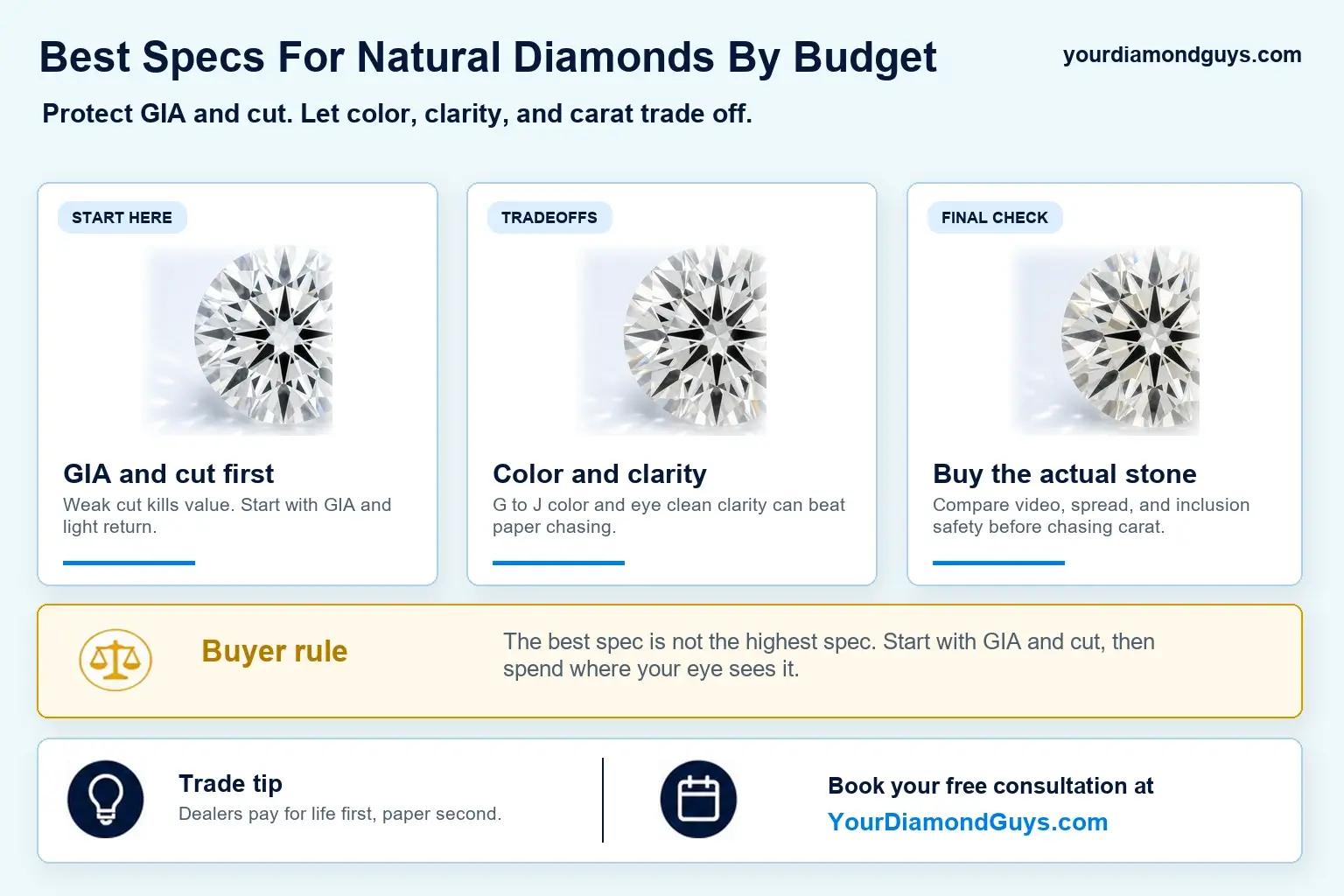
Quick mindset shift: "best specs" does not mean highest specs
Most people think best means highest grade.
It doesn't.
It means best look for your money.
A grading report is a filter.
Not the finish line.
As GIA explains, only round brilliants receive an official GIA cut grade, while fancy shapes play by different rules and proportions can change face-up appearance fast.
That is why two diamonds with similar paper can look nothing alike in video.
Same grade. Very different look.
The few places to stay strict

1) Cut and make
This is first.
Always.
For rounds, keep cut in the top tier.
Keep polish strong.
Keep symmetry strong.
For fancy shapes, trust your eyes in video.
Not just the report.
The American Gem Society notes that cut affects sparkle and quality because it controls how the diamond reflects light.
That is the whole game.
If light does not move, the stone does not move.
2) Durability basics
Do not get cute here.
Avoid ultra-thin edges.
Be careful with very shallow stones.
Protect corners on princess cuts, tips on pear shapes and marquises.
If you wear the ring daily, security matters as much as sparkle.
3) Straight answers and clean disclosure
Treatments should never be buried.
Marketing language should not do the heavy lifting.
The FTC Jewelry Guides require truthful representation of things like cut, color, treatment, durability, and origin.
Good.
That is the baseline.
Where you can flex without losing the wow
Color
Yellow gold and rose gold give you room.
White metal gives you less.
If you want an icy look, stay tighter on color.
If you want value, metal color can do some of the work.
Clarity
You are not buying a bragging grade.
You are buying a clean face-up look.
That is a big difference.
If the stone looks clean in real viewing, do not overpay for microscopic perfection.
Fluorescence
This one gets oversimplified.
A lot.
According to CIBJO, fluorescence is visible light a diamond can emit under long-wave ultraviolet light, and it can show up in different colors and intensities.
That does not make it automatically good.
Or bad.
It makes it case by case.
Check it in video.
Luxury budget brackets with spec sweet spots
These brackets are here to keep this practical.
Not theoretical.
For context, the Natural Diamond Council says the average U.S. natural diamond engagement ring costs about $7,364, which is why many luxury buyers start above that range.
The table: where to stay strict vs where to flex
| Diamond budget (stone only) | Round sweet spot | Oval / Pear sweet spot | Cushion sweet spot | Emerald sweet spot | Best place to flex |
|---|---|---|---|---|---|
| $8k–$12k | Keep cut at the top. Favor brightness over paper perfection. | Look for lively light return and a balanced outline in video. | Find a bright center and a pattern you actually like. | Keep it clean face-up first. Step cuts expose more. | Color |
| $12k–$18k | Keep cut strong, then push face-up size or cleanliness. | Add size carefully without losing shape precision. | Upgrade brightness and pattern definition. | Push for a sleeker outline and cleaner look. | Clarity |
| $18k–$30k | Combine strong cut with higher color and a cleaner overall look. | Balance size with shape precision and strong light return. | Buy character, but do not buy a sleepy center. | Higher color and clarity become easier here. | Carat jumps |
| $30k+ | Put cut first, then tune everything else to taste. | Be strict on shape precision and video performance. | Choose the standout look with crisp facet definition. | Keep the hall-of-mirrors look clean and elegant. | Very little |
How to use the table fast
Pick your shape first.
Lock the strict items for that shape.
Then choose one flex point.
One.
Not three.
That is how you buy size without quietly draining the life out of the diamond.
Shape cheat sheets

Round
Round is the easiest place to win visually.
If you are torn between slightly bigger and noticeably better cut, better cut usually wins.
Every time.
Oval
Ovals can look huge for the weight.
That is the appeal.
But watch the center.
Watch the outline.
If the middle goes soft in video, you will keep seeing it.
Pear
Pear shapes punish bad symmetry.
Fast.
If one shoulder looks heavier, your eye will go there immediately.
Protect the point with the setting.
No shortcuts.
Cushion
Cushion is not one look.
Some are chunky.
Some are splintery.
Choose the personality first.
Then find the brightest version of that personality.
Emerald
Emerald cuts are honest.
They show more.
They hide less.
Open facets make clarity and color easier to notice, so if you love this shape, spend more of your budget on a clean, elegant face-up look.
Featured snippet: How to choose the best natural diamond specs for your budget (6 steps)
- Choose your shape first because round and fancy shapes do not follow the same playbook.
- Put cut and overall make at the top of your list.
- Pick a color target that matches your setting metal.
- Choose clarity for a clean face-up look, not a vanity grade.
- Treat fluorescence as a case-by-case feature and verify it in video.
- Match the report to the listing and keep every document.
How YourDiamondGuys can help
Luxury shopping moves fast.
Bad advice moves faster.
This is where people overpay for a stone that never had the look to begin with.
We slow it down.
We screen the details that matter.
Measurements.
Comments.
Video.
Light behavior.
The things that separate a bright stone from a dead one.
We do not sell diamonds.
We guide you.
Get a Free Diamond Consultation
If the numbers look right but the stone still feels off, trust that feeling.
That is usually where the make starts talking.
Book your Free Diamond Consultation and we will tell you where to stay strict, where to flex, and which options are actually worth your money.
Questions? Reach out directly for a free consultation, or drop them in the Diamond Buyers Academy community — Rob and I answer personally.
Frequently Asked Questions
Start with shape.
Then put cut and make at the top of the list.
Once the diamond looks bright and balanced in video, you can tune color and clarity around your taste.
No.
A slightly smaller diamond with stronger light return usually feels more premium than a larger one with a flat center or soft outline.
Presence and brilliance matter more than carat weight alone.
Usually color or clarity.
But only one at a time.
The moment you flex in multiple places, the look can fall apart quickly. Choose one trade-off that you won't notice day to day.
Yes.
Round has a more structured grading system. Fancy shapes need more visual judgment.
That is why video matters more for ovals, pears, cushions, and emerald cuts.
Use the report as a filter. Use the video as the final judge.
Look for even brightness, a balanced outline, and a clean face-up look.
If anything feels soft, get a second opinion before you wire the money. Paper never tells the full story.
*Some links on our site may earn us a small commission at NO EXTRA cost to you, helping us keep our content free*