Conflict-Free Diamonds and the Kimberley Process

By Josh Allen, Co-Founder — YourDiamondGuys.com Josh has over 25 years of experience in the global diamond trade, sourcing from Mumbai, Tel Aviv, and Antwerp, and has supplied diamonds to Tiffany, Cartier, Harry Winston, and more.
Most people hear conflict-free and get nervous.
They should not.
Here is the bigger truth.
Natural diamonds are still one of the safest, most meaningful luxury purchases you can make when you work with a reputable jeweler.
And conflict diamonds?
A very small part of the global trade.
The Kimberley Process says its participants prevent 99.8% of worldwide trade in conflict diamonds.
That matters.
Because most buyers have been left with the wrong impression.
They hear one phrase.
They assume the whole market is risky.
It is not.
The modern natural diamond trade has real safeguards in place. Real documentation. Real systems upstream.
So yes.
You should understand what conflict-free means.
But this page is not here to scare you out of buying a natural diamond.
It is here to show you why you can feel good about it.
What "conflict-free" actually means under the Kimberley Process

This is the baseline.
And it is a real one.
Under the Kimberley Process, conflict diamonds are rough diamonds used by rebel movements or their allies to finance armed conflict against legitimate governments.
That definition is narrower than most people think.
But narrower does not mean weak.
It means specific.
It means there is a formal international framework built to keep that category of rough diamonds out of trade.
That should give you confidence.
Not because any system is magic.
Because real controls beat vague fear every time.
Where the Kimberley Process starts — and where it stops
The Kimberley Process is built around rough diamonds.
That is where the protections start.
Upstream.
Early in the chain.
The U.S. State Department's overview of the Kimberley Process describes it as an international certification regime created to increase transparency and oversight in the rough diamond trade. The Kimberley Process definition page makes the same point.
That does not mean polished diamonds are floating around without structure.
It means the formal Kimberley control sits at the rough stage.
That is how the system was designed.
And it is one reason the natural diamond market is far more controlled than most people realize.
Same headline.
Very different reality.
What U.S. buyers should know about documentation
If you are shopping in the U.S., the formal Kimberley paperwork usually lives upstream.
Not in your ring box.
The rule in 19 CFR 12.152 says shipments of rough diamonds imported into or exported from the United States must be accompanied by an original Kimberley Process Certificate.
Read that carefully.
Rough diamonds.
Not polished retail goods.
So if you buy a polished natural diamond, you probably are not getting a Kimberley Process Certificate at checkout.
That is normal.
Not suspicious.
It just means the formal document sits earlier in the chain, where the process was built to work.
A good jeweler should still be able to explain what sourcing standards they rely on and what supplier assurances support the stone.
The extra layer most people never hear about
This part matters too.
The trade does not stop with Kimberley.
There is another layer.
The World Diamond Council's System of Warranties requires buyers and sellers of rough diamonds, polished diamonds, and diamond jewelry to include a warranty statement on B2B invoices and memos. The WDC SoW overview explains how those assurances continue through later stages of the trade.
That is a good thing.
It means the natural diamond market is not leaning on one checkpoint and hoping for the best.
It means there are multiple systems designed to support confidence as diamonds move through the supply chain.
That is exactly what you want.
How to read common sourcing claims the right way
You will see four versions of this language all the time.
Conflict-free
Usually a Kimberley Process-based claim.
Kimberley Process compliant
Usually referring to rough-diamond controls upstream.
Responsibly sourced
Can mean broader sourcing standards depending on the jeweler.
Backed by supplier warranties
Now you are talking about paperwork moving through the chain.
None of those are reasons to back away from natural diamonds.
They are just different layers of language.
Same phrase does not mean same backup.
That is the real point.
The questions to ask before you buy
Keep this simple.
Ask these.
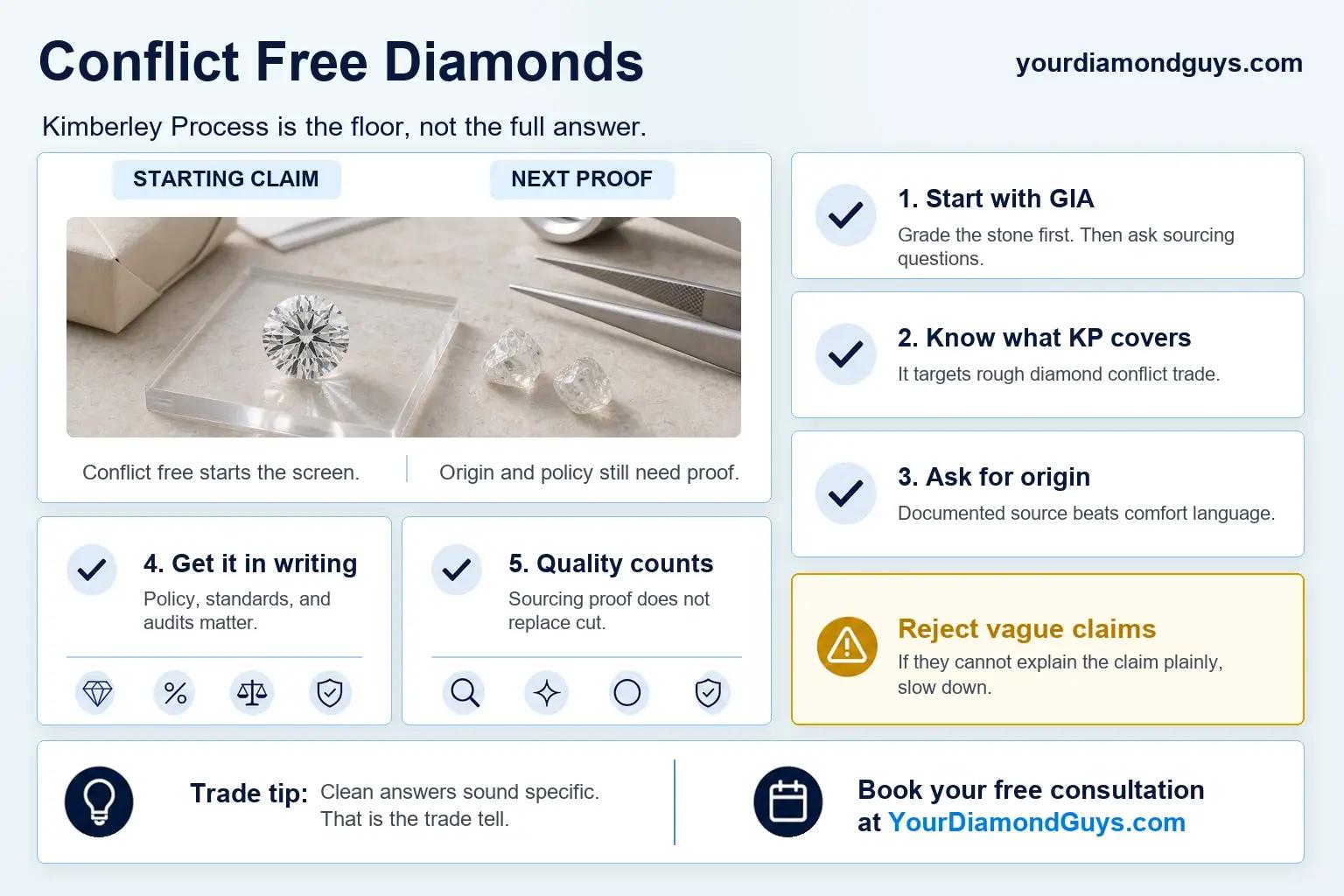
- What do you mean by "conflict-free"?
- Is that based on the Kimberley Process, supplier warranties, or both?
- What do you keep on file to support that claim?
- Can you send that explanation in writing?
- If I have a sourcing question later, who owns the answer?
That is not being difficult.
That is buying well.
And when a jeweler can answer those cleanly, it should increase your confidence.
Not reduce it.
What to do with vague answers

If the explanation gets fuzzy, slow down.
Not because natural diamonds are the issue.
Because loose language is.
The FTC's buying guidance says gemstones and diamonds may be natural, manufactured, or treated, and shoppers should get store policies in writing before they buy.
Same principle here.
Clear words.
Clear process.
Clear paper.
That is how confidence gets built.
What this means in plain English
Here is the blunt version.
You should feel good about buying a natural diamond.
Really.
The modern trade has more controls, more documentation, and more sourcing structure than most people realize.
The Kimberley Process says its participants prevent 99.8% of worldwide trade in conflict diamonds.
That tells you something important.
Conflict diamonds are not the center of the natural diamond market.
They are a very small part of global trade.
That is the reality.
So when you buy a natural diamond from a jeweler who can explain the sourcing language clearly, you are not making some reckless decision.
You are buying something rare.
Something beautiful.
Something lasting.
And you can feel good about it.
If a jeweler says conflict-free, you want three things:
- a definition
- a process
- something in writing
If they can give you that, good.
Now you are dealing with substance.
Not just a label.
Free Diamond Consultation
Still want a second set of eyes on a jeweler's sourcing claim?
Bring it to us.
We will tell you what the wording means.
What is solid.
And whether the explanation actually holds up.
Book your Free Diamond Consultation
Questions? Reach out directly for a free consultation, or drop them in the Diamond Buyers Academy community — Rob and I answer personally.
Frequently Asked Questions
Not exactly.
The phrase is often tied to Kimberley Process standards, but different sellers can use it with slightly different backup.
That is why a clean explanation matters.
Not directly.
Its formal controls are built around rough diamonds in international trade.
Usually not when you are buying a polished diamond.
That certificate usually sits upstream in the rough trade.
Yes.
Especially when you are working with a reputable jeweler who can explain the sourcing standards behind the stone.
Ask this: What do you mean by conflict-free?
Then listen.
A good answer should make you more confident.
Not less.
*Some links on our site may earn us a small commission at NO EXTRA cost to you, helping us keep our content free*