Responsible Sourcing and Country of Origin

By Josh Allen, Co-Founder — YourDiamondGuys.com Josh has over 25 years of experience in the global diamond trade, sourcing from Mumbai, Tel Aviv, and Antwerp, and has supplied diamonds to Tiffany, Cartier, Harry Winston, and more.
Natural diamonds make "origin" sound simple in marketing.
It is not.
This is one of the easiest places for a seller to get vague.
And vague is where you get stuck.
This page gives you a clean way to think about origin without getting lost in slogans.
You will learn what origin can mean.
What proof is stronger.
And what to ask when sanctions or restricted sourcing show up in the conversation.
The 3 meanings of "origin" buyers run into
When a listing says "origin," start with one question.
Which step are we talking about?
There are three buckets.
Mine origin: where the diamond was extracted.
Cut and polish origin: where rough became a finished stone.
Ring-making origin: where the setting was made or assembled.
Keep those separate.
That alone clears up most of the confusion.
Same word.
Very different meaning.
Country-of-origin basics for U.S. shoppers
Here is the part that catches people off guard.
The country shown on trade paperwork is not always the country where the diamond was mined.
That is not automatically a red flag.
Sometimes it is just trade language.
Under U.S. trade treatment, country of origin can turn on substantial transformation, and CBP ruling N307372 found that rough diamonds cut and polished in India became finished diamonds of Indian origin.
That is why you need to ask one clean follow-up.
When you say origin, do you mean mined, cut and polished, or ring-made?
If they cannot answer that clearly, slow down.
What "responsible sourcing" means in practice

Responsible sourcing is not one magic stamp.
It is a process.
A real one.
The OECD minerals guidance describes due diligence as an ongoing process for identifying, preventing, mitigating, and accounting for risks in mineral supply chains.
That is what you want from a serious seller.
Not perfect language.
Clear process.
What do they check?
What do they keep on file?
Who signs off?
Traceability and proof: what can actually be verified
A lot of origin language is built on confidence.
Your job is to find out what that confidence is built on.
Some sellers can trace a diamond through internal records.
That can help.
But it is still their own chain talking about itself.
If you want stronger proof, look for a method built to reduce mixing and guesswork.
The GIA Diamond Origin Report is one example: it is only available for diamonds that went through GIA rough analysis before polishing, and it requires sealed parcels plus supporting paperwork such as a Kimberley Process certificate when applicable and an invoice from the mining company.
That does not mean you need it every time.
It does show you what verified origin looks like when controls are tight.
How to evaluate origin marketing responsibly
Here is the simple method.
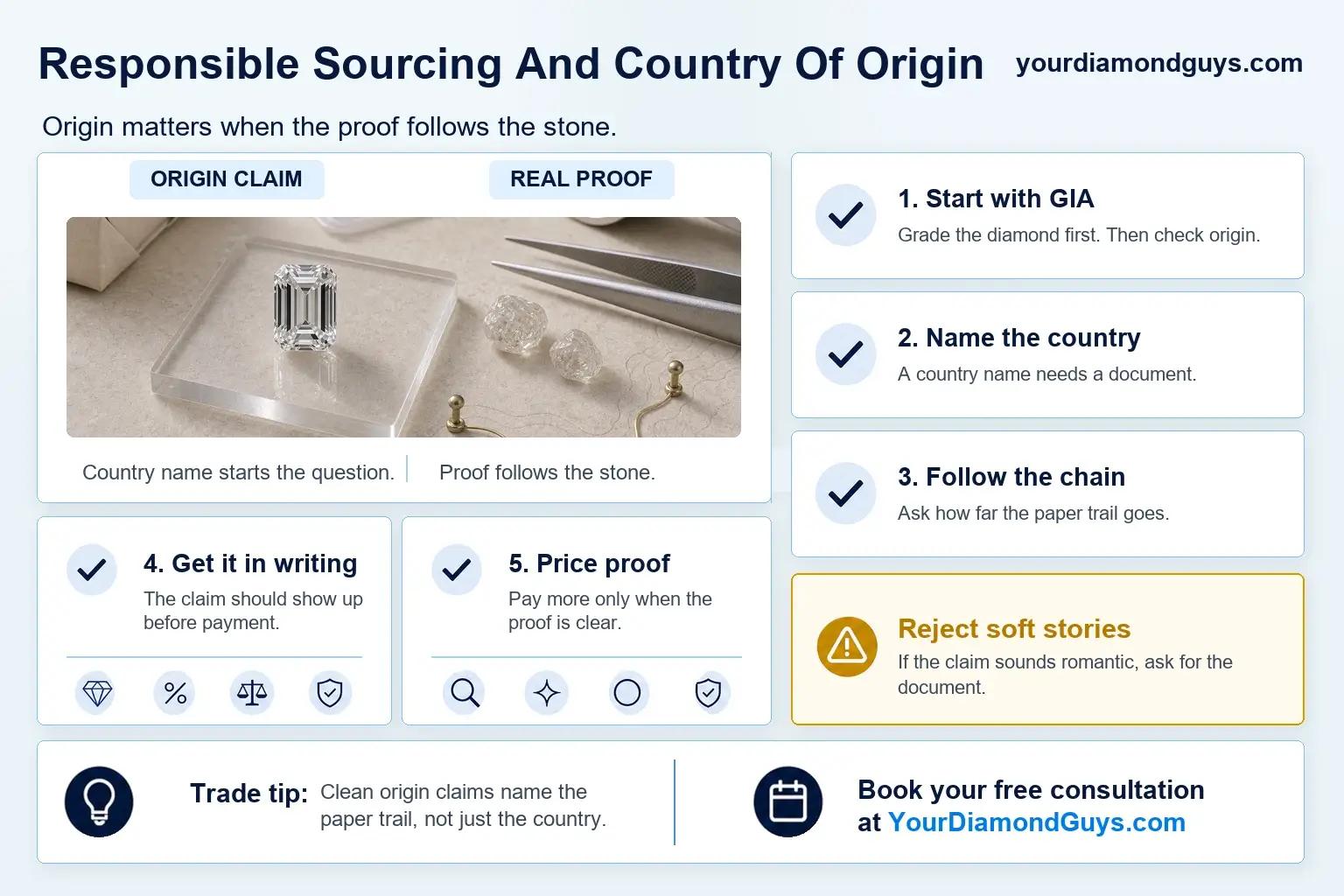
Step 1: Ask what kind of origin they mean
Use this exact line.
"When you say origin, do you mean mined, cut and polished, or ring-made?"
Do not let them blur those together.
That is where buyers get hurt.
Step 2: Ask if the claim is documented
You are not asking for trade secrets.
You are asking for a real explanation.
Good follow-ups:
- "Is that claim written in your policy or invoice paperwork?"
- "What do you keep on file from suppliers to support it?"
- "If I ask again after purchase, who can answer the same way?"
Step 3: Ask who verified it
"Verified" should mean more than confidence.
It should mean there is a method.
The RJC provenance guidance defines provenance claims as claims made through descriptions or symbols relating to origin, source, or supply-chain practices.
That is the standard in plain English.
Define the claim.
Support the claim.
Keep the claim consistent.
A simple word guide to common origin phrases

Use this to translate product-page language into your next question.
"Mined in (country)" Mine origin. Ask: "Is that verified by a third party or only by supplier records?"
"Crafted in (country)" Usually ring-making or manufacturing. Ask: "Does crafted refer to the setting, the diamond, or both?"
"Cut in (country)" Cutting and polishing origin. Ask: "Is that country tied to cut and polish or to mining?"
"Traceable" A tracking claim. Ask: "Traceable to which point?"
"Origin verified" A verification claim. Ask: "Who verified it, and what exactly did they verify?"
You do not need a louder opinion here.
You need a sharper question.
Sanctions and why origin conversations changed
If you have seen more talk about restricted origin, there is a reason.
The OFAC FAQ 1164 explains U.S. import prohibitions tied to Russian diamonds under Executive Order 14068 and later determinations, including phased restrictions that also reached certain diamonds processed in third countries.
That changed how serious retailers talk about screening.
And it should.
What to ask a retailer, without making it awkward
Keep it practical.
- "Do you screen for restricted origin, and what documents do you rely on?"
- "If a diamond moved through multiple countries, what do you treat as the origin for screening?"
- "If I choose this stone today, can you confirm in writing how you evaluate restricted sourcing risk?"
You are not asking for politics.
You are asking for process.
Free Diamond Consultation
If the origin language sounds polished but still feels soft, trust that feeling.
That usually means the details are not landing.
Rob and I can help you pressure-test the claim, cut through vague wording, and focus on the questions that actually change your confidence.
Book your Free Diamond Consultation
Key takeaways
- Origin can mean mined, cut and polished, or ring-made. Same word. Different claim.
- The best origin claims are specific, documented, and consistent when you ask twice.
- If restricted sourcing matters to you, ask how the retailer screens and what they keep on file.
Questions? Reach out directly for a free consultation, or drop them in the Diamond Buyers Academy community — Rob and I answer personally.
Frequently Asked Questions
Ask one question before you compare anything.
Do you mean mined, cut and polished, or ring-made?
That answer tells you whether the claim matches what you actually care about.
Yes.
A diamond can be mined in one country, cut in another, and set somewhere else.
Same diamond.
Different step.
Treat it like the start of the conversation.
Not the end.
Ask traceable to what point, and what documents support that path.
Slow down first.
Ask for the answer in writing.
If they still cannot define the claim, keep shopping.
Keep it process-based.
Ask what they screen for, what records they rely on, and whether they can confirm it in writing.
*Some links on our site may earn us a small commission at NO EXTRA cost to you, helping us keep our content free*