Live Chat
Search

We Don’t Sell Diamonds. We Help You Choose the Right One.

Free expert guidance by email or video chat.

No pressure, No sales pitch. Just honest help from diamond experts.

Natural Diamonds for Stud Earrings

natural diamonds for stud earrings

By Josh Allen, Co-Founder — YourDiamondGuys.com Josh has over 25 years of experience in the global diamond trade, sourcing from Mumbai, Tel Aviv, and Antwerp, and has supplied diamonds to Tiffany, Cartier, Harry Winston, and more.

Natural diamonds make stud earrings look simple. Buying them well is not simple.

Most people think matched means same carat. It doesn't.

Same carat does not mean the same look. Same grade does not mean the same twin effect. And when the pair is on your ears, your eye catches the mismatch fast.

That is why you do not buy studs by certificate alone. You buy them by how close the two stones look in real life.

Below is the checklist I would use if you were buying your first pair online in the US.


What a matched pair actually means

A real matched pair should read like one set.

Not close enough. Not almost. One set.

Your eye notices three things first:

  1. Face-up size
  2. Tone
  3. Light pattern

According to the GIA 4Cs guide for diamond studs, color, clarity, cut, and carat weight are the standard way to judge diamond quality, and stud earrings make that comparison even more important because you are buying two stones, not one.


Confirm it is sold as a pair

confirm it is sold as a pair visual selection

Start here.

If the listing feels vague, slow down.

You want both stones shown. Both stones described. Both stones easy to compare.

That usually means:

  1. The same shape
  2. The same overall style
  3. Clear visuals of both diamonds together
  4. Lab details for each stone when available

If half the story is missing, move on.


Match measurements before you look at anything else

This is where buyers get hurt.

Two diamonds can weigh the same and still face up differently.

For rounds, compare diameter. For princess cuts, compare length and width. For ovals, compare the outline, not just the weight.

If one oval reads longer and slimmer while the other reads shorter and wider, you will see it. Even if the paperwork looks tidy.


Keep finish and symmetry in the same range

This part gets skipped all the time. Big mistake.

Polish and symmetry are part of finish. They help explain how cleanly the stone was made and how even the pattern looks face-up. The American Gem Society's finish guide notes that symmetry affects the evenness of brilliance and contrast patterns, while polish and symmetry faults can impact appearance.

What does that mean for you?

If one stone has softer finish grades, the pair can feel uneven side by side. Not always on paper. Usually in real light.

This matters even more in princess and oval studs, where your eye leans hard on outline and pattern.


Keep table and depth in the same neighborhood

You are not hunting one magic number. You are hunting harmony.

When one diamond is built very differently from the other, the pair can stop reading like twins. One may look brighter. One may look darker. One may just feel heavier in personality.

On its 4Cs overview, HRD Antwerp explains that cut is driven by proportions, symmetry, and polish, and that diamond color runs from D to Z, which is why you want the pair to stay close in both build and tone.

That is the point. Close enough to look like family. Not random cousins.


Keep color consistent so the pair reads as one tone

For studs, color mismatch is easier to spot than most people think.

You do not need the highest color. You need the same color story on both ears.

The safest move is simple. Keep both stones in the same color grade. Then check the photos and video to make sure they still read the same.


Keep clarity consistent so one stone does not steal attention

Studs should look balanced. Not left stone, right stone, problem stone.

The IGI clarity guide explains that clarity grading is based on the visibility of inclusions and blemishes at 10x magnification, and that lower included grades can affect transparency and brilliance.

That matters because one inclusion in the wrong place can pull your eye. Especially if one diamond looks cleaner than the other.

Same clarity does not always mean same clean. But it is still the right place to start.


Use photos and 360° video to confirm the twin look

Reports narrow the field. Visuals make the decision.

You want to see both stones together. Not one hero shot. Not one flattering angle. Both.

Look for:

  1. A straight-on view of the pair
  2. A moving video of the pair together
  3. Lighting that does not blow one stone out in glare

You are not trying to grade them from your phone. You are checking one thing. Do they belong together?


Read the return policy before checkout

Even a strong pair on paper can disappoint in person. That is why the return policy matters.

The BBB return guide recommends checking store policies before you buy and reading the fine print because some sellers charge restocking fees or make you pay return shipping.

Your checklist is simple:

  1. Return window
  2. Restocking fee
  3. Return shipping
  4. Condition rules

No safety net? No sale.


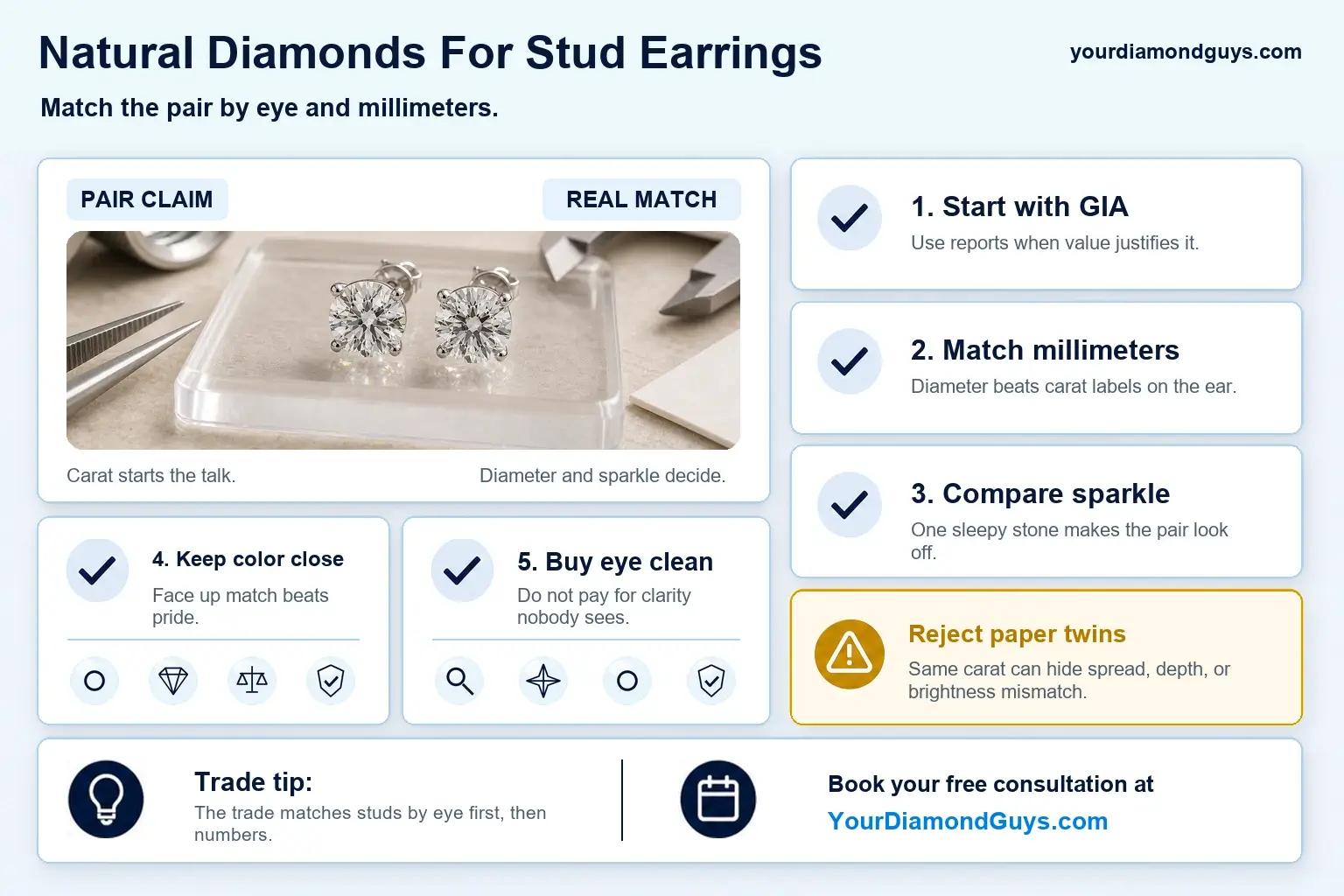
Quick matched-pair checklist

quick matched pair checklist visual selection
  1. Confirm the pair is sold clearly as a pair
  2. Match measurements and face-up outline
  3. Keep finish and symmetry aligned
  4. Keep table and depth close enough to support a similar look
  5. Keep color grades consistent
  6. Keep clarity grades consistent
  7. Review photos and 360° video of both stones together
  8. Read the return policy before you check out

Free Diamond Consultation

If the numbers still do not add up, trust that feeling.

That is usually where a pair starts to drift. One stone is softer. One stone is darker. One stone just does not belong.

If you already have a listing in mind, send it over for a Free Diamond Consultation.


Questions? Reach out directly for a free consultation, or drop them in the Diamond Buyers Academy community — Rob and I answer personally.

Frequently Asked Questions

Start with face-up size and overall look. If the pair does not look even from the front, nothing else saves it.

That is the safest path. Matching color grades gives you the best shot at a pair that reads as one tone.

Because big differences in build can create a different look in brightness, spread, and personality.

Yes. Studs sit side by side. If one pattern looks tighter and the other looks softer, your eye can catch it.

Clear visuals of both stones, enough lab detail to compare them, and a return policy that protects you if the pair does not look right in person.

*Some links on our site may earn us a small commission at NO EXTRA cost to you, helping us keep our content free*