Natural Diamond Types: Type IIa And What Buyers Should Know
By Rob Cornfield, Co-Founder of YourDiamondGuys.com. 30+ years in the global diamond trade. Specialist in diamond cut and light performance.
Natural diamond type sounds more important than it is for most buyers.
Type IIa, Type Ia, and similar labels describe trace elements and rarity categories. They do not replace cut, color, clarity, or GIA documentation.
For natural diamonds, start with GIA. If a seller uses type language as a premium claim, ask what it changes in the actual buying decision.
In the trade, a special type label gets attention only after the stone already looks worthy.
What Diamond Type Means
Diamond type groups diamonds by trace elements, especially nitrogen and boron. Type Ia is common in natural diamonds. Type IIa is rarer and often associated with very chemically pure diamonds.
That sounds impressive. It still does not tell you whether the diamond has strong cut quality, a clean video, or a fair price.
When Type Matters To A Buyer
Type matters when the buyer is considering a high value colorless natural diamond, a rare claim, or a collector style purchase. It matters less for a normal engagement ring where cut, shape, and visible quality decide the result.
Use the D to F colorless guide when type gets tied to colorless marketing.
The Buyer Filter
Keep the type label in its proper lane.
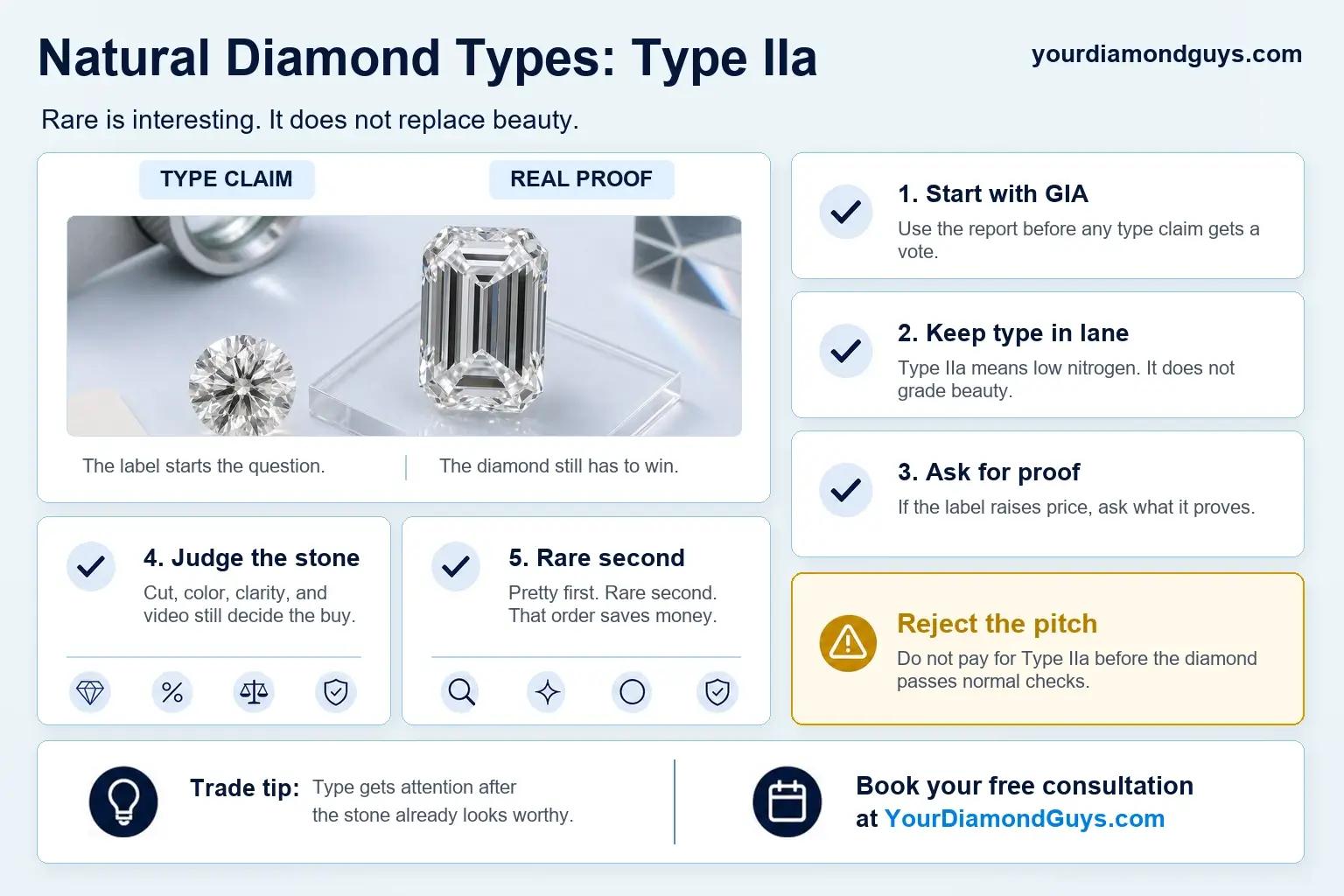
| Term | Plain Meaning | Buyer Warning |
|---|---|---|
| Type Ia | Common natural diamond category | Still needs normal quality checks |
| Type IIa | Rarer low nitrogen category | Rarity does not prove beauty |
| Marketing claim | Seller value story | Ask for proof and price logic |
| GIA report | Trusted natural grading baseline | Still review the actual stone |
My Buyer Recommendation
Do not pay for a type label until the diamond already passes the normal buying checks. Pretty first. Rare second.
Reach out to Rob or me at YourDiamondGuys.com, or book your free consultation. We will look at the actual stone with you.
How This Fits Into A Real Buying Decision
A buyer sees Type IIa in a listing and gets excited. I would still ask the same questions: Is it GIA, is the cut strong, does the color look right, and does the price make sense?
Mistakes I Would Avoid
- Do not treat Type IIa as a beauty guarantee.
- Do not let rare language distract from cut quality.
- Do not buy type claims without documentation.
- Do not compare natural type categories to lab growth methods as if they are the same thing.
A Practical Example
A Type IIa diamond with weak cut is still weak. A normal Type Ia diamond with beautiful cut can look better on the hand. The eye gets a vote before the label.
What To Ask Before You Buy
- Is the type claim documented?
- Does the diamond already pass cut and visual checks?
- Does the claim change the price?
- Would I buy this stone without the type label?
Related Guides
Where I Would Compare Type IIa Claims
Use these sites as comparison tools, not automatic recommendations. I would compare rarity claims on Brilliant Earth and Blue Nile, then make the actual diamond prove beauty, report strength, and price before paying extra for type language.
Why GIA Is the Only Lab That Matters for Natural Diamonds
Questions? Reach out directly for a free consultation, or drop them in the Diamond Buyers Academy community — Rob and Josh answer personally.
Questions Buyers Ask Us
*Some links on our site may earn us a small commission at NO EXTRA cost to you, helping us keep our content free*