Fluorescence in Natural Diamonds

By Josh Allen, Co-Founder — YourDiamondGuys.com Josh has over 25 years of experience in the global diamond trade, sourcing from Mumbai, Tel Aviv, and Antwerp, and has supplied diamonds to Tiffany, Cartier, Harry Winston, and more.
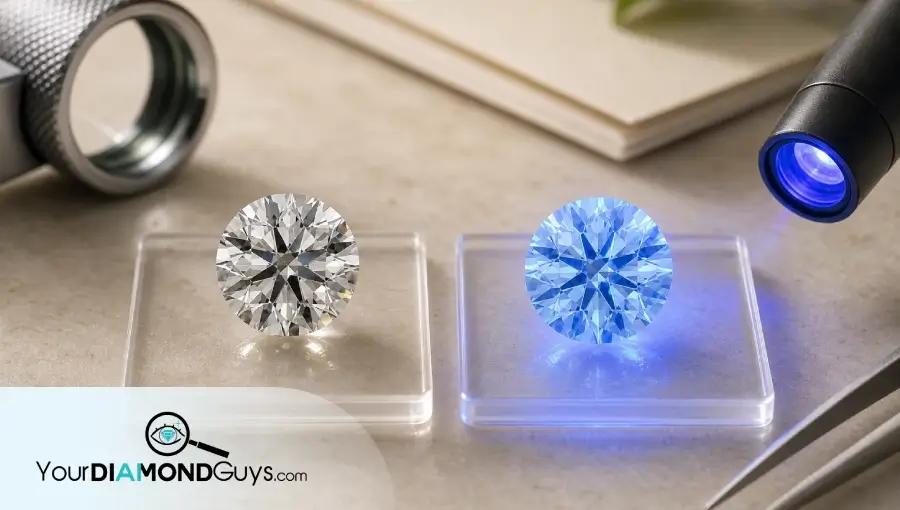
Natural diamonds with fluorescence are not automatically a problem, but GIA explains that fluorescence is a reaction to long-wave UV light, is graded from None to Very Strong on reports, appears in about 25% to 35% of diamonds, and is blue in more than 95% of those cases.
That matters.
Because one line on a report can scare people off.
Or save you money.
Same fluorescence grade does not mean the same look.
That is the part most people miss.
One fluorescent diamond can look bright and crisp.
Another can look soft.
Foggy.
A little dead.
So the right question is not, "Is fluorescence bad?"
It is, "What does this diamond look like in real light?"
Quick answer: when fluorescence is a bargain, and when to walk
Fluorescence can be a smart value.
It can also be a headache.
Both are true.
A bargain when:
- The diamond still looks crisp in daylight and indoor video.
- You are shopping near-colorless or slightly warmer colors.
- The stone gives you a discount without giving you haze.
A risk when:
- The fluorescence is strong or very strong.
- The stone looks soft in more than one lighting setup.
- The transparency already feels a little off.
At a glance:
Faint to Medium, looks crisp
Usually worth considering.
Strong, still looks crisp
Could be a real value.
Strong or Very Strong, looks hazy
Keep moving.
What fluorescence actually means
This part is simpler than people make it.
Not always visible.
Not always a negative.
Just a reaction under UV.
And yes, that can show up in normal life.
According to SSEF's daylight note, natural daylight includes small amounts of UV, and some diamonds can show a bluish or even milky appearance because of that visible fluorescence.
That is why store lighting is not enough.
You want to see the diamond in lighting that tells the truth.
Daylight.
Indoor room light.
A normal video.
Not just a hyper-lit showroom spin.
When fluorescence can be a deal
This is where people overcorrect.
They hear "fluorescence" and assume it kills the stone.
Not always.
Sometimes it helps you.
IGI notes that blue fluorescence can improve the look of natural diamonds in the H to K color range by softening yellow tint, while strong fluorescence in higher colors can sometimes create a hazy or milky look.
That is the window.
If you are buying a slightly warmer natural diamond and it stays sharp on video, fluorescence can be the reason you get better value.
Better cut.
More size.
Less money.
Same budget.
Very different result.
When fluorescence becomes a risk
The risk is not the word itself.
It is the look.
You are screening for one thing.
Lost transparency.
That can show up as milkiness.
Haze.
A soft film over the diamond.
Facet edges that do not look clean.
A center that feels sleepy instead of alive.
If you see that in one bad video, maybe the media is weak.
If you see it in two lighting setups, believe your eyes.
How to check a fluorescent diamond for haze or milkiness

This is the part that saves you.
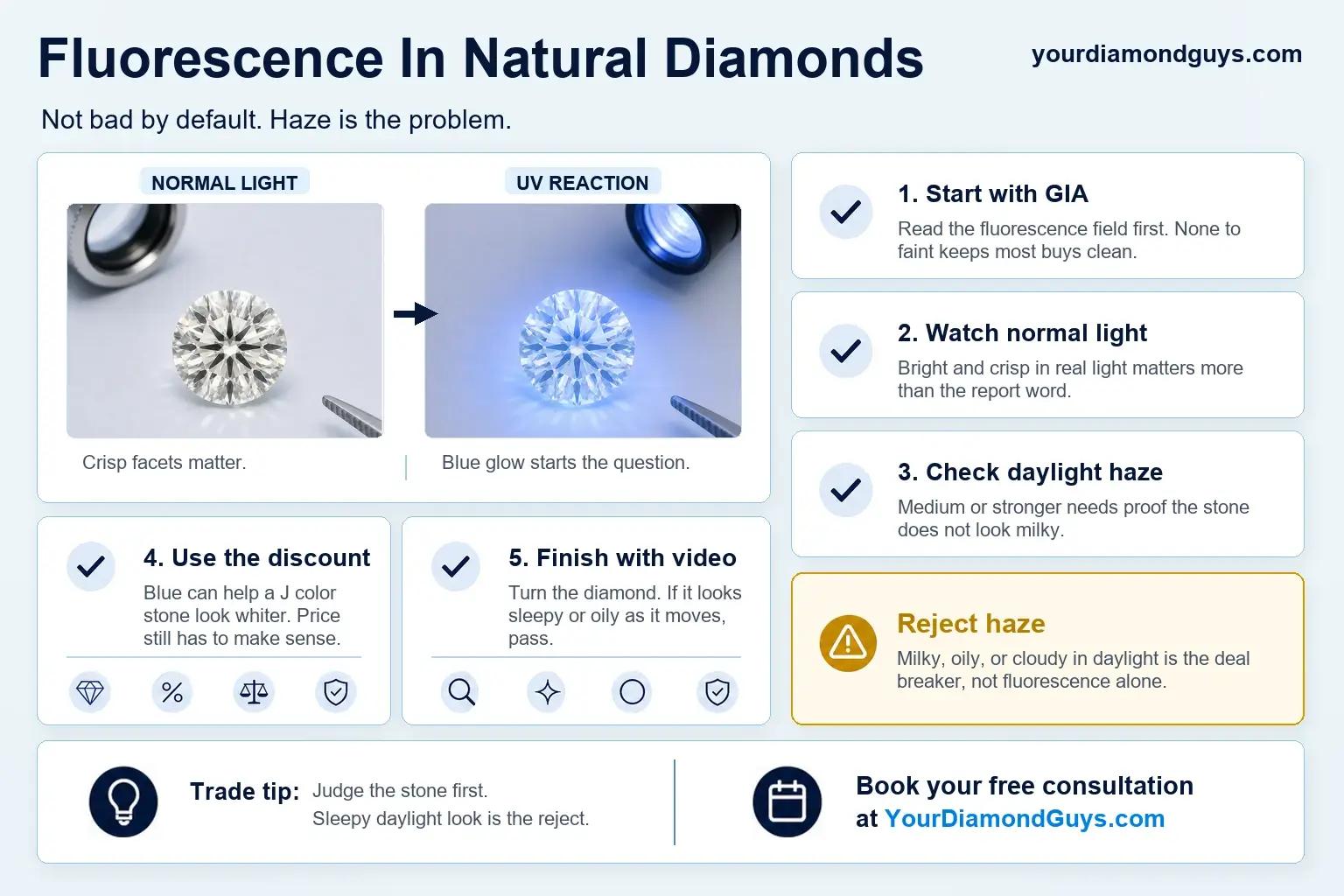
Use the report first.
Then the video.
Then the comparison.
1) Confirm the fluorescence level on the report
Do not guess.
Read the line.
None. Faint. Medium. Strong. Very Strong.
If the stone is Strong or Very Strong, slow down.
Not because it is automatically bad.
Because it now needs better proof.
2) Ask for two videos
You want:
- A daylight or daylight-equivalent video
- An indoor video under softer light
One video is not enough.
A diamond can look great in one setup and flat in another.
3) Watch for a fog that stays put
This is the fastest test.
As the stone moves, ask yourself:
- Do the facet edges stay sharp?
- Does the center stay crisp?
- Is there a soft film that does not go away?
Sparkle moves.
Haze sits there.
That is the difference.
4) Compare it to a similar diamond with no fluorescence
Same shape.
Close color.
Close clarity.
Same kind of video.
You are not trying to win a lab debate.
You are trying to spot whether one stone looks less transparent than it should.
5) If it looks filmy twice, move on
That is the rule.
Not maybe.
Not probably.
Move on.
There are too many clean diamonds out there to force a questionable one.
Why the report still matters
People love to say, "Just trust your eyes."
That is half right.
You trust your eyes after you trust the paperwork.
IGI's report overview says a diamond report includes fluorescence along with core grading details and identifying features, which is exactly why the report should be your first filter before you judge the stone on video.
Paper does not tell the full story.
But no paper is worse.
And vague paper is worse than that.
What to ask before you buy
Keep it blunt.
Ask these.
- Can I see this diamond in daylight?
- Can I see it indoors too?
- Do you have a comparable stone with no fluorescence?
- Does anything in the stone reduce transparency?
- Will everything you told me be written on the invoice?
That last one matters.
The FTC's jewelry buying guidance says sales paperwork should include details the seller told you, and if those details are not put in writing, you should consider working with someone else.
That is not being difficult.
That is being smart.
A fast buyer filter

Use this and you will avoid most mistakes.
Green light
The fluorescence level makes sense for the color.
The daylight video looks crisp.
The indoor video looks crisp too.
Yellow light
The fluorescence is strong.
The stone still looks good.
You want one more comparison before you decide.
Red light
The diamond looks cloudy.
Facet edges feel soft.
The haze repeats in more than one setup.
Why wording matters
Different sellers describe fluorescence differently.
Some sound careful.
Some sound slippery.
That is why consistent trade language matters.
CIBJO's terminology guidance exists as a reference for the diamond trade and is built on internationally accepted standards, which is exactly why clean wording on reports and listings matters when you are comparing stones.
If the language gets fuzzy, the stone usually does too.
Free Diamond Consultation
Still stuck between a fluorescent diamond that looks promising and one that feels risky?
That is where we help.
We will tell you whether the discount is real.
Or whether the diamond is just soft.
Book your Free Diamond Consultation
Questions? Reach out directly for a free consultation, or drop them in the Diamond Buyers Academy community — Rob and I answer personally.
Frequently Asked Questions
Sometimes.
Not always.
The report line alone does not decide that.
The actual appearance does. A small percentage of strongly fluorescent diamonds can appear hazy or milky, but many are perfectly crisp and offer excellent value.
No.
A crisp fluorescent diamond can be a very smart buy.
A hazy one is not. Blue fluorescence in near-colorless and slightly warmer diamonds can actually make them appear whiter in daylight while the market discounts them.
Strong and Very Strong.
Not because they always fail.
Because they deserve better screening.
If a strong fluorescent diamond stays crisp in both daylight and indoor video, it can still be a great buy.
Yes, it can.
But only if the stone stays transparent.
And when you are talking about strong blue, the value case is more relevant in lower colors starting around J and down.
Blue fluorescence can offset yellow tint in warmer diamonds, but the diamond must remain crisp and clear in all lighting conditions.
Check the report.
Ask for daylight and indoor video.
Compare it side by side.
If the softness shows up twice, pass.
The comparison test is especially valuable — putting a fluorescent diamond next to a non-fluorescent one of similar specs reveals any transparency issues fast.
*Some links on our site may earn us a small commission at NO EXTRA cost to you, helping us keep our content free*