Live Chat
Search

We Don’t Sell Diamonds. We Help You Choose the Right One.

Free expert guidance by email or video chat.

No pressure, No sales pitch. Just honest help from diamond experts.

How to Read a GIA Report for Natural Diamonds (Fast)

how to read a gia report for natural diamonds

By Josh Allen, Co-Founder — YourDiamondGuys.com Josh has over 25 years of experience in the global diamond trade, sourcing from Mumbai, Tel Aviv, and Antwerp, and has supplied diamonds to Tiffany, Cartier, Harry Winston, and more.

Natural diamonds can look simple on paper and still go wrong fast when you miss the lines that actually matter.

That is the problem.

Most people stare at color and clarity.

Then skip the parts that change the buying decision.

Comments.

Plot.

Proportions.

That is where buyers get hurt.

This guide gives you a fast scan.

Not a gemology lecture.

Just the parts worth your attention before you send real money.


What this report is good for

Use the report to confirm you are looking at the right stone.

Use it to screen for issues.

Use it to decide what deserves better video.

That is it.

As GIA explains, a Diamond Grading Report includes the 4Cs, a plotted clarity diagram, a proportions graphic, a Comments section, and, for standard round brilliant diamonds in the D-to-Z range, a cut grade.

Useful.

But not complete.

Paper does not tell you how the diamond performs in your lighting.

It does not tell you whether an inclusion placement will bother your eye.

It does not tell you whether the stone feels alive.


The fast scan: read it in this order

the fast scan read it in this order visual selection

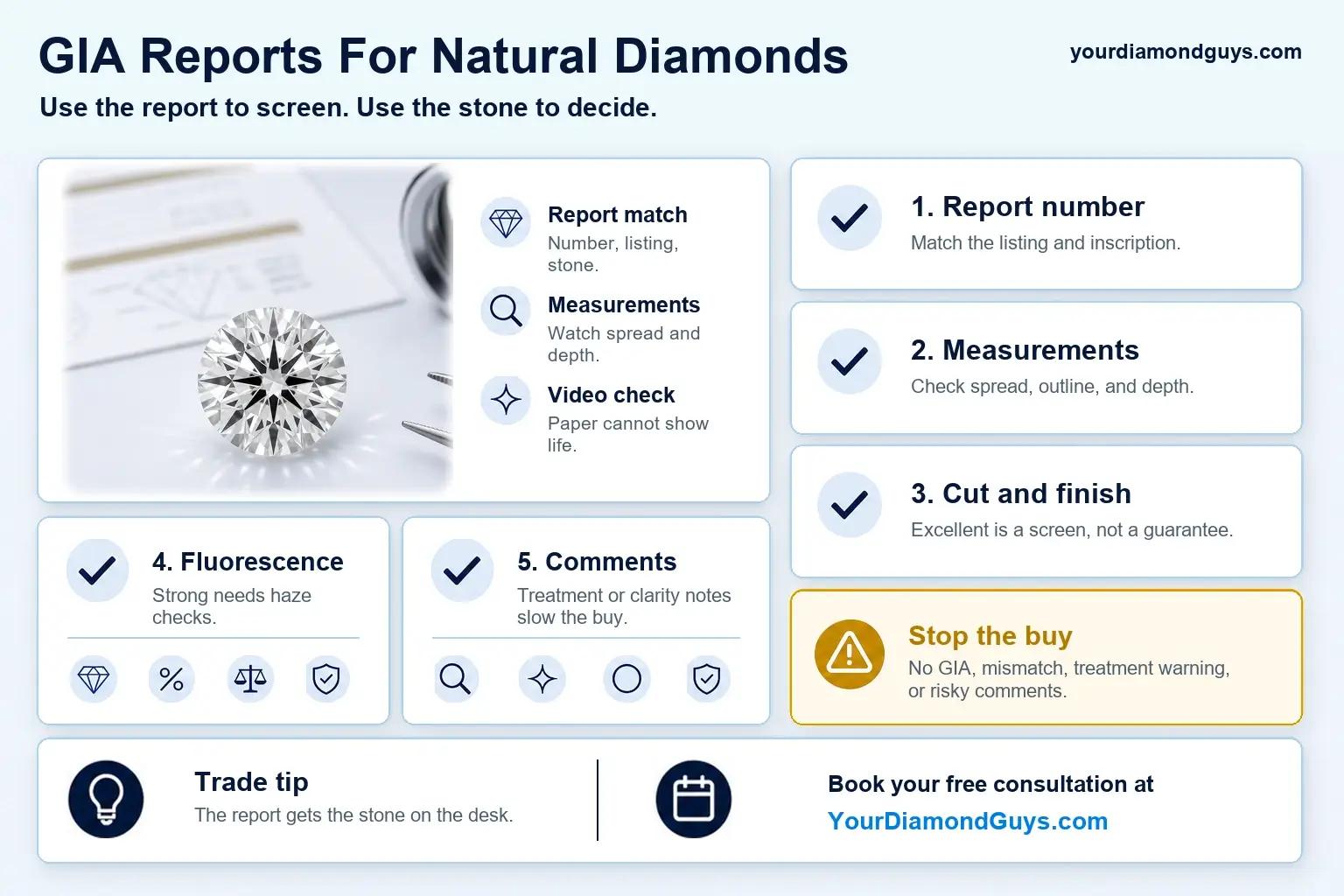
1) Match the diamond to the paper

Start here.

Not with color.

Not with clarity.

Just make sure the report and the diamond are the same stone.

Check the report number.

Check the shape.

Check the measurements.

Check the inscription line if one is shown.

If any of that is fuzzy, stop.


2) Go straight to the risk zones

This is the real scan.

Comments.

Plot.

Proportions.

Those three areas change the story fastest.

If Comments says something you do not understand, slow down.

If the plot puts a feature where your eye will live, slow down.

If the proportions look extreme, slow down.

That is the whole point of reading fast.

You are not trying to admire the report.

You are trying to catch the reason not to buy.


3) Confirm the core grades

Now scan the basics.

Carat.

Color.

Clarity.

Cut grade if your shape gets one.

That gives you the summary.

Not the answer.


4) Finish line checks

End with polish.

Symmetry.

Fluorescence.

Quick lines.

Still worth reading.


What to check first if you care about how it will look


Measurements: how big will it look?

Carat tells you weight.

Measurements tell you spread.

That is a big difference.

If two diamonds weigh the same but one faces up smaller, the measurements usually explain why.


Clarity: where is it, not just what is it?

A clarity grade is a summary.

Location still matters.

According to CIBJO's diamond guide, clarity grading weighs size, visibility, nature, location, and number, and report plots mark external features in green and internal features in red.

That is why a plot is not decoration.

It is a map.

If the issue sits where your eye lands first, ask for better visuals.


Proportions: is anything extreme?

You do not need to memorize every number.

You are looking for imbalance.

Too deep.

Too shallow.

Something that looks off for the shape.

That is enough to trigger a second look.


What you can skim on the first pass

The grading scales.

The symbol key.

The security elements.

Useful.

Not where I would spend my first minute.

Your first minute goes to matching the stone, reading the risk zones, and checking the core grades.


Don't-buy-this cues

dont buy this cues visual selection

This section is strict on purpose.

It should be.

You are not buying a toaster.


1) Treatment language in Comments

This is a hard stop.

Not because every treated stone is worthless.

Because hidden treatment language is where trust breaks.

The FTC's Jewelry Guides require marketers to describe jewelry products truthfully and disclose material information, including treatments when disclosure is required.

If you see treatment language, get it explained in writing.

What it is.

When it was done.

How it affects care.

How it affects value.


2) A plot that suggests face-up risk

You are not counting marks.

You are judging whether the marks land somewhere your eye will notice.

Center matters more.

That is not complicated.

If the plot makes you nervous, ask for a crisp top-down video.


3) Proportion cues that look extreme

Bad proportions can kill the look.

Quietly.

No drama on the report.

Then the stone shows up flat.

If the geometry feels aggressive, do not guess.

Get better video.

Get another opinion.


4) Fluorescence that needs a closer look

This line gets ignored too often.

According to the American Gem Society, fluorescence is visible light emitted when a diamond is exposed to ultraviolet light, and GIA reports classify it as None, Faint, Medium, Strong, or Very Strong.

That does not make Medium or Strong bad.

It means you verify it.

Daylight.

Indoor light.

Same stone.

Same camera.


A fast compare method for two GIA reports

Keep it simple.

Build one line for each stone.

Shape plus measurements.

Carat plus color plus clarity.

Cut grade if listed.

Polish plus symmetry.

Fluorescence.

Comments.

Then ask for the same style of video for both.

Same zoom.

Same angles.

Same lighting.

Same report does not mean same look.

That is the trap.


A simple script before you pay

Copy this. Send it to the seller.

  1. "Can you confirm the report number matches the diamond being shown?"
  2. "Can you share a top-down video and a side video in indoor and daylight lighting?"
  3. "Is there anything in Comments I should know about?"
  4. "Are there any treatments, extra notes, or identifiers I should understand before I buy?"
  5. "What is the return window and are there any restocking fees?"

One extra filter most people forget

Use magnified images correctly.

Not emotionally.

The GIA clarity standard explains that clarity grades are based on the number, size, relief, nature, and location of characteristics evaluated under 10x magnification.

That matters.

Because sellers love giant blown-up images.

A feature that looks huge on a screen may be far less meaningful in real viewing.

So use magnification to locate issues.

Not to panic.


How we help

Most people do not need more data.

They need a sharper filter.

That is what we do.

We look at the report.

Then the video.

Then the small details that make the stone worth buying.

Or not.

We do not sell diamonds.

We guide you.


Get a Free Diamond Consultation

If the report looks fine but something still feels off, trust that feeling.

It usually means the paper is not matching the performance.

Book your Free Diamond Consultation and we will tell you what matters, what does not, and where the red flags actually are.


Questions? Reach out directly for a free consultation, or drop them in the Diamond Buyers Academy community — Rob and I answer personally.

Frequently Asked Questions

Most people use those words the same way.

For you, the important part is simpler.

Match the report to the stone.

Then read the lines that can change the buying decision — Comments, plot, and proportions are where the real story lives.

Match the stone to the report.

Read Comments.

Read the plot.

Read the proportions.

Then scan the grades and finish lines.

That order catches the biggest risks fastest.

Stop.

Get it explained in writing.

Then decide whether you still want the stone after you understand the trade-off.

Treatments can affect care, durability, and value — know exactly what you're getting before you buy.

Treat it like a map. Not a verdict.

Your job is to flag what might show.

Then confirm it in video.

A mark that looks dramatic on the plot may be completely invisible in real viewing if it's off-center or low-contrast.

Make a one-line strip for each report.

Then compare the stones in the same video conditions.

That is how you stop paper from fooling you.

Same report number format, same lighting, same zoom level — that's the cleanest apples-to-apples comparison.

*Some links on our site may earn us a small commission at NO EXTRA cost to you, helping us keep our content free*