Pre-Owned & Recycled Natural Diamonds

By Josh Allen, Co-Founder — YourDiamondGuys.com Josh has over 25 years of experience in the global diamond trade, sourcing from Mumbai, Tel Aviv, and Antwerp, and has supplied diamonds to Tiffany, Cartier, Harry Winston, and more.
Pre-owned natural diamonds can be a smart buy.
They can also be where people get hurt.
Because now you are not just judging sparkle.
You are judging history.
Condition.
Paperwork.
And whether the seller is telling you the full story.
That is the part most people miss.
They think secondhand means simple.
It does not.
It means you need a process.
A real one.
This guide gives you that process.
So you can buy with your eyes open.
What "pre-owned" and "recycled" actually mean
Pre-owned means the diamond or ring has had a previous life.
Maybe it came from an estate jeweler.
Maybe a trade-in.
Maybe an auction.
Maybe a private seller.
Recycled usually means the stone came back into the market and may have been reset, polished, or repaired before resale.
That label is not a quality grade.
It is a supply story.
Big difference.
And if you are buying for an engagement ring, here is the frame that matters:
You are not buying sparkle alone.
You are buying verified identity.
Verified condition.
Verified value.
Why people look at pre-owned rings in the first place
Because sometimes the value is better.
Sometimes the style is better.
Sometimes the ring has character modern retail just does not have.
And sometimes you find a piece faster than building one from scratch.
All fair reasons.
But none of them matter if the diamond is soft, the setting is tired, or the paperwork falls apart under scrutiny.
Same price does not mean same buy.
How to buy safely in 7 steps

Step 1 — Vet the seller before you fall in love
Do not start with the ring.
Start with the seller.
Because a beautiful listing proves nothing.
A clean seller process proves a lot more.
Look for a real return window.
Clear refund terms.
A business address.
Responsive support.
And payment methods that do not trap you.
BBB's business search tools let you check a company's profile, rating, reviews, and complaint history before you send money.
That does not make a seller perfect.
But it gives you a real starting point.
Step 2 — Ask for the right paperwork
If the seller gets weird about documentation, stop.
That is not a small issue.
That is the issue.
Ask for the sales receipt.
Ask for clear photos.
Ask for video in normal light.
Ask what work has already been done.
Reset.
Repair.
Polish.
Resizing.
You want the full history they are willing to stand behind.
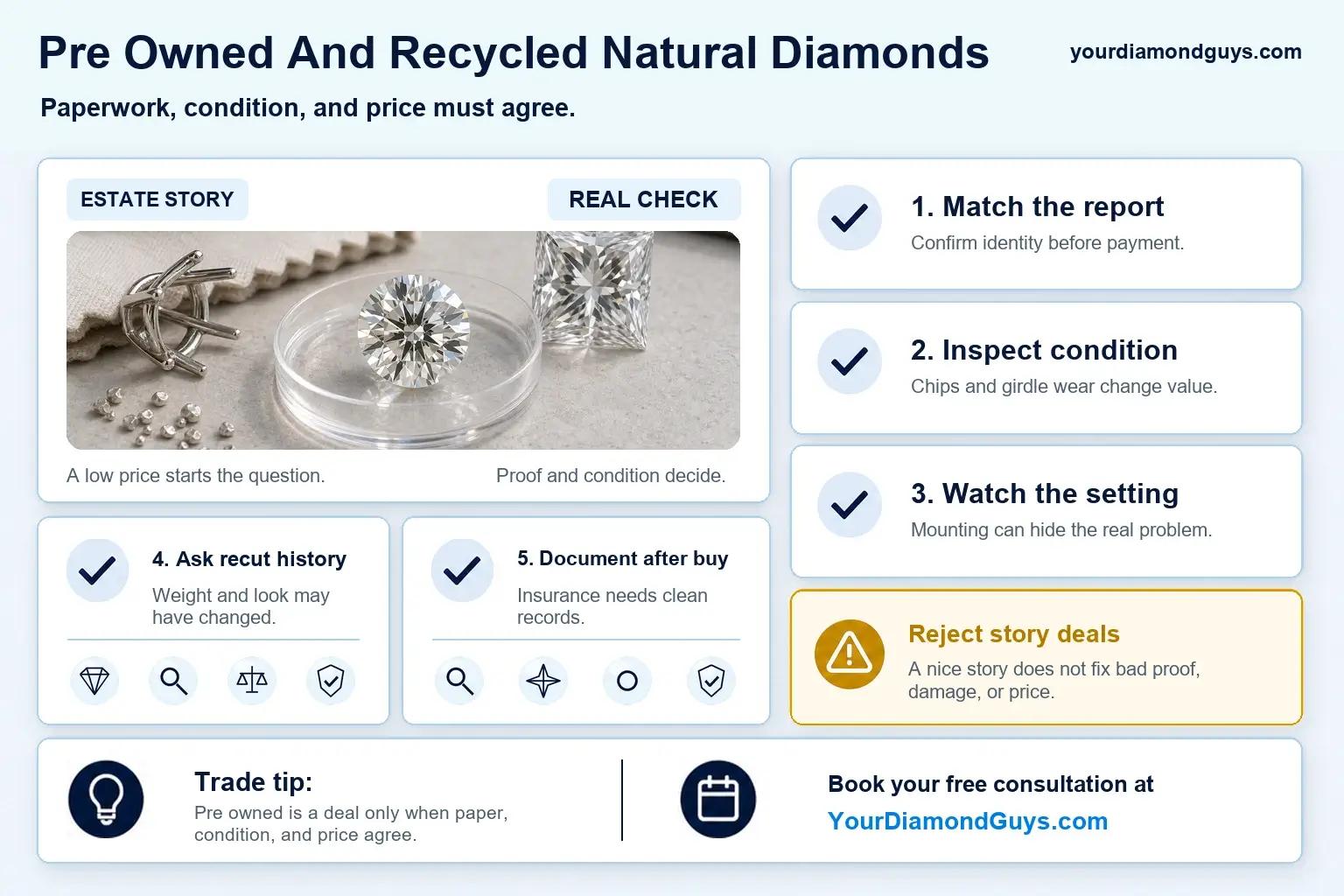
Step 3 — Match the diamond to the report
This is where buyers either protect themselves.
Or wing it.
Never wing it.
GIA explains that a natural diamond grading report can include the stone's shape, color, clarity, cut, carat weight, proportions, finish, treatments, and a plotted clarity diagram.
That means you have something real to match against the stone in front of you.
Measurements should line up.
The report details should line up.
And if they do not, that is not a maybe.
That is a stop sign.
Step 4 — Inspect the setting like it owes you money
A diamond can be fine.
The ring can still be a problem.
Look hard at the prongs.
The head.
The basket.
The shank.
Any side stones.
You are looking for wear.
Past repairs.
Thin metal.
Loose stones.
Uneven work.
Because a "great deal" disappears fast when the ring needs real repair work the second it arrives.
Step 5 — Do not romanticize recutting
Some sellers throw around the idea of recutting like it is a free upgrade.
It is not.
It is surgery.
Sometimes it helps.
Sometimes it strips out the personality that made the stone worth buying.
If recutting even comes up, make the seller or jeweler explain exactly why.
Not vaguely.
Exactly why.
Then decide if the problem is real.
Or if someone is just trying to turn an antique stone into something it was never meant to be.
Step 6 — Sanity-check the listing language
Words matter here.
A lot.
Especially in the U.S.
The FTC's Jewelry Guides say marketers must truthfully represent things like type, kind, grade, quality, size, weight, cut, color, treatment, origin, price, and value.
So if a listing feels slippery, trust that feeling.
"Estimated."
"Looks like."
"Should be."
"Newly appraised" with no document.
That is how people talk when the details are soft.
Step 7 — Handle appraisal and insurance in the right order
Buy within a return window first.
Then get the piece checked.
Then insure it.
Not the other way around.
Jewelers Mutual explains that a written jewelry appraisal typically includes a detailed description, photographs, and an estimate of current retail replacement value.
That is the document insurers want.
And it is also the document that tells you whether the ring needs work right now.
Not six months from now.
Keep, restore, reset, or walk away?
Use a simple filter.
- Keep it if the ring is structurally sound and you love it as is.
- Restore it if the style is right but the metal needs help.
- Reset it if the diamond is the win and the mounting is not.
- Walk away if the seller cannot verify what matters. Identity. Condition. Return terms.
That is not being picky.
That is being smart.
What an appraisal actually does
A grading report is not an appraisal.
Big difference.
One describes the diamond.
The other describes the item and assigns value for a purpose.
Usually insurance.
Jewelers of America explains that an appraisal report describes the item, assesses its relative quality, and gives an opinion of value.
That is why a current appraisal matters on pre-owned jewelry.
It reflects what the ring is now.
Not what it was years ago.
Red flags that should slow you down fast
- No return policy. Or a vague one.
- Only stock photos. No exact measurements. No close-ups.
- Pressure to pay with irreversible methods.
- Paperwork they will not share.
- A seller who gets defensive when you ask normal questions.
That last one matters.
A safe seller welcomes verification.
An unsafe seller wants speed.
Where you buy changes the risk

Estate jeweler.
Online resale platform.
Auction.
Private seller.
Different channel.
Same rule.
Verify everything.
The safer the process, the safer the buy.
That does not mean you need perfection.
It means you need proof.
Free Diamond Consultation
If you are looking at a pre-owned ring and something feels off, do not force the deal.
That instinct is usually picking up on something real.
We do not sell diamonds.
We guide you.
That means we can help you review the listing, the paperwork, the condition, and whether the price actually makes sense before you commit.
Book your Free Diamond Consultation
Questions? Reach out directly for a free consultation, or drop them in the Diamond Buyers Academy community — Rob and I answer personally.
Frequently Asked Questions
They can be.
But "pre-owned" does not verify anything by itself.
You still need paperwork that matches the stone and a seller willing to stand behind it.
Not automatically.
Sometimes that move helps.
Sometimes it kills the charm.
Treat recutting like surgery. Not routine cleanup.
Look for missing return terms, vague wording, weak photos, and pressure around payment.
If the seller resists verification, that is your answer.
Usually yes.
Because you need current condition. Current photos. Current value.
Old paperwork can still miss what matters now.
After purchase. Inside the return window. And after you have the documentation you actually trust.
That order keeps you protected.
*Some links on our site may earn us a small commission at NO EXTRA cost to you, helping us keep our content free*