Natural Diamond Treatments to Avoid

By Josh Allen, Co-Founder — YourDiamondGuys.com Josh has over 25 years of experience in the global diamond trade, sourcing from Mumbai, Tel Aviv, and Antwerp, and has supplied diamonds to Tiffany, Cartier, Harry Winston, and more.
Natural diamonds can still come with treatments that create care headaches, paperwork issues, and resale questions later.
That catches people off guard.
Because the stone can look fine in the moment.
Then the report tells a different story.
If you want the cleanest path, there are three treatments most shoppers pause on:
- Laser drilling
- Fracture filling
- Coatings
The reason is simple.
Paper matters here.
According to GIA's treatment guide, laser drill holes are treated as a clarity characteristic on grading reports, while fracture filling and coatings are considered non-permanent or unstable enough that GIA does not issue grading reports for those treated diamonds.
Quick answer: the 3 treatments most buyers skip

Here's the fast version.
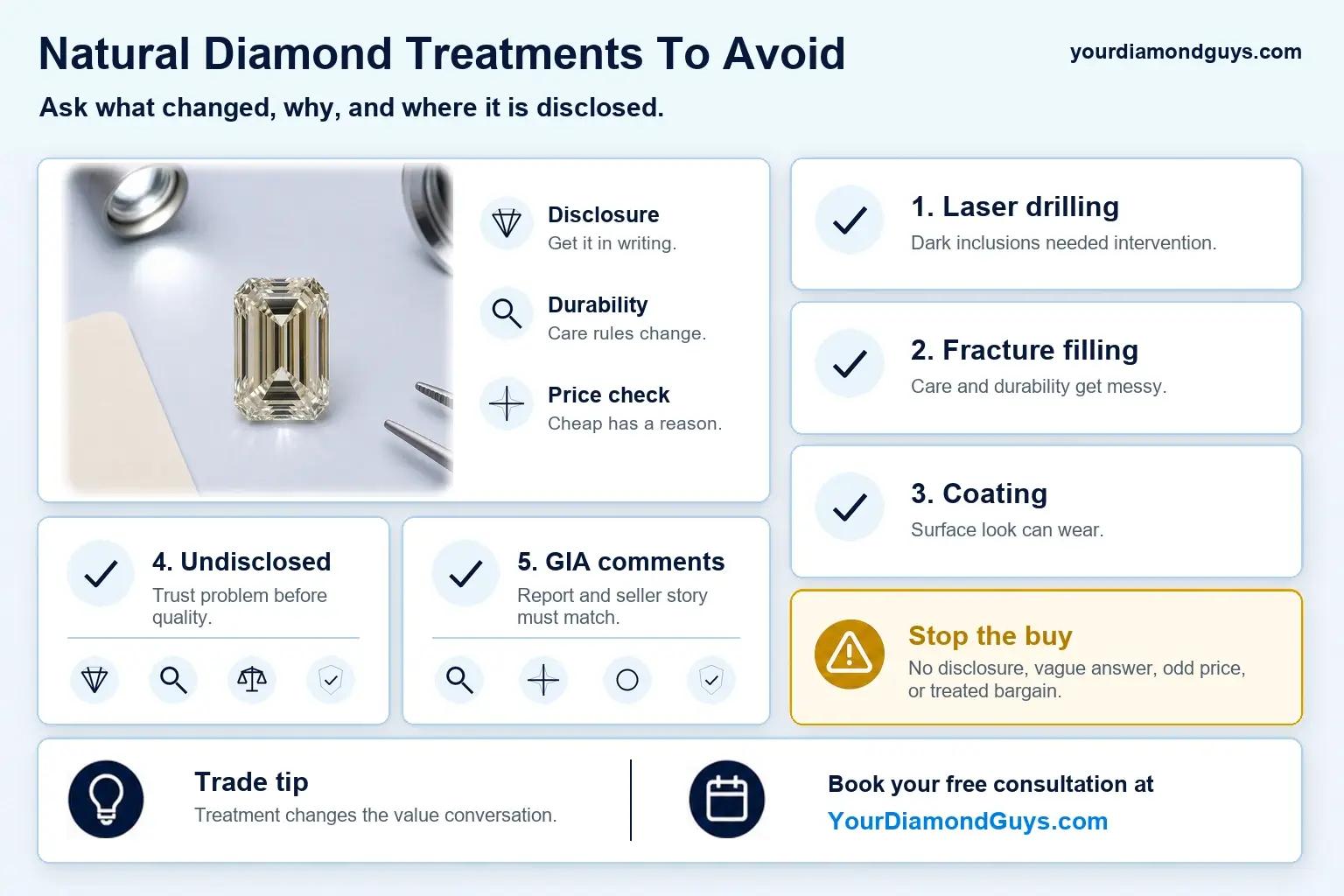
Laser drilling Used to reach dark inclusions and make them less visible.
Fracture filling Used to fill surface-reaching breaks so a diamond looks cleaner.
Coatings Used to change or mask color with a thin surface layer.
That does not make every treated stone "bad."
It does make the decision more technical.
And when a diamond needs extra explanation, extra care, or extra disclosure, many people would rather keep walking.
Why this is a report problem first
Most shoppers think treatment is a microscope issue.
It isn't.
It is a paperwork issue first.
The FTC's consumer guidance says sellers should disclose gemstone treatments when they are not permanent, create special care requirements, or significantly affect value.
That is your filter.
Before you fall in love with the stone, read the document.
Check the comments. Check the plot. Check the report type.
If the paperwork gets vague, slow down.
Laser drilling: permanent, but still not nothing
Laser drilling is the lightest of the three.
But it is still a treatment.
Same clarity grade does not mean the same stone.
One diamond can be naturally clean for the grade. Another can need a laser tunnel to get there.
That difference matters.
What should you look for?
Start with the plot. Then the comments. Then any treatment disclosure language.
If the report shows drill holes, you are not looking at an untouched stone.
For some people, that is fine.
For a gift, heirloom, or collector piece, it is often not ideal.
Fracture filling: the biggest red flag here
This is where many buyers should get very cautious.
Fracture filling can make a diamond look cleaner than it really is.
But the cleaner look comes from foreign material sitting inside a surface-reaching break.
That is the part people miss.
It is not just cosmetic.
It is maintenance.
It is risk.
It is uncertainty during repair work.
That is why this category scares careful buyers more than laser drilling.
The diamond may look better today.
That does not mean it will stay that way after normal ownership, cleaning, or bench work.
Coatings: easy to miss, easy to regret
Coatings sound minor.
They are not.
A coated diamond can look appealing in the case because the surface layer changes how the color reads.
The problem is what happens later.
Wear. Heat. Chemicals. Polishing.
Once the appearance depends on a surface layer, you are no longer dealing with a simple natural-diamond decision.
You are managing a treatment.
And most people do not want that surprise after they already paid.
The 2-minute report red-flags checklist
If you only do one thing, do this.
- Comments section — look for treatment, drilling, filling, coating, or enhancement language.
- Clarity plot — check for drill-hole symbols or anything unusual around clarity features.
- Treatment line — some labs separate this out, some bury it.
- Color notes — wording around color origin or appearance changes deserves a second look.
- Report type — confirm you are looking at a full grading report, not a lighter document.
- Mounting language — mounted-stone paperwork can be more limited than loose-stone paperwork.
- Lab wording — if the phrasing feels unclear, compare it with standard trade language.
On mounted jewelry, IGI notes that any detected treatment is disclosed in the comments section, which is exactly why that part of the report should never be skipped.
And if you want the wording grounded in trade standards instead of store talk, the CIBJO Blue Books are the industry's maintained standards for diamond terminology and nomenclature.
Questions to ask before money changes hands

Keep it simple.
Ask these exact questions.
- Has this diamond had any treatment or clarity enhancement?
- Which treatment?
- Is it permanent?
- Does it need special care?
- Will you write that on the receipt?
If the answer gets slippery, that tells you something.
If the seller starts talking around the question, that tells you more.
A safer way to buy beauty
You do not need treatments to end up with a beautiful diamond.
You need better priorities.
Cut first. Transparency second. Documentation always.
A diamond with honest inclusions and clean paperwork is usually easier to own than a diamond that needed help looking clean.
That is especially true when you are buying an engagement ring, a gift, or anything you may trade or upgrade later.
The goal is not perfection.
The goal is no surprises.
Free Diamond Consultation
Still not sure what the report is telling you?
That is where we come in.
We will tell you what is real, what is marketing, and what is likely to cost you later.
Book your Free Diamond Consultation
Questions? Reach out directly for a free consultation, or drop them in the Diamond Buyers Academy community — Rob and I answer personally.
Frequently Asked Questions
Not always.
But they are rarely a simple buy.
The Jewelers Vigilance Committee's summary of the FTC Jewelry Guides explains the rules are built around avoiding deceptive omissions in jewelry marketing, which is exactly why clear treatment disclosure matters before you pay.
Understand what you're getting before you commit.
Fracture filling is usually the one that gives people the most trouble.
Not because it always fails immediately.
Because it adds instability to something most buyers assume is straightforward.
The filler can be damaged by routine cleaning or repair work.
No.
Laser drilling is typically viewed as the lighter issue.
But it is still treatment.
Untreated usually wins when you care about simplicity. Laser drill holes are permanent, but they still represent human intervention in the diamond's natural state.
Not the way most people hope.
If a diamond's look depends on a surface layer, you should assume that look deserves extra caution.
Coatings can wear off over time, be damaged by heat or chemicals, or be scratched during normal wear.
Read the paperwork before you read the sales pitch.
That is where the real story usually shows up.
Check the comments section, look for treatment language, and verify the report number. If anything is unclear, ask direct questions before you consider buying.
*Some links on our site may earn us a small commission at NO EXTRA cost to you, helping us keep our content free*