Colorless Diamonds (D to F): When They Are Worth It
By Josh Allen, Co-Founder — YourDiamondGuys.com Josh has over 30 years of experience in the global diamond trade, sourcing from Mumbai, Tel Aviv, and Antwerp, and has supplied diamonds to Tiffany, Cartier, Harry Winston, and more.
Buy D to F when you can see the difference and care about it. If you cannot see it, do not donate money to the certificate.
Most buyers hear colorless and think better. Sometimes it is. Sometimes it is just more expensive. D, E, and F make sense only when the buyer will actually see and value the difference.
GIA puts D, E, and F at the top of the D to Z color scale. That does not mean every buyer should pay top money for them.
I have seen plenty of buyers choose F because it feels responsible. Then a better cut G sits next to it and steals the show.
How I Would Shop It
D to F should be compared against the main diamond color guide and real D color diamonds examples only after the buyer knows the premium is visible enough to matter.
What Changes The Call
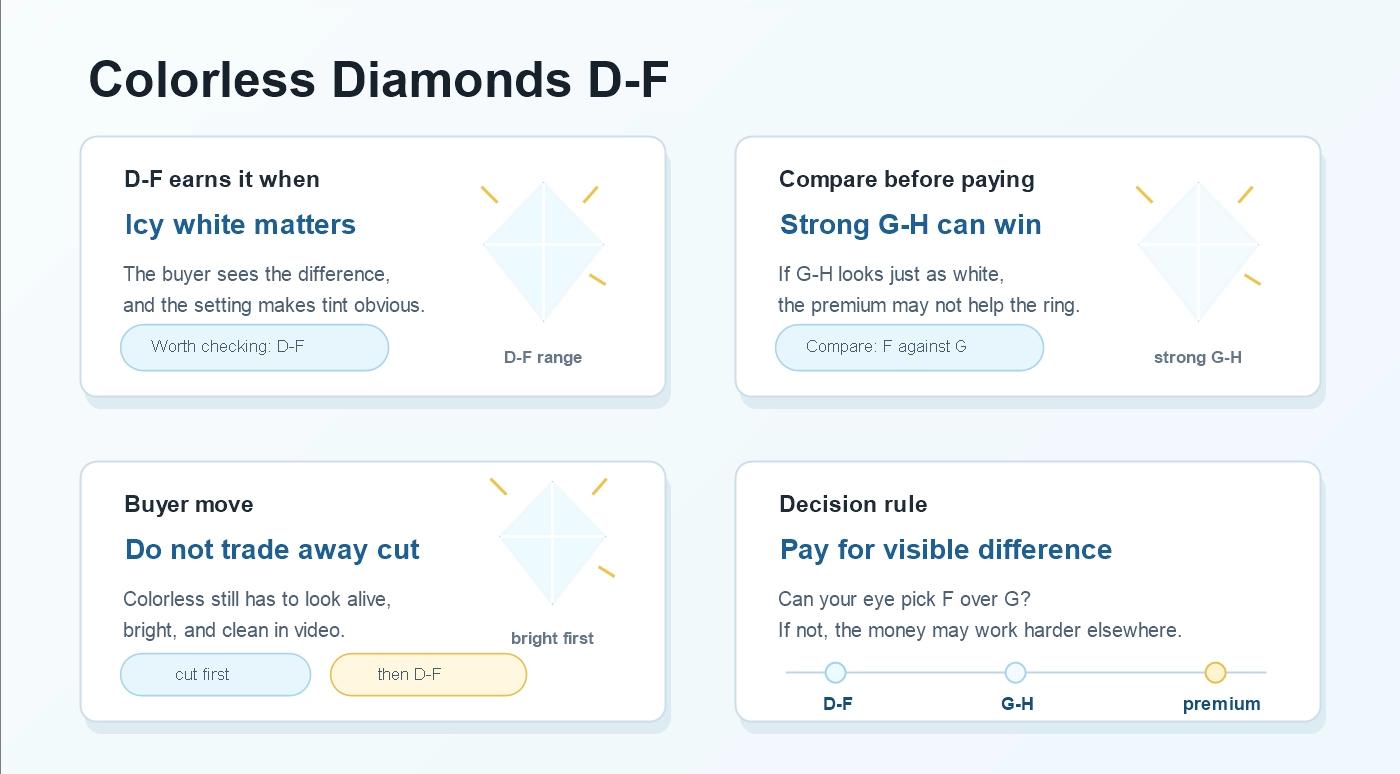
D to F is a precision purchase. It makes the most sense when the brief is icy white, the setting is white metal, or the diamond shape gives color fewer places to hide.
The mistake is paying for colorless while accepting weak cut, poor spread, or a video that does not look alive.
| Factor | Why It Matters | Buyer Move |
|---|---|---|
| D to F | Colorless range | Worth it for color sensitive buyers or step cuts |
| G to H | Near colorless sweet spot | Best default for many buyers |
| I to J | Value range | Works best with strong cut and smart setting |
| K to M and lower | Visible warmth | Buy only when the look is intentional |
Where I Start
If D to F is in the budget, I still compare it against a stronger G to H. The colorless stone has to justify the premium on the hand, not only on the report.
How To Check It In Video
- Compare F against G in the same shape.
- Look away, then look back.
- If your eye cannot pick the colorless stone, the upgrade did not earn its keep.
How This Plays Out
Colorless makes sense when the brief, setting, and buyer's eye support it. If the buyer cannot see the difference next to a strong G to H, that money can work harder elsewhere.
Mistakes I Would Avoid
- Do not pay for a color grade you cannot see in the finished ring.
- Do not judge color from one studio photo.
- Do not ignore cut quality when judging face up whiteness.
A Practical Example
A buyer compares an F and a G round brilliant in platinum. The F costs more. The G has better cut, a cleaner video, and faces up just as white. I would not pay for the F unless the buyer can see the difference and wants that peace of mind.
What To Ask Before You Buy
- Can I see F next to G?
- Is the cut already strong?
- Is the setting white and open?
- Am I paying for a visible difference or a comfort letter?
If you want Rob or me to look at the stone with you, book your free consultation at YourDiamondGuys.com.
Where To Compare Live Listings
If you are shopping colorless, keep the comparison tight. I would compare similar stones on Whiteflash and Blue Nile before paying for the top of the scale.
Questions? Reach out directly for a free consultation, or drop them in the Diamond Buyers Academy community — Rob and I answer personally.
Frequently Asked Questions
Only when you can see it or you simply want the top grade. No shame in that. Just know what you are paying for.
To many eyes, yes, especially once the diamond is set.
Large stones, step cuts, very white settings, or a buyer who spots warmth instantly.
Better cut first. A dull F is still dull.
Paying for colorless while accepting weak light return. That is backwards.
*Some links on our site may earn us a small commission at NO EXTRA cost to you, helping us keep our content free*