GIA Color Grading for Natural Diamonds: What Buyers Should Know
By Rob Cornfield, Co-Founder — YourDiamondGuys.com Rob has over 30 years of experience in the global diamond trade, specializing in diamond cut and light performance.
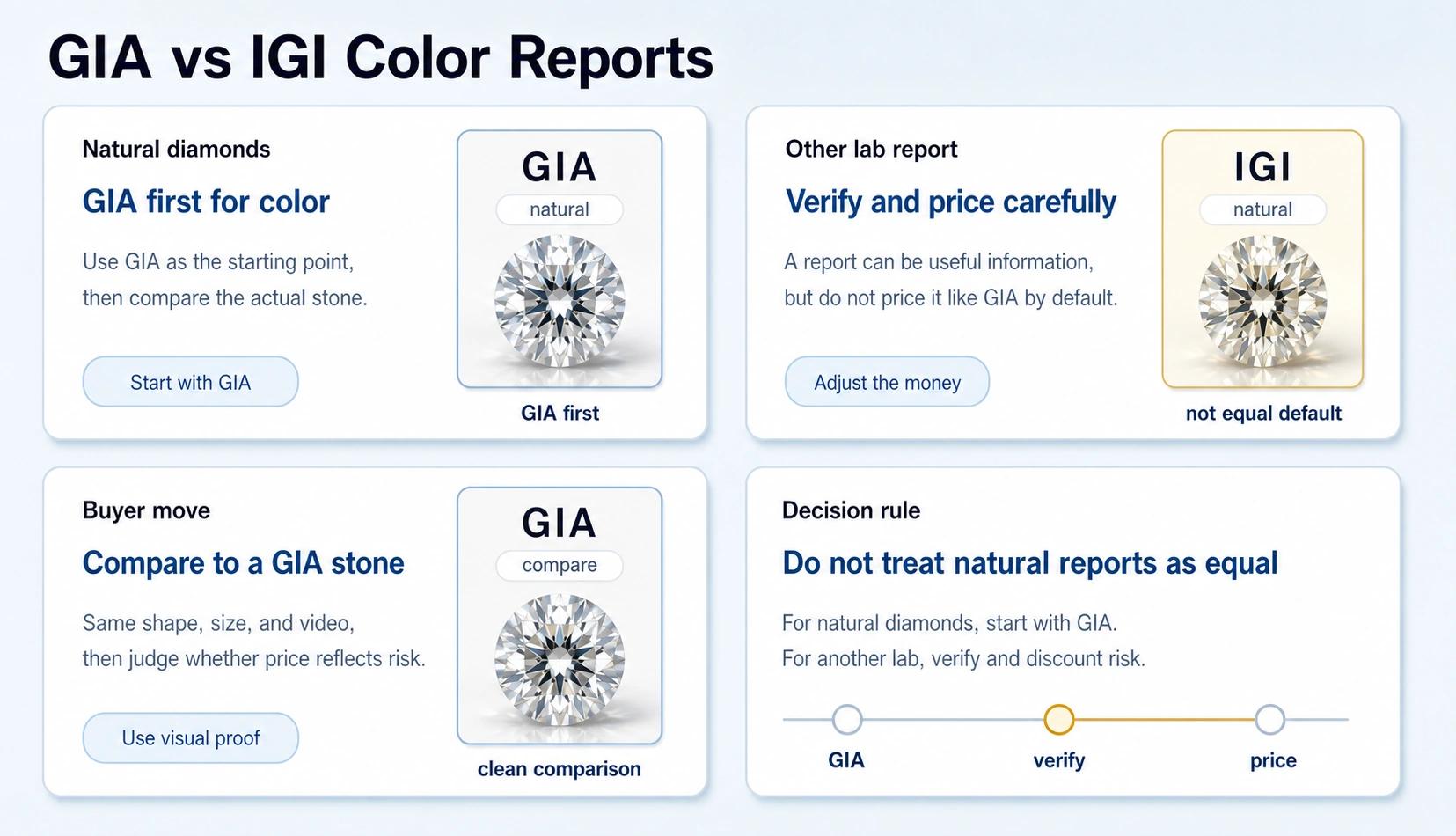
For natural diamonds, use GIA as the starting point. If another report is involved, price the stone more conservatively.
Most buyers treat every lab report like the same kind of promise. I do not. For natural diamonds, the color grade starts with GIA or I start asking harder questions.
The FTC Jewelry Guides expect sellers to represent diamond quality truthfully. That is the baseline. In the trade, the lab still changes how I price the grade.
For natural diamonds, I start with GIA. I am not trying to be difficult. I am trying to protect the buyer from paying strong money for a grade I do not trust the same way.
How I Would Shop It
Lab trust changes the value calculation. Compare the main diamond color guide with diamond grading laboratories before treating two color grades as equal.
What Changes The Call
The color grade is a market signal. If the lab is not read the same way by the trade, the price should not be read the same way either.
This matters more when a listing looks like a deal only because the report is softer than the buyer realizes.
| Factor | Why It Matters | Buyer Move |
|---|---|---|
| D to F | Colorless range | Worth it for color sensitive buyers or step cuts |
| G to H | Near colorless sweet spot | Best default for many buyers |
| I to J | Value range | Works best with strong cut and smart setting |
| K to M and lower | Visible warmth | Buy only when the look is intentional |
Where I Start
If the report is not GIA for a natural diamond, I want the price and visual proof to reflect that added uncertainty.
How To Check It In Video
- Compare it to a GIA graded stone.
- Do not let the report do all the work.
- If the price only looks good because the lab is softer, that is not a deal.
How This Plays Out
The lab changes how the grade should be priced. For natural diamonds, I would rather start with GIA than explain away a report I do not fully trust.
Mistakes I Would Avoid
- Do not compare lab grades as if every report uses the same standard.
- Do not pay GIA level money for a grade you do not trust.
- Do not ignore the difference between natural and lab grown diamond reporting.
A Practical Example
If two natural diamonds are both listed as G color but one has a GIA report and the other has a softer report, I do not treat them as equal. I either adjust the price expectation or move to a cleaner comparison.
What To Ask Before You Buy
- Is the diamond natural?
- Which lab issued the report?
- How is the price adjusted?
- Can I compare it with a GIA report?
If you want Josh or me to look at the stone with you, book your free consultation at YourDiamondGuys.com.
Where To Compare Live Listings
Once the report checks out, compare price with discipline. I would look at similar stones on Blue Nile and Ritani before calling one listing cheaper.
The Dirty Truth About Diamond Grading
Not all diamond labs grade the same way. Some give higher grades too easily, which can mislead buyers.
That's why a trusted report matters. If the certificate is not reliable, the diamond may not be either.
Questions? Reach out directly for a free consultation, or drop them in the Diamond Buyers Academy community — Rob and I answer personally.
Frequently Asked Questions
Yes. That is where I start.
No. That is how people overpay.
It can give information. I just do not price it like GIA without more proof.
A stone looks cheaper because the grade is softer, not because the value is better.
Compare it to a GIA stone and adjust the money before getting excited.
*Some links on our site may earn us a small commission at NO EXTRA cost to you, helping us keep our content free*