Near Colorless Diamonds (G to J): The Buyer Sweet Spot
By Josh Allen, Co-Founder — YourDiamondGuys.com Josh has over 30 years of experience in the global diamond trade, sourcing from Mumbai, Tel Aviv, and Antwerp, and has supplied diamonds to Tiffany, Cartier, Harry Winston, and more.
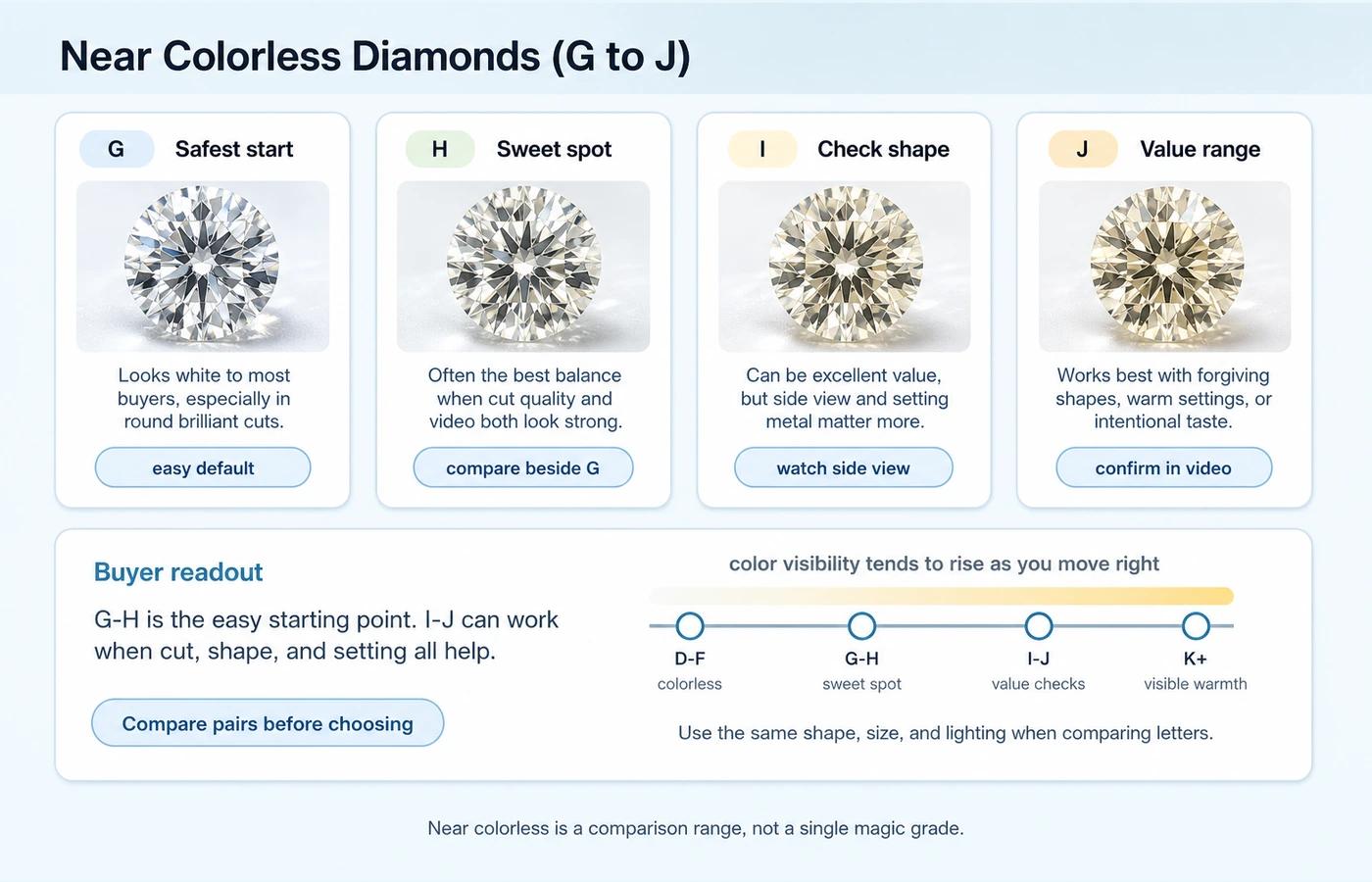
G to H is the easy starting point. I to J can work when the cut is strong, the shape is forgiving, and the setting is not exposing warmth.
Most buyers should spend time in the near colorless range before they pay for colorless. G, H, I, and J are where a lot of smart diamond purchases happen.
GIA calls G through J near colorless on the D to Z scale. This is where a lot of smart buying happens.
If I am helping a friend, I live in this range for a while. Not because it is cheap. Because it is where the value often gets real.
How I Would Shop It
G to J works best when the buyer compares the main diamond color guide with real G color diamonds examples instead of choosing one letter from a chart.
What Changes The Call
Near colorless is where the paper grade and the real visual result can separate. A strong H can be the smart buy. A weak J in the wrong setting can be too warm.
This range should be compared in pairs. Look at G next to H, H next to I, and I next to J in the same shape before deciding where your eye draws the line.
| Factor | Why It Matters | Buyer Move |
|---|---|---|
| D to F | Colorless range | Worth it for color sensitive buyers or step cuts |
| G to H | Near colorless sweet spot | Best default for many buyers |
| I to J | Value range | Works best with strong cut and smart setting |
| K to M and lower | Visible warmth | Buy only when the look is intentional |
Where I Start
The sweet spot is not one grade. It is the point where the buyer stops seeing meaningful color and the saved money can improve the rest of the diamond.
How To Check It In Video
- Compare G, H, I, and J in the same shape.
- Do not jump between random videos.
- If J looks warm from the side, believe it.
How This Plays Out
G to J is where many buyers find the right balance. The final grade should come from side by side comparison, not from fear that anything below F is automatically too warm.
Mistakes I Would Avoid
- Do not pay for a color grade you cannot see in the finished ring.
- Do not judge color from one studio photo.
- Do not ignore cut quality when judging face up whiteness.
A Practical Example
A G and an I can both look strong on paper. The G is safer in white metal. The I can be the better value in yellow gold if the cut is strong and the side view does not bother the buyer.
What To Ask Before You Buy
- What shape am I buying?
- Is the setting white or warm metal?
- Does I or J bother me from the side?
- Would G to H free money for better cut or size?
If you want Rob or me to look at the stone with you, book your free consultation at YourDiamondGuys.com.
Where To Compare Live Listings
For this range, compare slowly. I would look at similar G to J stones on Whiteflash and Blue Nile and before assuming higher color is smarter.
Questions? Reach out directly for a free consultation, or drop them in the Diamond Buyers Academy community — Rob and I answer personally.
Frequently Asked Questions
Yes. G is a safe place for a lot of people, especially in white metal.
No. H is often the sweet spot if the stone is bright.
Yes, but do the side view test. Warmth can sneak up there.
G to H when they want safe. I to J when they want value and the stone proves itself.
Line up the videos. Same shape. Similar size. Then let your eye pick the limit.
*Some links on our site may earn us a small commission at NO EXTRA cost to you, helping us keep our content free*