Best Diamond Color for White Gold and Platinum
By Josh Allen, Co-Founder — YourDiamondGuys.com Josh has over 30 years of experience in the global diamond trade, sourcing from Mumbai, Tel Aviv, and Antwerp, and has supplied diamonds to Tiffany, Cartier, Harry Winston, and more.
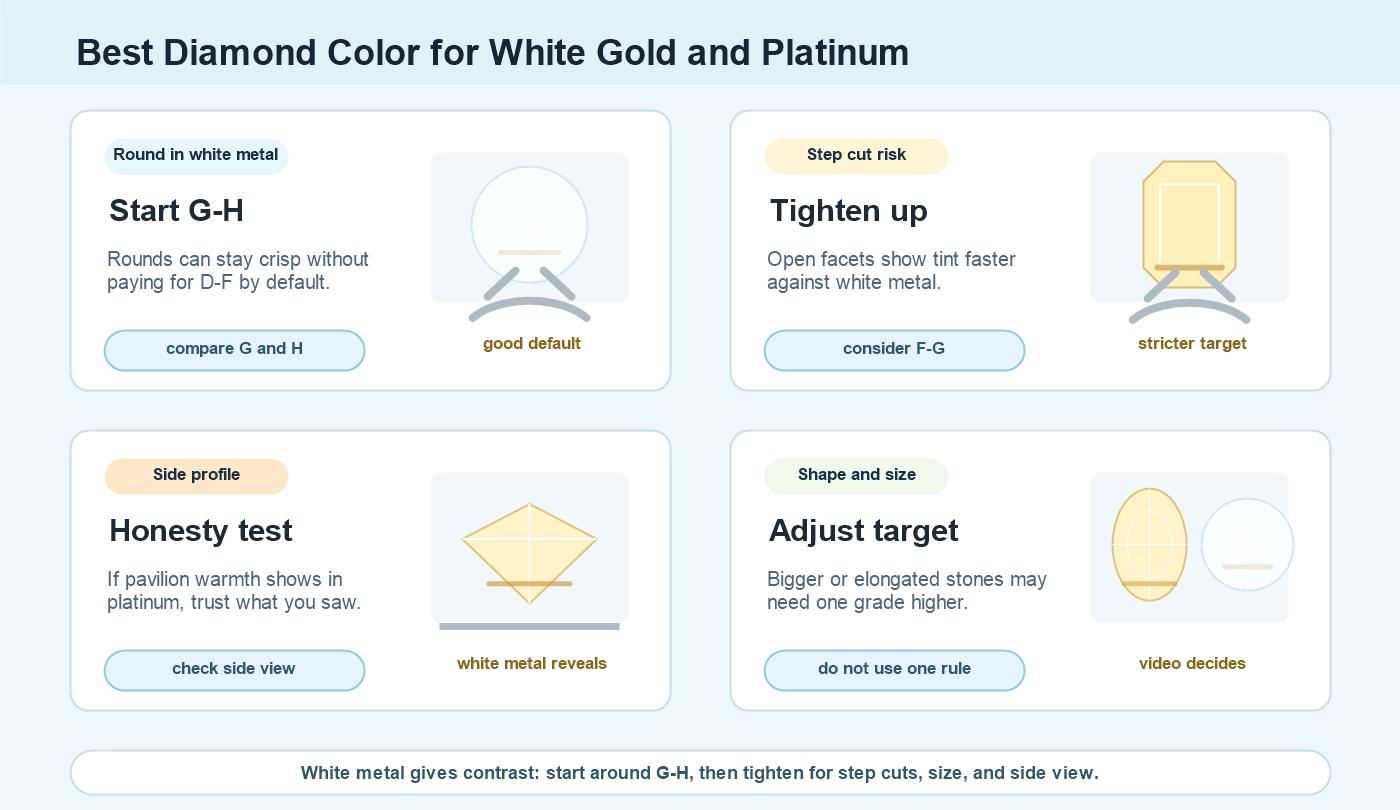
For white gold and platinum, I usually start at G to H for rounds. For step cuts, I tighten up. For bigger stones, I tighten up again.
Most buyers think white gold and platinum automatically require a colorless diamond. That is not true. White metal makes warmth easier to see, but it does not mean every buyer needs D, E, or F.
GIA gives you the color grade on the D to Z scale. White metal gives you the honesty test, because warmth has fewer places to hide.
On the desk, I see this all the time. A buyer loves an I color in the listing, then the side view in platinum gives it away.
How I Would Shop It
White metal makes the decision stricter, so compare this against the main diamond color guide and the finished ring design before paying for a higher grade. The platinum choice matters, but shape and side view still decide the safe range.
What Changes The Call
White metal does not warm the diamond visually. That is why side view tint can feel more obvious in platinum and white gold than it does in yellow or rose gold.
The setting style matters too. A low basket can hide some side color. An open basket or four prong solitaire gives the eye more chances to catch warmth.
| Factor | Why It Matters | Buyer Move |
|---|---|---|
| White gold or platinum | Reveals warmth more easily | Start G to H, tighten for step cuts |
| Yellow gold | Softens warmth | G to J often gives strong value |
| Rose gold | Makes warmth feel intentional | G to J or K to M when style supports it |
| Open side setting | Shows body color from the side | Check side view video |
Where I Start
If the buyer wants a crisp white look, I would compare G and H first, then move to F only if the shape, size, or side view makes the warmth too obvious.
How To Check It In Video
- Check the top view.
- Then check the side profile.
- If the pavilion looks warm against white metal, do not talk yourself out of what you saw.
How This Plays Out
After the buyer chooses white metal, the next step is shape. A round brilliant in platinum and an emerald cut in platinum do not need the same color target.
Mistakes I Would Avoid
- Do not pay for a color grade you cannot see in the finished ring.
- Do not judge color from one studio photo.
- Do not ignore cut quality when judging face up whiteness.
A Practical Example
A buyer choosing a platinum solitaire can compare an H round with a G oval. The H round can still look clean, while the G oval can show warmth near the ends. The metal is the same, but the shape changes the decision.
What To Ask Before You Buy
- Is the basket white metal too?
- How open is the side of the setting?
- Does the stone stay white from the side?
- Can I compare it with one grade higher?
If you want Rob or me to look at the stone with you, book your free consultation at YourDiamondGuys.com.
Where To Compare Live Listings
For white metal, compare apples to apples. I would look at similar stones on Whiteflash and Blue Nile before paying extra for a higher color letter.
Discover the Perfect Diamond, Effortlessly
Our dual filtration system offers a unique approach by combining statistical insights with visual analysis—so you only see diamonds that meet the highest standards of brilliance and precision. Why settle for less when you can have the best? Let us do the heavy lifting and present you with top-tier diamonds, tailored to your needs.
Questions? Reach out directly for a free consultation, or drop them in the Diamond Buyers Academy community — Rob and I answer personally.
Frequently Asked Questions
No. Most buyers do not. Start around G to H for rounds, then tighten if the shape or size makes warmth obvious.
Yes, but I want video proof. I color can work in a well cut round. It gets riskier in open settings.
The metal is not helping you. Yellow or rose gold can soften tint. White metal gives you contrast.
Emerald and asscher cuts. They show more body color because the facets are open.
Do not pay for D because you are nervous. Compare G, H, and I in the actual style you want.
*Some links on our site may earn us a small commission at NO EXTRA cost to you, helping us keep our content free*