Round Diamond Proportions: The Buyer Targets
By Rob Cornfield, Co-Founder of YourDiamondGuys.com. Fifth generation diamantaire with 30+ years in the global diamond trade. Former supplier to Tiffany & Co., Cartier, and Harry Winston.
Start with the numbers, round diamond proportions screen table, depth, crown angle, pavilion angle, spread, polish, symmetry, fluorescence, and video before price gets serious.
Most buyers think GIA Excellent is the target. It is not. It is the starting line. The real target is a round diamond with table, depth, crown, and pavilion numbers that work together in the actual stone.
I always start with GIA for natural diamonds. Not because the cut grade alone is enough, but because GIA gives me proportions I can actually trust. Softer lab reports do not give me the same confidence in those numbers.
A cutter can leave weight in places that help the carat number but hurt the look. That is why I read the millimeter spread beside the carat weight before I get impressed by the size on the listing.
The Proportion Range I Start With
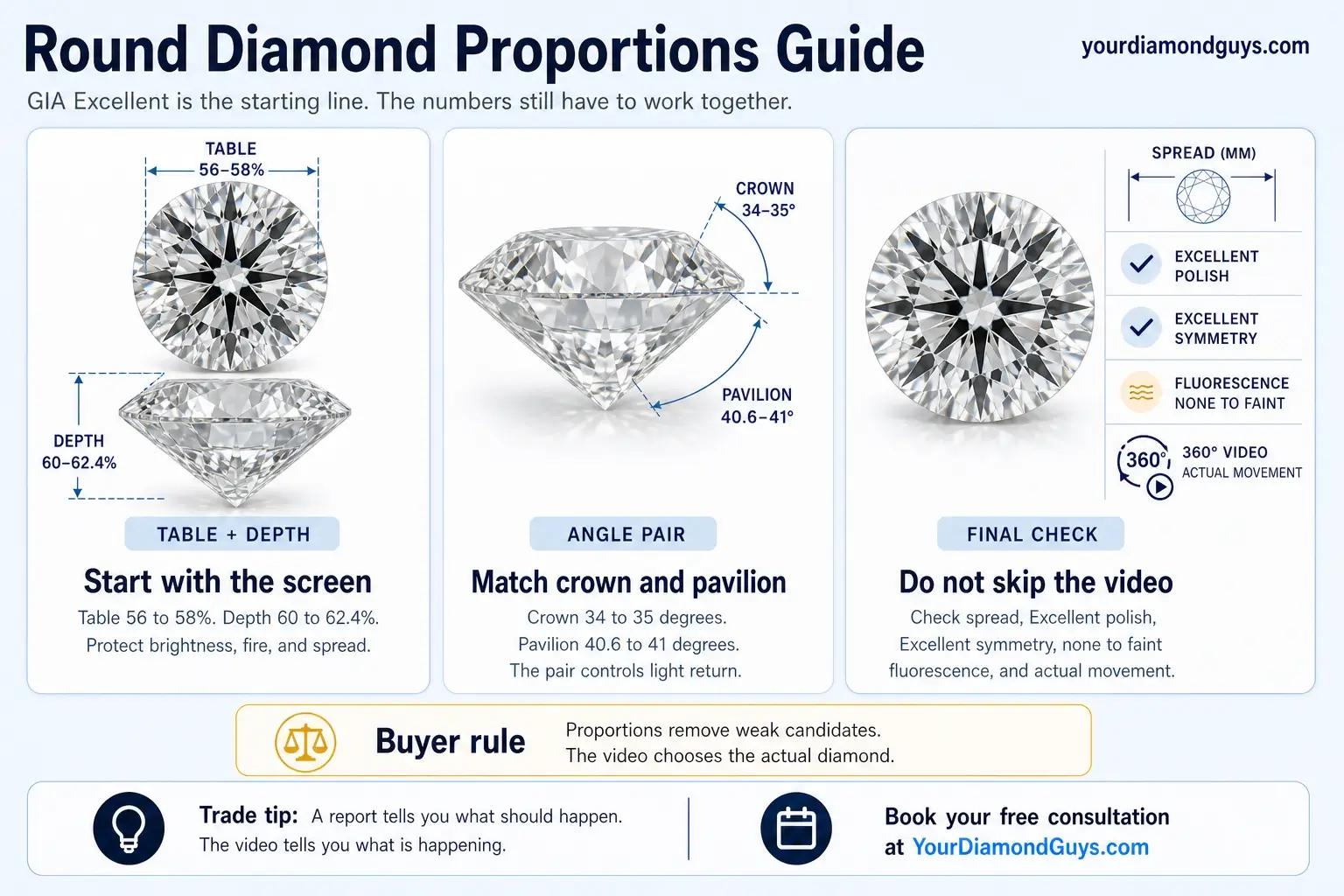
For round brilliants, my starting screen is table 56 to 58 percent, depth 60 to 62.4 percent, crown angle 34 to 35 degrees, pavilion angle 40.6 to 41 degrees, Excellent polish, Excellent symmetry, and none to faint fluorescence.
These are not blind approval numbers. They are the first screen. A diamond can sit inside these ranges and still need video review. A diamond outside them is not automatically worthless, but it needs a reason to stay in the conversation.
| Proportion | Strong Starting Target | What It Affects |
|---|---|---|
| Table | 56 to 58 percent | Brightness and fire balance |
| Depth | 60 to 62.4 percent | Spread and hidden weight |
| Crown angle | 34 to 35 degrees | Fire and upper half performance |
| Pavilion angle | 40.6 to 41 degrees | Light return |
| Polish and symmetry | Excellent | Finish and pattern precision |
| Fluorescence | None to Faint | Haze risk and market discount |
Why The Angles Matter More Than The Label
A pavilion angle that is too deep can send light out the wrong way. A crown angle that does not complement it can make the problem worse.
This is where many buyers overpay. They see Excellent, they see a good color, and they assume the stone is safe. In the trade, the better buyer checks the angle pair first.
Spread Is Part Of Cut Quality
A round diamond should face up well for its carat weight. Depth affects that.
A 1.00 carat diamond that is cut too deep can look closer in size to a smaller stone. You paid for weight you cannot see. That is not a good use of budget.
How To Use These Numbers
Use proportions to remove weak candidates. Then use video and images to choose the actual diamond.
The final approval is not a spreadsheet. It is the stone. A report tells you what should happen. The video tells you what is happening.
Reach out to Rob or me at YourDiamondGuys.com, or book your free consultation. We will look at the actual stone with you. No sales pitch.
Where Proportions Save The Search
Use round proportions as the main screening tool after you confirm the GIA report. This is where buyers can remove many weak stones before getting emotionally attached to size, color, or a low price.
Mistakes I Would Skip
- Do not stop at GIA Excellent.
- Do not ignore spread for carat weight.
- Do not buy a diamond with attractive numbers before watching the video.
- Do not treat proportion ranges as a guarantee of beauty.
Same Grade Different Proportions Example
Two round diamonds can both be 1.20 carat, G color, VS2, and GIA Excellent. One has a 56 percent table, 61.5 percent depth, 34.5 degree crown, and 40.8 degree pavilion. The other is deeper with a less favorable angle pair. The certificates look close to a buyer. In hand, the first stone is usually the one I want to study further.
Why Round Diamonds Are More Expensive
Questions I Ask About Round Proportions
- Does the stone sit inside the main round proportion screen?
- How does the face up size compare with similar stones?
- Does the video show clean light return?
- Is the price fair for the cut quality shown?
Where I Would Compare Round Stones
Use these sites as comparison tools, not automatic recommendations. I would compare similar stones on Ritani and Blue Nile, then judge each diamond by the report, video, spread, and price. If the stone is weak, the link does not save it.
Questions? Reach out directly for a free consultation, or drop them in the Diamond Buyers Academy community — Rob and I answer personally.
Questions Buyers Ask Us
For round brilliants, my starting screen is table 56 to 58 percent, depth 60 to 62.4 percent, crown angle 34 to 35 degrees, pavilion angle 40.6 to 41 degrees, Excellent polish, Excellent symmetry, and none to faint fluorescence.
No. GIA Excellent is too broad to be the final decision. Use it as a starting filter, then check the actual proportions and video.
Both matter, but neither works alone. Table, depth, crown angle, and pavilion angle have to support the same light performance goal.
Think of hidden weight as carat weight carried in depth or girdle thickness instead of visible face up size. It makes a diamond cost more without looking larger.
No. But a diamond outside the range needs stronger proof. I would want clear video, images, and a price that reflects the tradeoff.
*Some links on our site may earn us a small commission at NO EXTRA cost to you, helping us keep our content free*