What To Ask A Retailer Before Buying A Fluorescent Diamond
By Josh Allen, Co-Founder of YourDiamondGuys.com. Fifth generation diamantaire with 30+ years in the global diamond trade. Former supplier to Tiffany & Co., Cartier, and Harry Winston.
Ask for specific lighting, a clean stone, locked video, the original report, written transparency confirmation, and return terms. Those requests turn a vague reassurance into evidence.
Retailers answer faster when the buyer sounds organized. We learned that on the other side of the counter. Five precise questions get better results than a page of diamond theory.
Your message should ask for evidence, not repeat the myth that every fluorescent stone is bad. GIA says fluorescence is usually harmless and only rare stones look hazy or oily, which is why a clean retailer workflow saves good stones and exposes weak ones.
What Should You Know First About Questions To Ask A Retailer About Fluorescence?
Request the verified report, a neutral indoor video, shaded daylight video, direct sunlight video, controlled UV clip, written confirmation that the diamond is not milky or oily, and a return policy that starts after delivery.
Ask the seller to clean the stone and keep camera distance, background, white balance, focus, and exposure consistent. If they cannot provide the core evidence, skip the unknown.
Use Diamond Fluorescence 101 to understand why each evidence request matters before sending the script.
Copy This Short Email
Use a message the retailer can act on without guessing. Keep the report number in the subject line and number the requested files.
Here is the script: I am considering report number [number]. Please send the original grading report, one clean video in ordinary diffused indoor light, one in open shade, one in direct sunlight, and a short long wave UV clip. Please keep the camera distance, neutral background, and exposure consistent.
Add this sentence: Please confirm in writing whether the diamond shows any milky, hazy, oily, cloudy, or unusually blue appearance at normal viewing distance.
Ask For A Verified Report First
Open the original report and verify the number on the grading laboratory's website. Match origin, shape, measurements, carat, color, clarity, cut data, fluorescence, comments, and inscription.
For a natural diamond, start with GIA. The report clues for transparency risk tell you which comments need a direct visual answer.
Ask whether the listing's fluorescence wording comes from the report or from a retailer mapping. The exact lab language matters when two report systems differ.
Specify Lighting And Camera Conditions
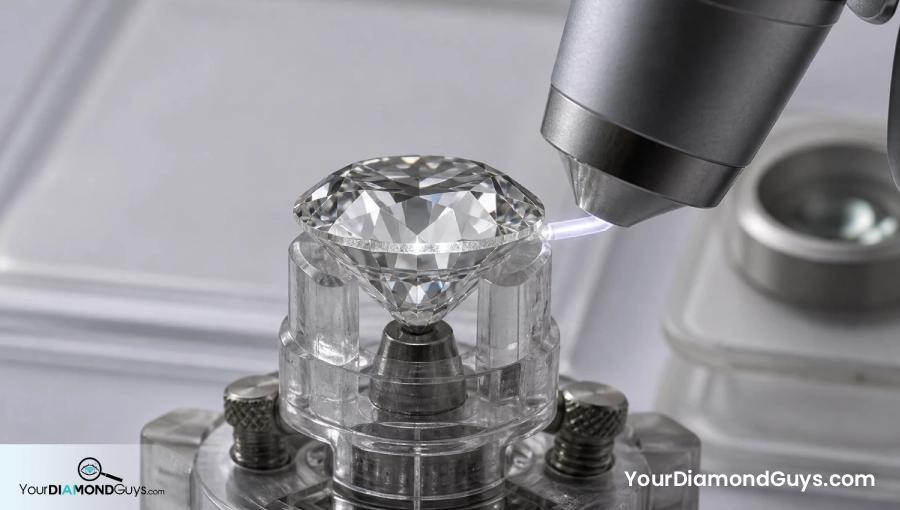
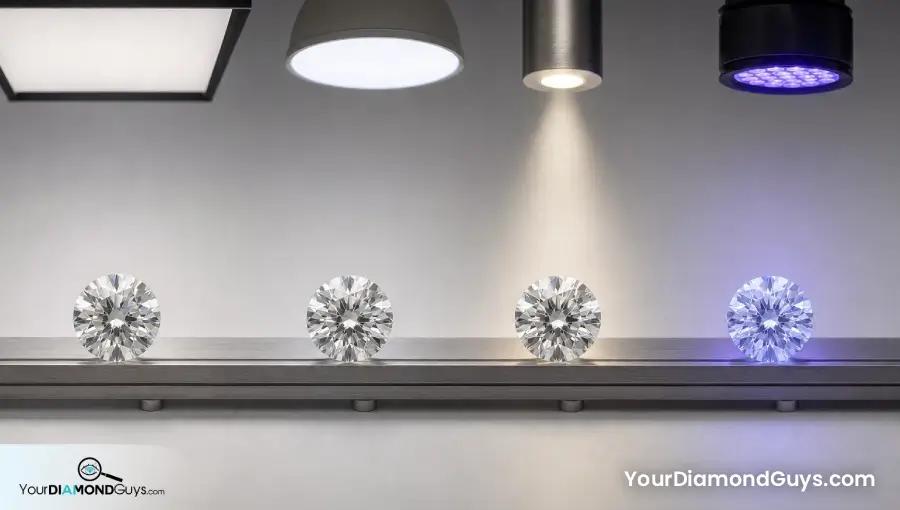
Ordinary diffused indoor light shows baseline transparency. Open shade shows natural UV response without hard sun glare. Direct sun shows the strongest outdoor reaction. A UV lamp shows the reaction itself.
The sunlight versus indoor guide explains what each view proves. Ask the seller not to substitute jewelry spotlights for the indoor clip.
Use the 360 video haze checklist once the files arrive. Check whether the holder remains sharp and the diamond's facet edges switch cleanly.
| Request | Why it matters | Weak substitute |
|---|---|---|
| Original verified report | Confirms lab wording and identity | Retailer summary card |
| Clean indoor video | Shows baseline transparency | Display case spotlight spin |
| Open shade video | Shows everyday outdoor reaction | Photo behind window glass |
| Direct sunlight clip | Shows maximum outdoor color response | Blacklight only |
| Long wave UV clip | Shows reaction color and distribution | Unlabeled purple lamp photo |
| Written haze confirmation | Creates a clear seller representation | "It should be fine" |
| Return terms | Lets buyer repeat the test | Exchange only promise |
Ask For A Comparison Stone
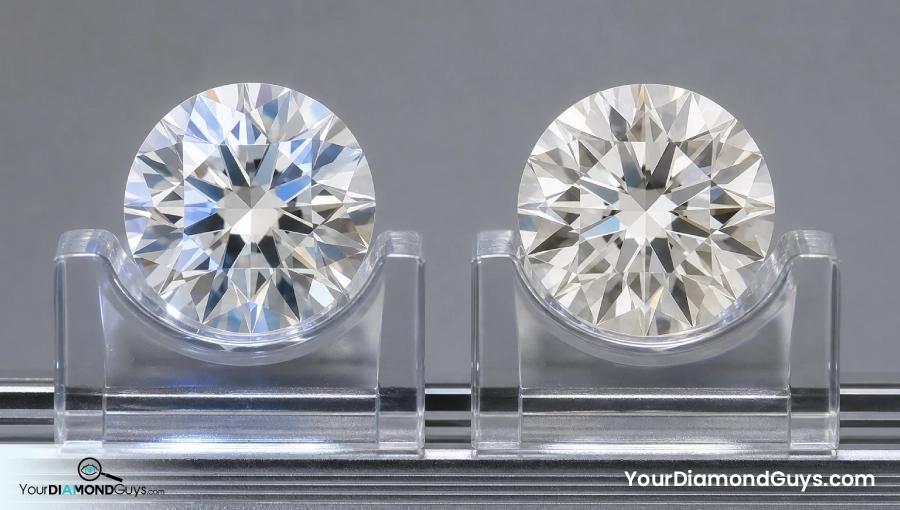
One fluorescent diamond in isolation is hard to read. Ask for a similar shape, carat, color, clarity, and cut with None or Faint fluorescence in the same frame.
Keep both stones at the same camera distance and angle. A comparison reveals whether Medium blue actually cools color, whether Strong changes transparency, and whether exposure favors one stone.
Use the fluorescence appearance risk guide to decide what difference counts as a rejection.
Lock Down Return And Inspection Terms
Ask when the return clock begins, whether the item must stay loose, who pays shipping, whether restocking fees apply, and whether setting or sizing changes eligibility.
Confirm that normal inspection under daylight and a consumer long wave UV light does not void the return. Do not expose the diamond to unsafe equipment or modify the stone.
The at home fluorescence test gives the safe sequence. Then use the buy or skip decision tree before the deadline.
- Get all material claims in writing.
- Save the listing, report, videos, and return page.
- Confirm the stone will be cleaned before filming.
- Ask for one matched comparison.
- Do not waive return rights for a discount.
How Does Questions To Ask A Retailer About Fluorescence Affect A Real Buying Decision?
A retailer does not need a film studio to answer these questions. A clean phone clip in honest light can be enough. What matters is consistency and willingness to show the stone.
A seller who gives clear files and a usable return window lowers your risk. A seller who says "trust us" while avoiding daylight raises it.
What Does A Real Questions To Ask A Retailer About Fluorescence Example Look Like?
A buyer asks for six files on a GIA graded J color stone with Strong blue fluorescence. The retailer sends a clean indoor clip, shade, direct sun, UV, report, and side by side comparison. The stone stays crisp in every view.
Another retailer sends one blacklight photo and says fluorescence never matters. The first stone remains a candidate. The second listing leaves the list, even if the diamond itself could be fine.
Which Questions To Ask A Retailer About Fluorescence Mistakes Should You Avoid?
- Asking only whether fluorescence is good or bad.
- Accepting a UV photo as an appearance review.
- Forgetting to request a clean stone and locked exposure.
- Skipping the original report and comments.
- Waiting until delivery to read return restrictions.
What Should You Ask About Questions To Ask A Retailer About Fluorescence Before Buying?
- Will you send the original verified grading report?
- Can you film indoor light, open shade, direct sun, and long wave UV?
- Can you confirm the stone is not milky, hazy, oily, or cloudy?
- Can you include a similar None or Faint comparison stone?
- What exact return terms apply after I inspect it at home?
Affiliate disclosure: Some retailer links are affiliate links. If you buy through one, Your Diamond Guys may earn a commission at no extra cost to you.
Where Can You Compare Evidence For Questions To Ask A Retailer About Fluorescence?
Use Brilliant Earth and Ritani as comparison tools, not automatic recommendations. Compare report viewers, video tools, daylight evidence, transparency confirmation, and written return terms, then judge how completely each seller answers the same buyer questions. The actual diamond has to earn the yes.
What Is The Buyer Recommendation On Questions To Ask A Retailer About Fluorescence?
Ask for files that answer one question each. Report for identity. Indoor light for transparency. Daylight for appearance. UV for reaction. Return terms for protection.
When a seller cannot show the diamond honestly, do not finance their uncertainty.
Return to the diamond fluorescence guide to place questions to ask a retailer about fluorescence inside the complete report, appearance, testing, and buyer decision system.
If you want another set of eyes on the stone, book your free consultation with Your Diamond Guys.
The Glow Factor: Understanding Diamond Fluorescence
Questions? Reach out directly for a free consultation, or drop them in the Diamond Buyers Academy community — Rob and Josh answer personally.
Questions Buyers Ask Us
*Some links on our site may earn us a small commission at NO EXTRA cost to you, helping us keep our content free*