CERTIFICATION PROCESS
Any accredited professional is technically able to certify a diamond. However, we do not recommend just "anyone" with an accreditation grade your diamond. The biggest and best laboratories in the world have an extremely strict process from the moment a diamond enters the laboratory to the time it gets the final grade. Laboratories are also able to detect quality enhancements, the most modern treatments and if the diamonds are natural or lab grown. Accreditation coupled with experience, the required tools, and a team of other trained experts, is what you are looking for when considering having a diamond "certified". To us, the GIA is the gold standard.
THE PROCESS
Below is an overview of what procedures a diamond goes through at GIA:
INTAKE
- As soon as the diamond arrives in the laboratory, it is assigned a unique code. Diamond grading is anonymous, so no gemologist can know who the owner of the diamond is. This is to help mitigate possible bias during grading.
CARAT WEIGHT
When a diamond is submitted to GIA, one of the first steps in the grading process is to determine its weight. To ensure precision, accuracy and consistency, GIA uses an electronic micro-balance scale to weigh each diamond. GIA adheres to strict calibration and maintenance procedures for its devices. These procedures exceed the manufacturer's recommendations. In addition, the laboratory monitors and controls environmental conditions that might affect the quality of the results, such as room temperature and humidity. CREDIT GIA.EDU
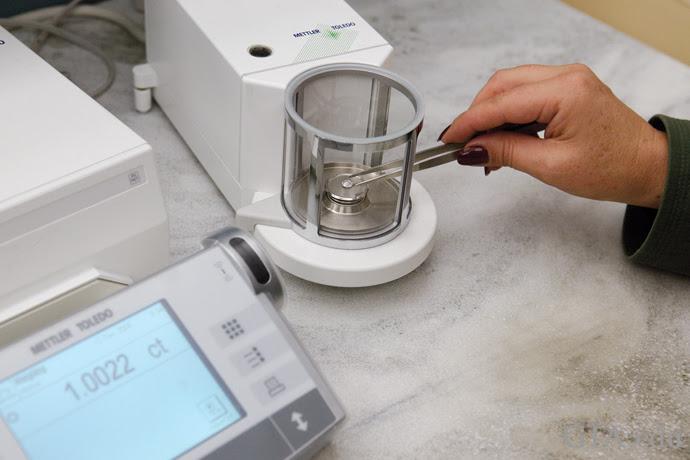
Diamonds submitted to GIA are weighed on an extremely sensitive electronic micro-balance scale. Photo: Valerie Power/GIA
Understanding carat weight - The diamond is then graded for its color, clarity, and cut by trained gemologists who use standardized lighting and viewing conditions as well as reference diamonds.
GIA DIAMONDCHECK (THIS IS ONE WORD, IT'S A REGISTERED TRADEMARK)
The process to help determine origin as well as detect natural diamonds, synthetic diamonds, and simulants.
COLOR DETERMINATION
Color is graded on a scale from D (colorless) to Z (light yellow or brown). The diamond is put upside down for a very specific reason. Looking at a diamond from top down can skew the actual color of the diamond for the human eye. Looking at it through the side and it being upside down allows the gemologist a clear and realistic view of the diamond's color.
GRADING CLARITY AND FINISH
Clarity grading of a diamond is done before the grading of Polish and Symmetry. The laboratory has determined that a gemologist's first impression on the diamond is crucial. Therefore, through rigorous trials, it was determined that grading clarity before grading color is the gemologist's best path to grading a diamond.
A diamond is graded on a scale from Flawless (no inclusions or blemishes) to Included (visible inclusions or blemishes).


FL
FLAWLESS
No inclusions and no blemishes visible to a skilled grader using 10x magnification.
Diamond
Clarity Grading
Move the slider to view examples of different diamond clarity grades. Click marker for more information.
GIA Cut Scale
- FL
- IF
- VVS1
- VVS2
- VS1
- VS2
- SI1
- SI2
- I1
- I2
- I3
The gemologist uses the "wedge technique" (the process by which the grader views specific portions of the diamond so as to focus on that area before visually moving on to the next section of the stone). From there, using a 10x magnification, the gemologist notes the inclusions characteristics from one edge to another, using a microscope or a loupe. The gemologist notes the location and nature of all relevant clarity characteristics, such as inclusions or blemishes, on a clarity plot. This creates a map of the diamond's features, which will in turn help to determine the clarity grade. Grading is always done by consensus. If 2 graders arrive at different clarity grade interpretation, a senior gemologist will blindly review the diamond and the consensus will become the grade.
Upon completion, the gemologist then grades the "finish" of the diamond. This has to do with determining the precision of both Polish and Symmetry. The determining scale runs from poor all the way to excellent.
The diamond may also be tested for any treatments or enhancements that could affect its quality or value. Some common treatments include laser drilling, fracture filling, irradiation, annealing, and high-pressure high-temperature (HPHT) color treatment. GIA will disclose any treatments on its report and may not grade diamonds that have been filled with a foreign substance.
CUT GRADING
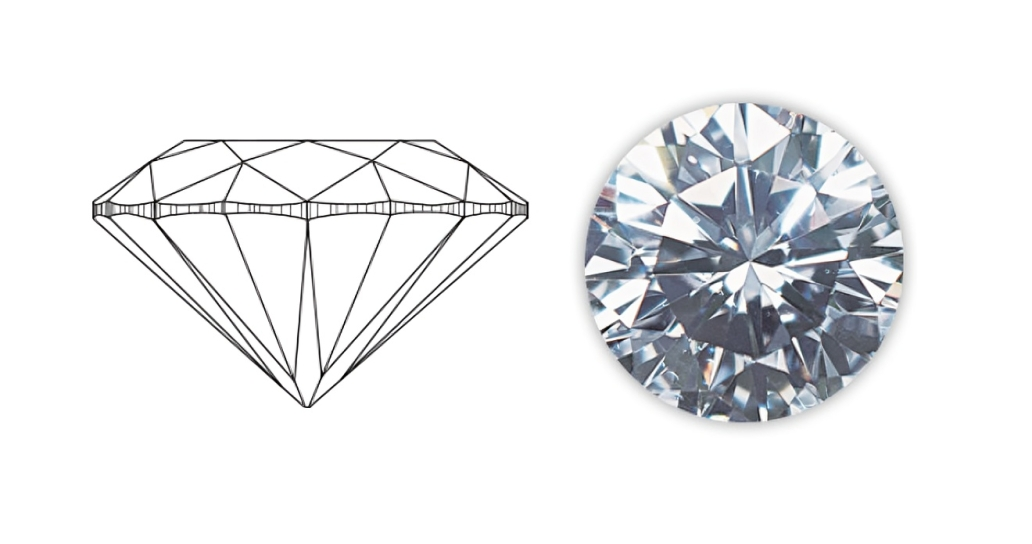
The cut of a diamond is graded on a scale from Excellent down to Poor. This grade is based on how well, or well the diamond reflects light and displays brilliance, fire, and scintillation. Additionally, the diamond must also fall within certain quantifiable technical specifications In order to receive an "excellent" or "very good grade".
Excellent
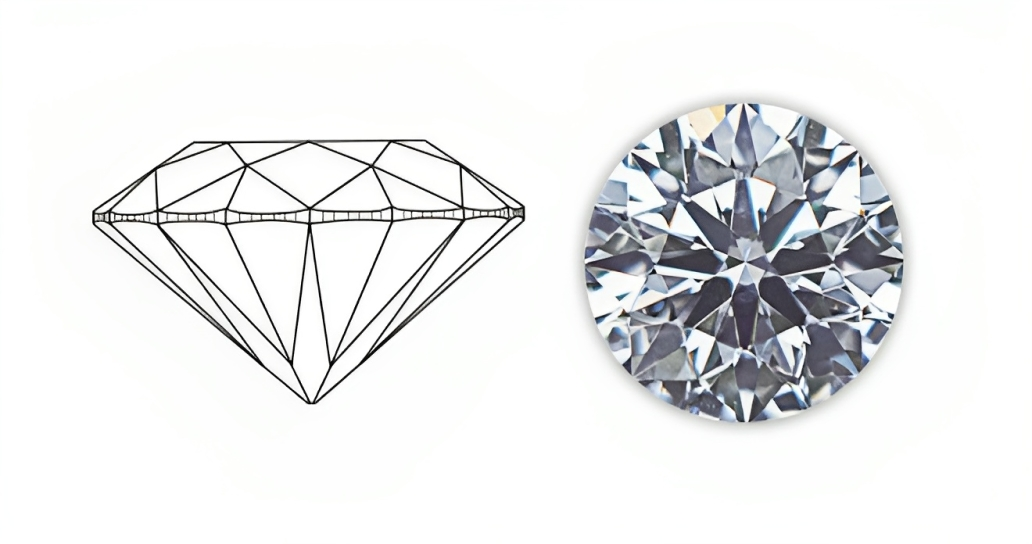
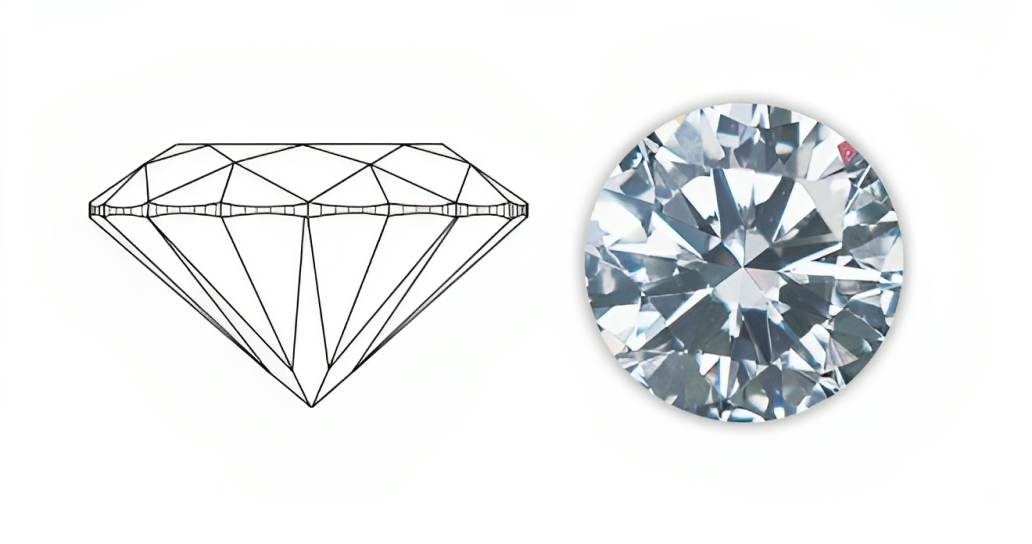
The diamond, which has an even pattern of bright and dark areas, scores in the top category for all grade-setting determinants.
Diamond
Cut Grading
Move the slider to view examples of different diamond cut grades. Click images to view different cuts.
GIA Cut Scale
- Excellent
- very good
- good
- fair
- poor
FLUORESCENCE DETERMINATION
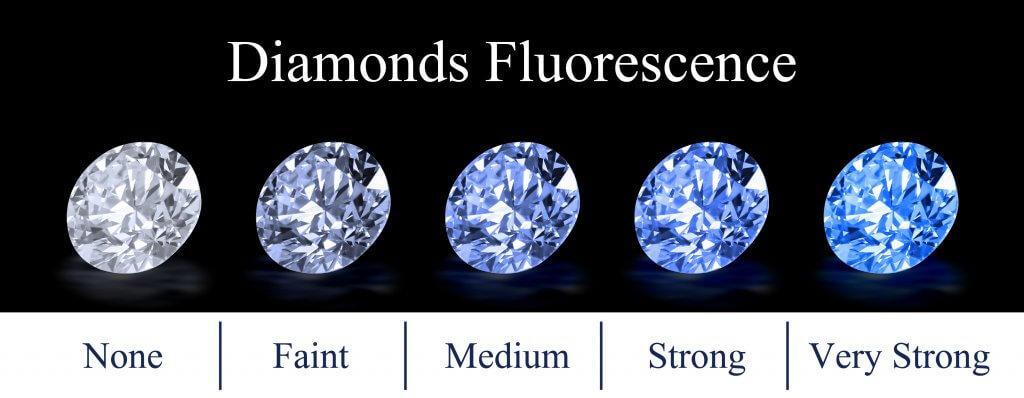
Fluorescence determination, which is done using a special UV light. If any fluorescence is present, the severity is noted based on the grading scale of: none, faint, medium, strong or very strong.
VERIFICATION
Following these steps, the diamond then goes to verification. A second gemologist will then analyze the diamond without knowing what the previous gemologist graded it. This way there is no preconceived judgment on what the diamond will be. If the second gemologist does not come to the same conclusion, then a senior gemologist will insert their analysis and a grade is then given upon consensus.
Proportions and Performance
Proportions - this is where the diamond is measured and analyzed in details on its specs only. Once the gemologist measures every aspect of the diamond, the specs are then entered into a table and it is given a proportion rating. Poor to Excellent.
Performance - After the proportion analysis is complete, the diamond goes to a visual performance test. The "face up appearance". Face-up Appearance is further broken down into visual factors such as Brightness, Fire, and Scintillation (including sub-components such as sparkle and pattern.
Finish - The gemologist then reviews the polish and symmetry(again) and also applies their findings to the table. A higher or lower rating given to polish or symmetry can affect the Final Cut grade given.
PRELIMINARY REPORTING
Once the process described above is completed, an email is sent to the submitter of the diamond with a spreadsheet indicating the analysis of the diamond and all grading aspects. IF the owner does not agree, they are able to challenge the grade and ask for a further review(for a fee of course).
LASER INSCRIPTION
Once the owner of the diamond advises the gia to complete the report process, any diamond under 1 carat will automatically be microscopically laser inscribed with the GIA logo and report number on the girdle. Regarding 1 carat and larger, this request has to be made in writing and there is an additional fee. If the submitter has a special logo, they can request that it be inscribed as well.
PRINTING AND PREPARATION FOR RETURN
Once the owner indicates they are ready for the diamond to be returned with the completed grading, the specialized certificate is printed and the diamond is prepared for return.
DIGITAL POSTING
Once the diamond is returned to the owner, a digital posting online is then activated. This way one can go to the GIA website and enter the GIA number given and verify the report. You may check the details of your report on Gia.edu where you may enter the report number in the "report check" section.
CAN I CHALLENGE THE GRADE IF I DON'T AGREE?
The answer is yes. If you submit a diamond and think it is one grade and you receive a different one, you are able to request a recheck. This recheck does come with a fee.
The diamond will then go through the same anonymous process it originally did. So for example, one may just be challenging the color grade. If that is the case, it will go through the exact same color grading process it went through before. It is completely anonymous, so if the gemologist sees it differently, then the grade will change. If they don't, it will not.
It is our experience that challenging grades and getting them overturned happens on rare occasions. Very often, the grade stays the same. Not to say it doesn't happen, but it is difficult.
The client will be charged for each grade they choose to recheck. This is designed to prevent the submitter of the diamond from repeatedly checking.
Below is an example of a recheck process
Owner thinks the diamond is a 2.07 F VS1
- Diamond is submitted
- GIA determines
- 2.07 carat
- G color
- VS1 clarity
- Excellent Cut
- Email generated with final results to client
- Client submits email request for a color recheck
- Recheck completed and F color determine
- Final grade F - VS1
- The final GIA grade is determined at the end of the inspection process. A report is generated that includes all the information about the diamond's quality and characteristics as well as a diagram of its clarity features and proportions. The report also has security features such as holograms, microprinting, watermarks, QR codes, etc. to prevent tampering or counterfeiting.
THE REALITY
So now let's talk reality. JUST because a certificate says a color and clarity grade does NOT mean it is going to look the same as the other diamond with the same color and clarity. NOPE! NO WAY, NO HOW…. Diamond grading is subjective. You have a group of gemologists grading diamonds and they may not see the same diamond the same way. So how is this solved? Well, more than one gemologist analyzes the diamond. It is multiple people and majority rules.
Example 1:
Gemologist A: G color
Gemologist B: H color
Senior Gemologist- G color
Final Color Grade - G
Example 2:
Gemologist A: G colorless
Gemologist B: G colorless
Final Color Grade - G colorless
Do you think both diamonds will have the EXACT same color in real life? NO! colorless
Explanation of REALITY
You may have one grader who sees a diamond as a G color and the others may see it as an H. But maybe internally they mark it as a high H color. Well, it still gets the H color even though a trained Gemologist saw it otherwise.
Let's take that same H color and compare it to a diamond where one gemologist graded it as an I color and the other internally graded it as a low H. Guess what? It gets an H. Now do you think the "high" H looks the same as the "low" H? Answer + it does not. One looks whiter than the other.
This goes the same for Clarity, CUT GRADE, POLISH, SYMMETRY etc. So when comparing diamonds, take this into account. Below is a perfect example of diamonds where both got the same clarity grade.
*Some links on our site may earn us a small commission at NO EXTRA cost to you, helping us keep our content free*