

Best Time to Buy: Seasonal Pricing Calendar (US)
By Josh Allen, Co-Founder — YourDiamondGuys.com Josh has over 25 years of experience in the global diamond trade, sourcing from Mumbai, Tel Aviv, and Antwerp, and has supplied diamonds to Tiffany, Cartier, Harry Winston, and more.
There is no secret month where diamond pricing suddenly gets easy. That is the myth. What changes is pressure. Deadlines. Noise. Inventory flow. And your odds of making a rushed decision.
That matters more than most people realize.
If you shop when everyone else is in a panic, you feel it.
If you shop when you have time, you see more.
That is the difference.
What "best time" really means
Before you pick a month, pick your priority.
Do you want calm shopping?
Do you want more time to compare?
Do you have a proposal date that cannot move?
Those are not the same thing.
Same budget does not mean the same strategy.
If your deadline is fixed, speed matters.
If it is not, patience usually wins.
The three forces that shape timing
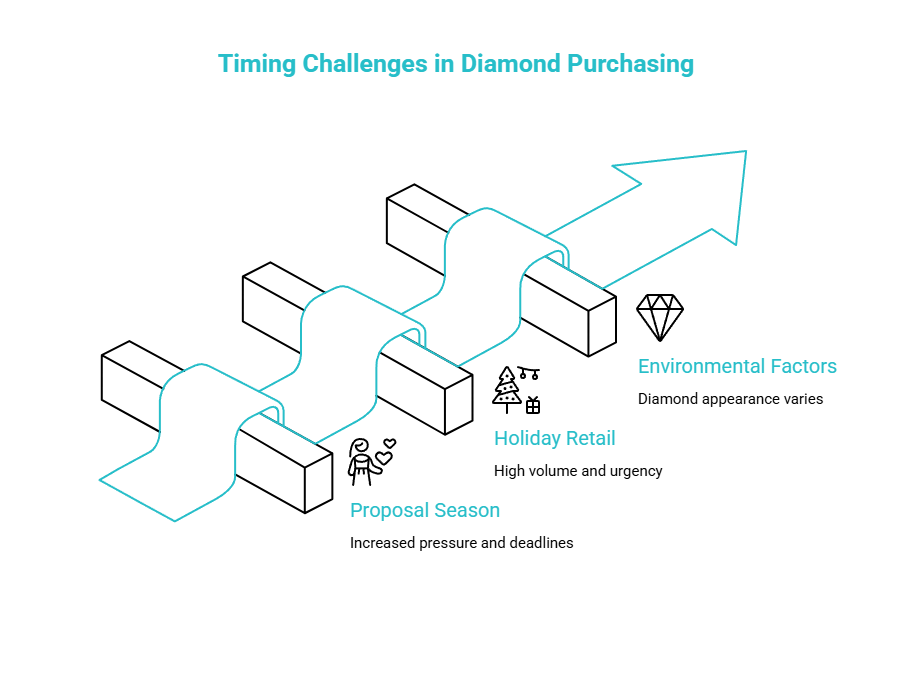
1) Proposal season changes the pressure
In the U.S., proposal activity stacks up late in the year. According to The Knot, about 47% of couples get engaged between November and February.
That does not mean you cannot buy then.
It means more people are shopping with a deadline.
And deadlines make people do dumb things.
2) Holiday retail season gets loud
The holiday window is not subtle. NRF says November and December holiday sales are expected to top $1 trillion in 2025.
That kind of volume creates noise.
More promos. More urgency. More "buy now" language.
Not always better decisions.
3) Diamonds do not look the same in every environment
This is where buyers get hurt.
A diamond can look alive in one setting and flat in another. GIA explains that a diamond's appearance changes with the light and the environment you are in.
So no, timing is not just about price.
It is also about giving yourself enough room to verify how the stone actually performs.
The seasonal pricing calendar
Use this as a planning tool.
Not a promise.
January
Good month to slow down.
The holiday rush is behind you.
Build a shortlist.
Compare videos. Compare measurements. Compare actual make.
February
Still workable.
But if your proposal is close, do not play games.
Prioritize verification.
Get the diamond checked.
Know the return window.
March
One of my favorite months for clean comparisons.
Less emotional noise.
More room to think.
April
Good for narrowing.
You should know your non-negotiables by now.
Shape. Budget. Spread. Eye-clean threshold.
May
Doable.
Just do not leave the setting to the last second.
That is how avoidable stress starts.
June
Solid month if you want guidance and time.
No reason to rush.
July
Good research month.
Ask for better visuals.
Push for clear side views.
Check the measurements twice.
August
Very similar to July.
If you want a fall proposal, this is where I would start tightening the list.
September
Time to get serious.
If you want the ring finished before the year-end rush, stop browsing and start deciding.
October
Last clean setup before the busiest stretch.
Good month to finalize.
Bad month to drift.
November
Pressure goes up.
Not because every diamond gets worse.
Because the clock gets louder.
December
This is the deadline month.
You can still buy well.
But you need buffers.
Shipping. Inspection. Setting. Pickup.
Everything needs room.
How to use this table the right way
Do not ask, "What month is cheapest?"
Wrong question.
Ask this instead.
When will I have enough time to compare stones without forcing a yes?
That is the month you want.
Because same lab report does not mean the same diamond.
And same carat does not mean the same face-up size.
Buying for a proposal date
If your proposal date is fixed, work backward.
Start with the day you need the ring in hand.
Then add buffer.
Then add more buffer.
You are not just buying a diamond.
You are buying time to inspect it.
Time to set it.
Time to fix a problem if something is off.
That matters even more during peak retail windows. Mastercard SpendingPulse reported U.S. retail sales rose 3.9% year over year from November 1 through December 21, 2025.
Busy retail periods do one thing really well.
They make every deadline feel tighter.
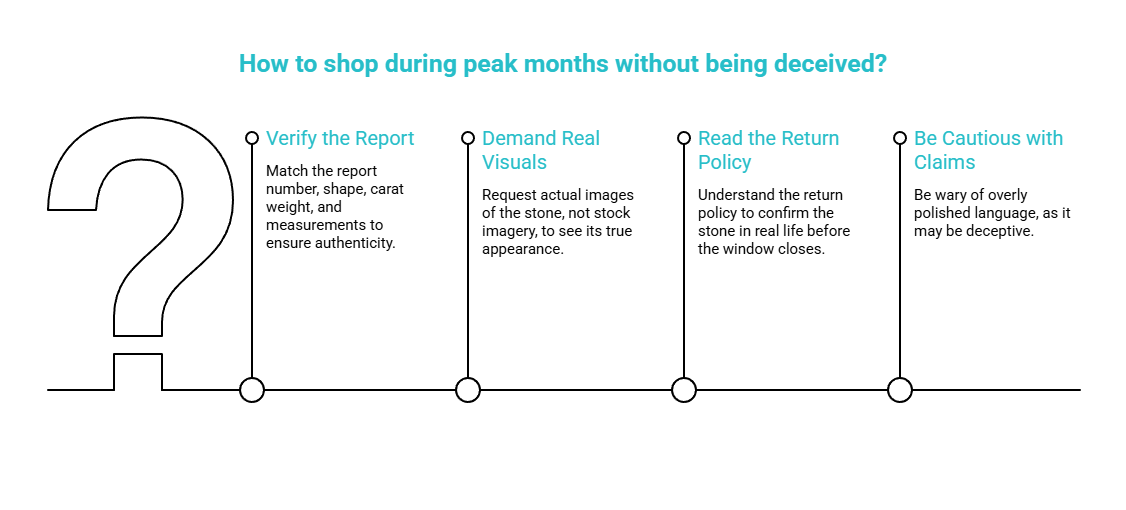
How to shop peak months without getting played
You do not need to know everything.
You need a filter.
Verify the report matches the stone
Match the report number.
Check the shape.
Check the carat weight.
Check the measurements.
If something feels soft, stop.
Demand real visuals
A cert filters.
It does not finish the job.
You want the exact stone.
Not stock imagery.
Not flattering lighting.
The exact diamond.
Read the return policy before you pay
You want room to confirm the stone in real life.
Not after the window closes.
Be careful with strong claims
If the language feels too polished, slow down. The FTC Jewelry Guides exist to help marketers avoid claims that are unfair or deceptive.
That should tell you everything.
Natural vs. lab-grown timing
The calendar pressure is similar.
Proposal season is still proposal season.
Holiday pressure is still holiday pressure.
The better question is not natural or lab.
It is this.
Does the diamond perform?
Do the visuals back up the paper?
Would you still want it in normal light?
That is the filter.
The simple checklist
Pick the version that sounds like your real life.
I want less pressure
Shop before you need to.
Not when you are cornered.
I want more choice
Start early.
Tighten later.
I have a fixed proposal date
Work backward.
Protect the buffer.
I am deciding between natural and lab-grown
Use the same standards.
Paper. Visuals. Performance. Return terms.
Free Diamond Consultation
If the numbers are close and your gut is not settled, trust that feeling.
That usually means the paper looks fine, but the make is not.
That is exactly what we look for.
Book your Free Diamond Consultation
Questions? Reach out directly for a free consultation, or drop them in the Diamond Buyers Academy community — Rob and I answer personally.
Frequently Asked Questions
*Some links on our site may earn us a small commission at NO EXTRA cost to you, helping us keep our content free*