
Live Chat
Search

We Don’t Sell Diamonds. We Help You Choose the Right One.

Free expert guidance by email or video chat.

No pressure, No sales pitch. Just honest help from diamond experts.

Cut Premium vs the 'Steep/Deep Discount' Trap

cut premium vs the steep deep discount trap

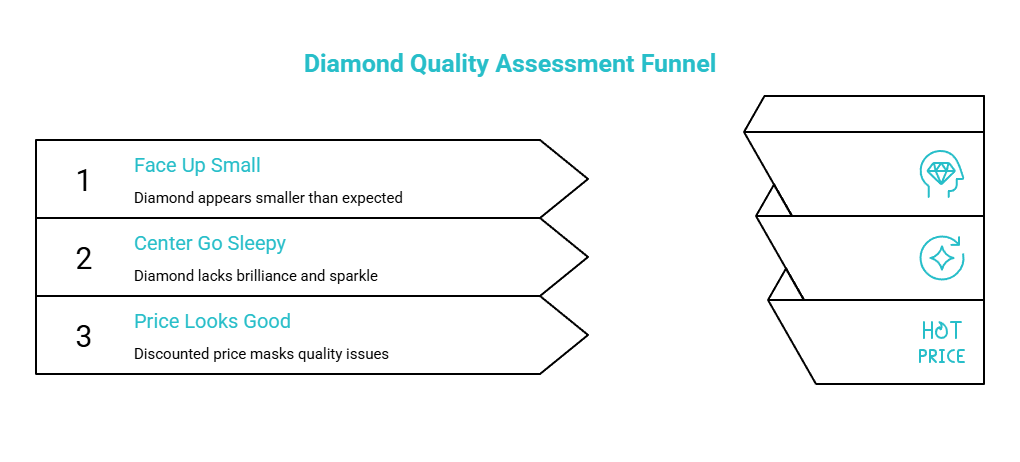
If you have ever seen two round diamonds with the same carat weight look completely different in person, you have already met the cut premium.

One diamond looks crisp, bright, and full of life. The other looks darker in the center, smaller than it should, or just a little sleepy. The price difference is rarely random. It is often cut—and it's one of the biggest drivers of Diamond Pricing.

This page shows you when paying more for cut makes sense, when it does not, and how to spot the steep/deep discount trap under normal store lighting.


The simple idea: why cut quality can cost more and still be worth it

Cut is not the same thing as shape. A round brilliant is the shape. Cut quality is how well that round is proportioned and finished so it handles light.

GIA describes cut as a mix of measured proportions and visual appearance factors like brightness, fire, and scintillation, and explains that cut grade is determined from multiple measured parameters plus observations, not a single number. GIA cut grade chart PDF


Why some diamonds get discounted: they look smaller and leak light

Discounted round diamonds often carry extra depth or awkward angle combinations. That can create two common outcomes:

  1. Less light returning to your eye, which can look like dull zones or a darker center.
  2. Less spread, meaning the diamond can face up smaller for the same carat weight.

What "steep/deep" means in shopper terms

Shoppers use "steep/deep" as a warning label for proportions that do not play nicely together.

In practical terms, it usually means the diamond's crown and pavilion geometry pushes light out the bottom or sides instead of sending it back up through the top.


The core problem: angles and depth stop light from returning to your eye

The most helpful way to think about steep/deep is this: light goes in, then it either returns to your eyes or it escapes. When main facet angles do not work together, the escape part grows.

This "return vs escape" concept is exactly what leakage tools are built to show. PriceScope explains that, depending on the main facet angles, light will either reflect back to the viewer as brightness or escape through the bottom as leakage. PriceScope Ideal-Scope guide


Why the price looks tempting: you are often paying for weight you cannot see

A deep diamond can carry weight in the bottom. On a listing, the carat looks impressive. On a hand, the diameter can look underwhelming.

That is why "discount" can be a trap: you may be paying for weight that does not show up as visual size or beauty.


GIA Excellent vs AGS Ideal: what they capture and what they miss

gia excellent vs ags ideal what they capture and what they miss visual selection

You asked for a round-brilliant focused, report-friendly way to shop. Here is the cleanest framework.


What GIA Excellent is designed to represent

GIA's system for standard round brilliants assigns a cut grade from Excellent to Poor and bases that grade on a combination of proportions, craftsmanship, and face-up appearance factors, with the overall cut grade driven by the lowest scoring component in the system (GIA cut grade chart PDF).

In plain language: "Excellent" is a strong starting point for most round shoppers, but it is still a range.


What AGS Ideal adds: a light performance lens

AGS built its Light Performance system to help separate poorly cut diamonds from those cut to strong proportions and high accuracy, and it has long centered consumer protection and education in that work. American Gem Society on Light Performance


Why two "great on paper" diamonds can look different

Two diamonds can sit under the same report category and still show different personality in real lighting.

That is why performance visuals matter. In the trade press, the AGS light performance approach is described as tracing virtual rays of light from a 3D scan to assess brightness, fire, contrast, and overall appearance. National Jeweler on AGS Light Performance


The balanced rule: when paying the cut premium makes sense

A rigid rule like "always pay top dollar for cut" sounds safe, but it can also waste budget.

A better approach is a threshold rule.


The threshold approach

  1. Get into the top cut neighborhood first (for rounds, that typically means staying in the high end of the grading ecosystem you trust).
  2. Once you are there, shop for value in the other areas that do not change the diamond's life as much day to day.

This matches what GIA's system is built to do: guide consumers toward commonly preferred appearances while reminding shoppers that diamonds can look different in different lighting and should be viewed in more than one environment (GIA cut grade chart PDF).


When the cut premium is usually worth it

Pay more for cut when:

  1. You are choosing between similar carat and color options and one clearly looks brighter.
  2. You want a round diamond that looks lively in both spotlight and softer lighting.
  3. The price jump buys you visible improvement, not just nicer words.

When the cut premium can be wasted

Spend less on cut when:

  1. The stone is already performing beautifully to your eye, and the extra cost does not change what you see.
  2. You are sacrificing too much size or clarity for tiny visual gains.

Red-flag patterns that show up in "discount" stones

You do not need to memorize every number. You do need to recognize patterns.


Pattern 1: too deep, faces up small

If a round diamond looks smaller than other stones of the same carat, it is often carrying extra depth.


Pattern 2: a center that goes dark or stays dark when you move it

A round diamond should not look like it has a permanent shadow in the middle under regular lighting. If that center stays dark as you tilt, it can signal leakage.


Pattern 3: "great carat for the price" but the sparkle feels uneven

Uneven brightness is a common sign that the geometry is not returning light consistently.


How to spot leakage in-store (no special equipment required)

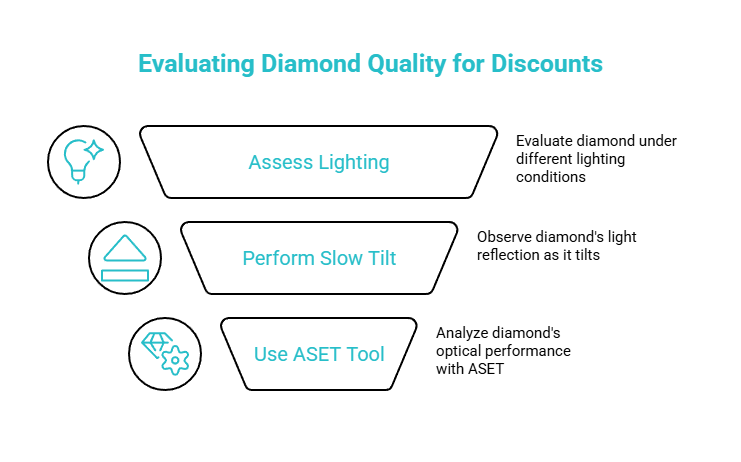
Store lighting can be flattering. The goal is to see how the diamond behaves when the light is less dramatic.


The quick lighting test

Ask to see the diamond in at least two lighting types:

  1. Bright overhead spotlights (most jewelry counters)
  2. Softer, diffuse light (step a few feet away from the brightest area, or ask to view near a more neutral space)

A diamond that only looks great in spotlights, but looks quiet in softer light, is often a cut value issue.


The tilt test

Hold the diamond face-up and tilt it slowly side to side.

  1. A strong performer keeps a lively pattern as it moves.
  2. A leaky stone can show larger areas that go gray or dark and do not recover quickly.

If a jeweler has an ASET viewer

ASET is designed to show optical symmetry and light-handling ability by color-coding what is seen through the viewer, and JCK described it as a device used to assess optical performance in faceted diamonds. JCK on ASET

If an ASET image shows big areas of weak return in the face-up view, treat that as a reason to slow down, even if the price is attractive.


When a discount is justified (and you can feel good taking it)

when a discount is justified and you can feel good taking it visual selection

Not every discount is a warning sign.

A discount can be fair when:

  1. The diamond gives up a small amount of performance that you genuinely cannot see without special tools.
  2. The stone looks bright and balanced in both spotlight and softer lighting.
  3. The value is coming from a minor tradeoff, not from a performance gap.

This is also where the GIA Excellent plus strong visuals or an AGS-style light performance view can work together: you are using the report as a filter, then letting your eyes confirm.


Natural vs lab-grown: the cut rules stay the same

Whether a diamond is natural or lab-grown, cut still controls how it handles light.

If you are comparing a natural and a lab-grown round side by side, the cut guidance in this page still applies. The category changes, but leakage still looks like leakage.


Quick buying rules (screenshot table)

Use this as a fast decision aid while you shop.

SituationRecommendationWhy it matters
Round diamond looks bright in both spotlight and softer lightingBUYReal-world performance shows up across lighting types
Big discount, but diamond faces up small for the caratAVOIDYou may be buying hidden depth instead of visible size
"Great deal" but center stays dark during the tilt testAVOIDPersistent darkness often tracks with light loss
GIA Excellent or similar top tier report, plus strong in-store behaviorBUYReport filter plus eye test is a strong combination
You love the look, but a higher cut tier costs a lot more with no visible gainMAYBEA premium only makes sense when you can see the improvement

Wrap-up and next step

The cut premium is not a luxury tax. It is often the difference between a diamond that stays bright in daily life and one that only shines under jewelry store spotlights.

Your safest path is simple: use a strong report framework for round brilliants, then confirm performance with a quick lighting check and a slow tilt.

If you want a second opinion before you commit, you can book a consult here: Diamond Consultation

Frequently Asked Questions

In shopper language, it is a warning that the diamond's proportions may not return light efficiently. If the stone looks darker in parts of the face-up view or seems small for its carat weight, treat the low price as a reason to test performance in person. Steep/deep proportions often mean the diamond is cut to retain weight rather than optimize light return.

Yes, because 'Excellent' is a range and two diamonds with the same label can look different. Use the report as a first filter, then confirm in-store with softer lighting and a tilt test. Some GIA Excellent diamonds perform significantly better than others depending on where they fall within the excellent range.

The biggest drivers are the ones that control how light enters, reflects, and returns, which is why angle and depth relationships matter more than chasing a single 'perfect' number. If the diamond looks balanced and bright across lighting types, you are usually in the right zone. Focus on how table, depth, crown angle, and pavilion angle work together.

See the diamond away from the strongest spotlights, then tilt it slowly. If large areas go gray or dark and do not recover quickly as it moves, that is a red flag. A strong performer maintains brightness and pattern even as you tilt it in softer lighting conditions.

Not always. Paying more makes sense up to the point where the diamond's performance is already excellent to your eye, and the next price jump does not change what you see day to day. The threshold approach—get into the top cut neighborhood first, then optimize other factors—usually delivers the best balance of beauty and value.

*Some links on our site may earn us a small commission at NO EXTRA cost to you, helping us keep our content free*