

Wholesale vs 'Dealer Cost' Myths
By Josh Allen, Co-Founder — YourDiamondGuys.com Josh has over 25 years of experience in the global diamond trade, sourcing from Mumbai, Tel Aviv, and Antwerp, and has supplied diamonds to Tiffany, Cartier, Harry Winston, and more.
Most people think a trade-sounding label means they found the real number. They didn't. And diamond pricing gets clearer the minute you stop chasing insider language and start checking what is actually being sold.
If you have spent any time shopping online, you have seen the usual lines. Wholesale. Dealer cost. Direct pricing. Below market. Insider access.
Sounds good. Usually means very little.
What "wholesale" actually means
Wholesale is a channel. Not a magic price.
The FTC's Jewelry Guides exist to help people get accurate information when shopping for jewelry, and they make clear that sellers across the trade cannot lean on misleading claims.
So when a seller says "wholesale," do not treat that like proof of a bargain. Treat it like a label that still needs proof behind it.
Better questions are simpler. Can you verify the stone? Can you verify the listing? Can you return it if it shows up soft?
That is the real test.
Why "dealer cost" usually tells you nothing
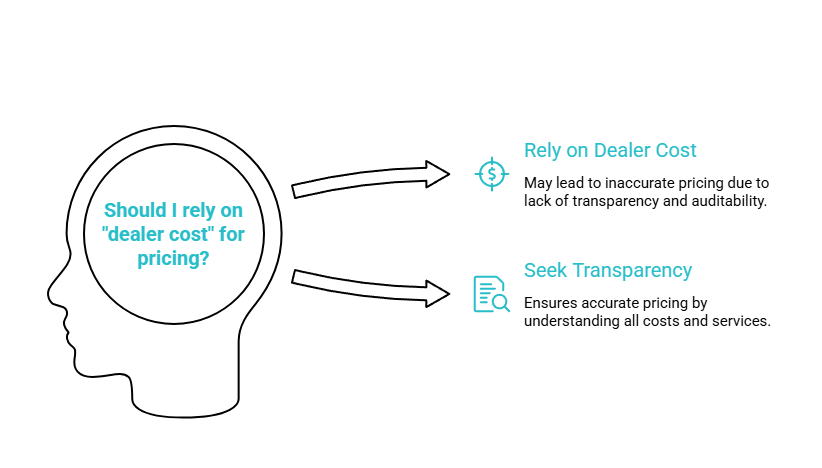
"Dealer cost" sounds precise. Most of the time, it isn't.
You usually cannot audit the benchmark. You do not know whose cost is being referenced. You do not know what services are included. You do not know if the comparison is current.
Same phrase. Very different meaning.
That is why this line should never carry the decision by itself. If the seller cannot prove the stone, the label does not matter.
Why the same diamond can show up at different prices
This part throws people. It should not.
The same report number can appear in more than one place because access and ownership are not always the same thing. Rapaport explains that much of the jewelry trade relies on memo, which is the industry's version of consignment.
That matters.
Because one seller may have actually reviewed the stone. Another may just be passing through shared inventory. One may help you avoid a weak performer. Another may leave you to figure that out after it arrives.
Same report. Not the same buying experience.
The mistake people make when they compare prices
They compare tags. Not diamonds.
That is backwards.
Your baseline starts with the grading report. GIA says the trade uses a systematic way to evaluate diamonds through cut, color, clarity, and carat weight so stones can be compared consistently.
That does not mean every diamond with similar broad grades is equal. It means you finally have a place to start.
Then you look at what still changes the buy:
- Exact measurements
- Actual media of that stone
- Whether anyone screened it
- Return terms
- Seller accountability
That is where the real spread shows up.
Four myths that keep buyers stuck
Myth 1: "Wholesale to the public" means automatic savings
Not always. It may only mean the seller has trade access. That is useful. It is not proof the diamond is well-vetted or fairly priced.
Myth 2: "Dealer cost" is a verified benchmark
Usually, no. It is often just an anchor. A way to make the asking price feel safer than it is.
Myth 3: An appraisal proves you got a great deal
Wrong document. Wrong job.
Jewelers of America says an appraisal is a snapshot in time, commonly used for insurance purposes. That does not make it a shortcut that proves the purchase price was fair.
Myth 4: If the report matches, every offer is basically the same
Not even close.
Paper can match. Seller can still be wildly different.
Screening matters. Communication matters. Return support matters. Those things are part of value whether you notice them up front or not.
How to judge fair value without pretending you know dealer cost
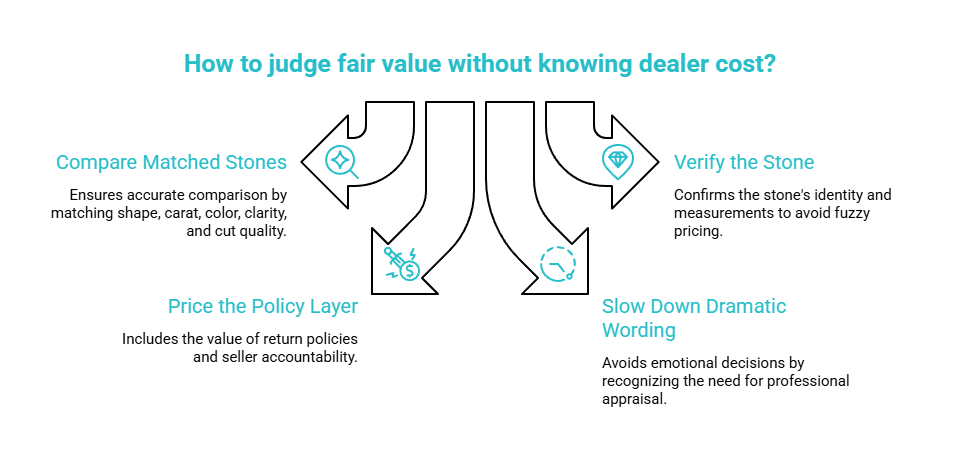
You do not need insider access. You need a process.
1) Compare matched stones
Same shape. Similar carat. Similar color. Similar clarity. Similar cut quality.
No lazy averages. No broad bucket comparisons.
2) Verify the stone, not the pitch
Ask for the report number. Check the measurements. Make sure the media is for the exact diamond. If that part is fuzzy, your pricing comparison is fuzzy too.
3) Price the policy layer in too
Return policy is not fluff. Responsiveness is not fluff. Seller accountability is not fluff.
A cleaner process has value. Less downside has value. That is part of the buy.
4) Slow down when the wording gets dramatic
This is where people save themselves. The American Gem Society says jewelry appraisals are specialized valuation documents that should be prepared by credentialed professionals. That is another reminder that diamond value is context. Not a magic number pulled from a sales label.
Questions worth asking any seller using "dealer cost" language
Send these before you buy:
- Can you confirm the grading report number?
- Do the measurements on the listing match the report?
- Do you have current video of the exact diamond?
- Has anyone reviewed this stone beyond the report?
- What is the return window?
- Who covers shipping if it goes back?
- What happens if the diamond does not match the description?
Those answers tell you more than any badge ever will.
Free Diamond Consultation
If the numbers still do not add up, trust that feeling. It usually means something in the listing is soft.
Bring us the diamond. Bring us the report. Bring us the price claim. We will tell you what is real, what is noise, and whether the stone is actually worth your money.
Book your Free Diamond Consultation
Questions? Reach out directly for a free consultation, or drop them in the Diamond Buyers Academy community — Rob and I answer personally.
Frequently Asked Questions
*Some links on our site may earn us a small commission at NO EXTRA cost to you, helping us keep our content free*