Environmental Claims for Lab Diamonds: What Buyers Should Trust
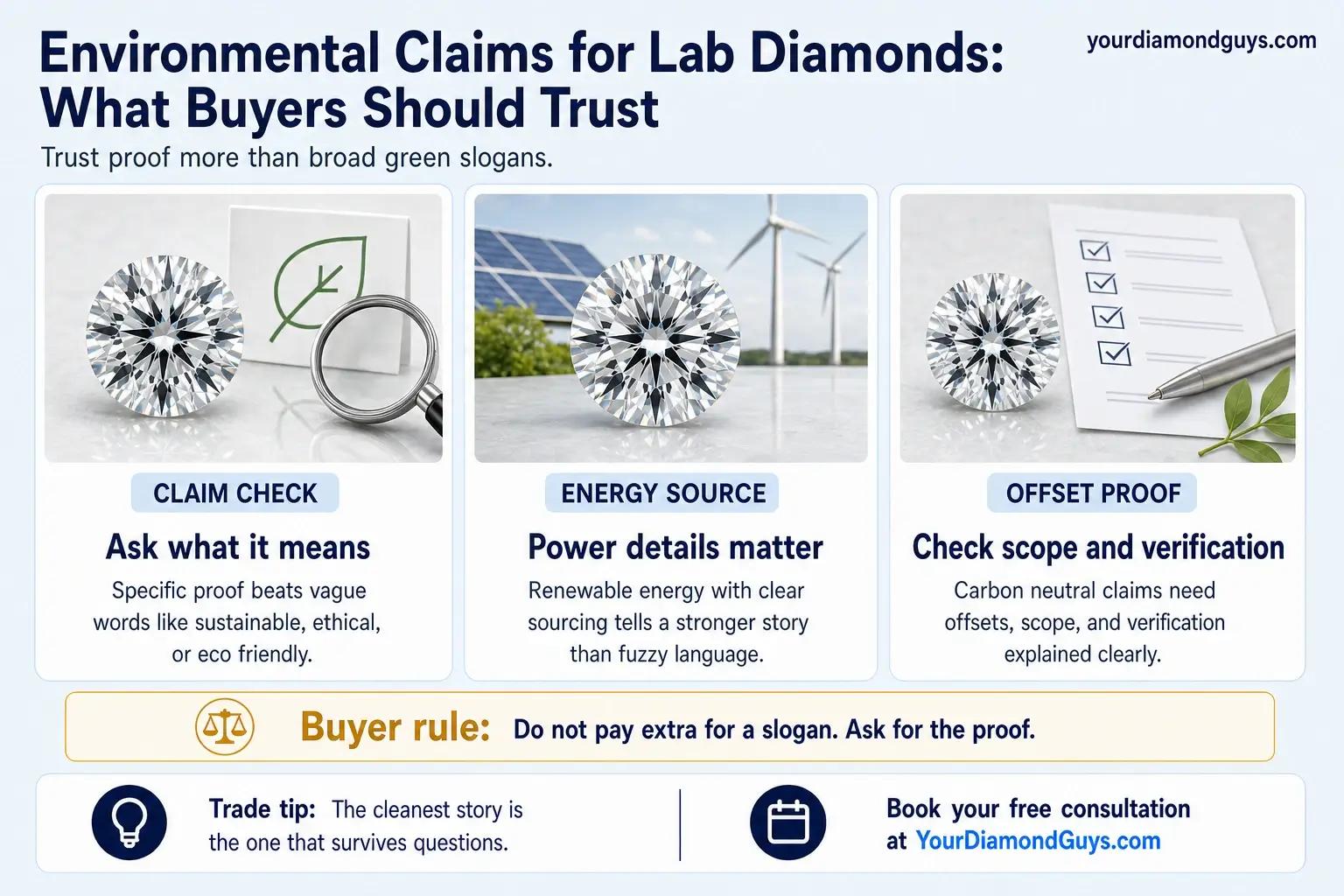
Do not pay extra for a slogan. Ask for the proof.
By Josh Allen, Co-Founder of YourDiamondGuys.com. Fifth generation diamantaire with 30+ years in the global diamond trade. Former supplier to Tiffany & Co., Cartier, and Harry Winston.
Lab diamond environmental claims deserve proof because clean marketing language does not tell you the energy source, production details, offsets, or disclosure quality.
That is the fair position.
You do not need a moral argument to buy a diamond. You need clear claims, honest limits, and enough proof to know what you are supporting.
The Fast Buyer Answer
Trust specific claims more than broad slogans.
Renewable energy claim with details beats eco friendly language with no proof. A clear supplier disclosure beats a vague green badge. A careful explanation beats a perfect sounding headline.
What Lab Diamond Marketing Gets Right
Lab grown diamonds do not require mining a new natural diamond from the earth.
That matters to many buyers.
It can also make lab grown feel simpler than it is. Growing diamonds still uses energy, equipment, transport, cutting, grading, setting, and shipping.
The question is not whether lab grown has no footprint.
The question is what footprint the seller can actually explain.
What To Ask About Energy
Energy source matters.
A lab using renewable energy tells a different story than a lab using electricity without clear sourcing details. Offsets can also enter the conversation, but offsets are not the same as directly powered production.
Ask for specifics.
If the answer stays fuzzy, treat the claim as marketing.
Claim Check Table
| Claim | Better Proof |
|---|---|
| Sustainable | Explain what makes it sustainable |
| Eco friendly | Show energy source and production details |
| Carbon neutral | Explain offsets, scope, and verification |
| Ethical | Explain labor, sourcing, and supply chain standards |
| Better than mined | Explain the comparison being made |
The words are easy.
The details are where trust starts.
Do Not Turn It Into A Slogan War
Lab grown and natural diamonds have different stories.
A natural diamond buyer can value rarity, geology, and long term value. A lab grown buyer can value size, price, and avoiding new mining. Both buyers deserve honest information.
This page is not here to shame either choice.
It is here to keep the claims clean.
How Production Connects To The Claim
If a seller talks about lab grown sustainability, they should be able to explain how the diamonds are made, where the energy comes from, what they measure, and what they do not measure.
The plain process starts in how lab grown diamonds are made.
Policy Still Matters
An environmental claim does not protect your purchase.
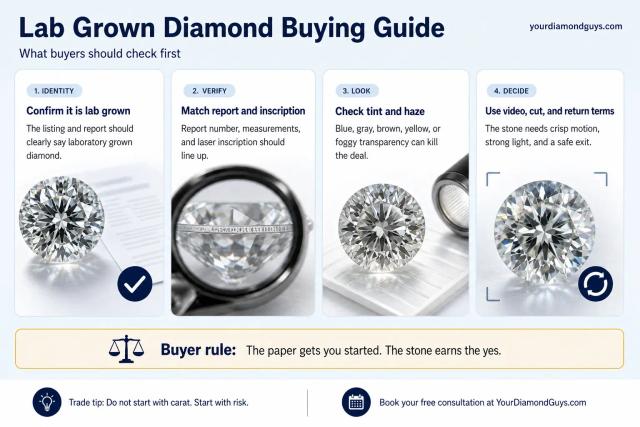
You still need the report, inscription, video, return window, warranty terms, and service details.
Use the return policy and warranty checklist before you pay.
Trade Insider Moment
In the diamond business, the cleanest story is the one that survives questions.
If a seller can explain the claim in plain language, good. If every answer turns into fog, I get less comfortable.
That is true for grading, pricing, and sustainability.
My Buyer Recommendation
Buy the diamond that fits your values and your budget, but do not pay extra for a slogan.
Ask for specific proof. Compare the claim to the actual report, seller policy, and stone quality. If the claim is important to you, make it part of the buying criteria before you fall in love with the setting.
What To Ask Before Buying
- What environmental claim are you making?
- What energy source supports the claim?
- Are offsets involved?
- Who verifies the claim?
- What parts of the supply chain are included?
- What parts are not included?
Book your free consultation if you want help comparing the diamond decision, not just the marketing.
Where I Would Compare Claims And Listings
Use these sites as comparison tools, not automatic recommendations. For claim and listing comparison, I would review similar lab diamonds on Brilliant Earth and Ritani, then separate the marketing language from the report, video, and return terms.
Lab-Grown vs Natural Diamonds: Why One Costs Thousands More Despite Looking Identical
Questions? Reach out directly for a free consultation, or drop them in the Diamond Buyers Academy community — Rob and Josh answer personally.
Questions Buyers Ask Us
Related Lab Grown Diamond Guides
Keep the full buying path close. These are the next checks that usually affect this decision.
*Some links on our site may earn us a small commission at NO EXTRA cost to you, helping us keep our content free*