Lab Grown Resale and Upgrade Expectations
Expect personal value and visual value, not strong resale.
By Josh Allen, Co-Founder of YourDiamondGuys.com. Fifth generation diamantaire with 30+ years in the global diamond trade. Former supplier to Tiffany & Co., Cartier, and Harry Winston.
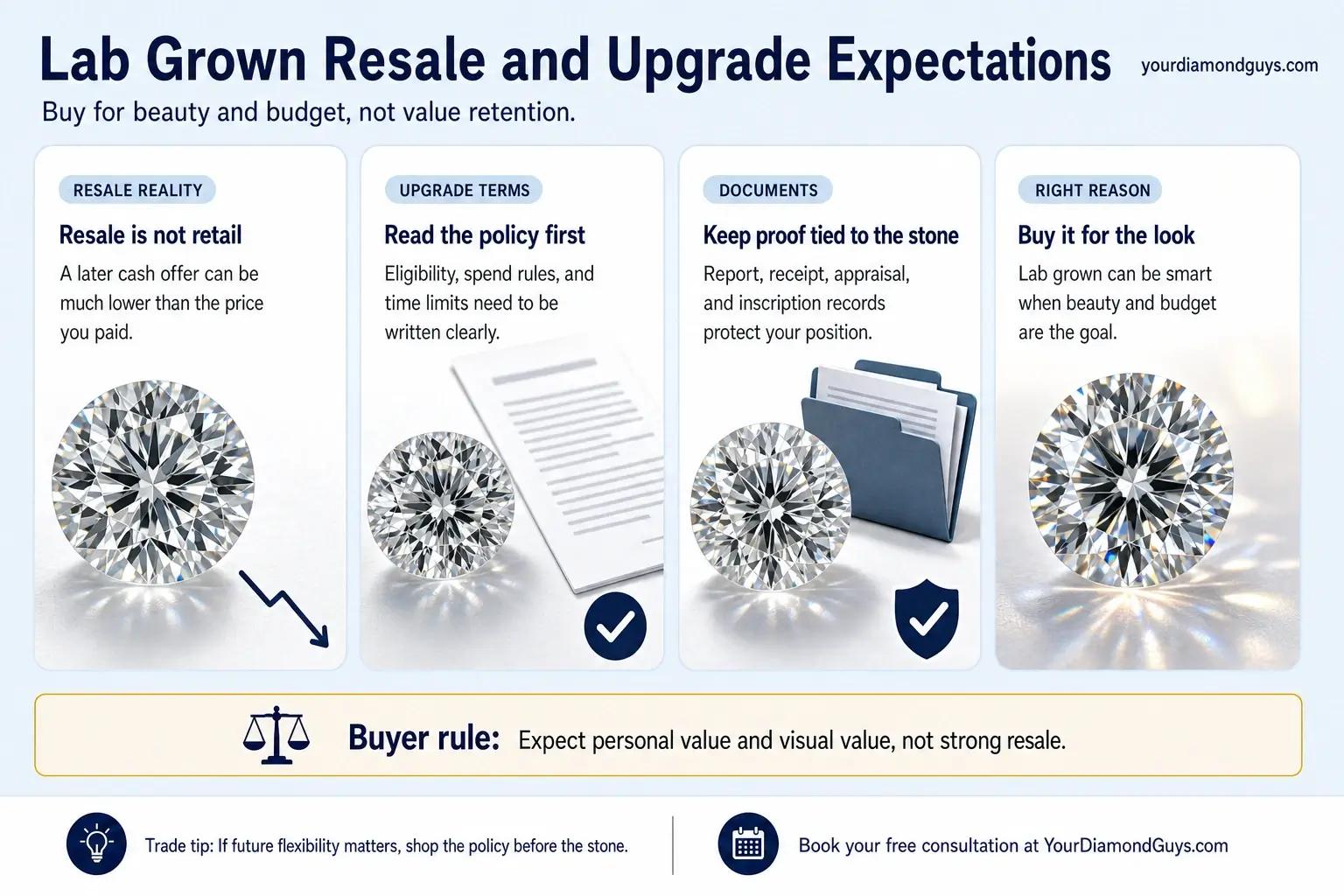
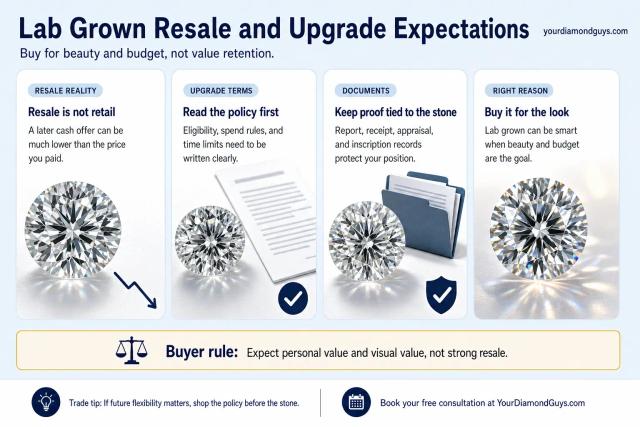
Lab grown diamond resale value is usually not the reason to buy one. Buy lab grown for look, size, and budget control, not as a store of value.
That does not make lab grown a bad purchase.
It makes expectations important.
If you go in thinking you can easily resell it later for close to what you paid, you are setting yourself up for disappointment.
The Fast Buyer Answer
Lab grown diamonds can be a smart engagement ring choice when you value beauty for the money.
They are weaker when the goal is resale, trade value, or long term value retention.
That is the honest frame.
For natural diamonds, rarity supports a different value conversation. For lab grown, supply and production keep changing the market.
Resale Is Not Retail
The price you pay from a retailer is not the price another buyer, jeweler, or trade source will offer later.
That gap exists with many jewelry purchases, but lab grown diamonds tend to face a tougher resale conversation because new lab diamonds are widely available.
Do not confuse retail listing price with cash resale value.
Upgrade Policies Matter More
If future flexibility matters, shop the policy before you shop the stone.
Some sellers offer upgrade programs. Some offer trade in terms. Some offer buyback language. Some offer very little.
The promise is only useful when the details are clear.
Use the return policy and warranty checklist before you pay.
What To Get In Writing
| Policy Detail | Why It Matters |
|---|---|
| Upgrade eligibility | Shows whether your stone qualifies later |
| Minimum spend | Can make the upgrade harder than it sounds |
| Original documentation | Protects your proof |
| Condition rules | Explains what voids the offer |
| Setting rules | Shows whether the diamond or ring is covered |
| Time limits | Prevents surprises later |
If it is not written, do not build your plan around it.
Documentation Helps
Keep the report, receipt, appraisal, insurance paperwork, setting details, and any policy language.
That does not guarantee strong resale.
It does make your position cleaner if you need service, insurance, trade in, or a future upgrade conversation.
The laser inscription verification guide helps keep identity proof clean from the start.
How This Fits An Engagement Ring
For many couples, lab grown makes sense because the ring looks bigger or cleaner for the budget.
That is a real benefit.
Just separate emotional value from resale value. The ring can be meaningful without being a financial asset.
The lab grown engagement ring guide helps with that buying decision.
Trade Insider Moment
In the trade, value is not only what someone paid.
Value is what the next buyer can replace it for today. With lab grown diamonds, that replacement number can move quickly, so resale expectations need to stay grounded.
That is not anti lab grown.
That is honest math.
My Buyer Recommendation
Buy lab grown when you love the look and the budget story.
Do not buy it because someone made resale sound easy.
If future flexibility matters, choose a seller with clear upgrade terms and keep every document tied to the stone.
What To Ask Before Buying
- Do you offer a lab grown diamond upgrade policy?
- What spend is required to upgrade?
- Does the policy apply to loose diamonds, finished rings, or both?
- What documentation do I need later?
- Is there any buyback or trade in option?
- What happens if the ring is resized, repaired, or reset?
Reach out to Rob or me at YourDiamondGuys.com if you want help reading the fine print before buying.
Where I Would Compare Live Market Reality
Use these sites as comparison tools, not automatic recommendations. For live market context, I would compare similar lab grown listings on Ritani and Blue Nile, then treat resale value as the weak part of the plan.
Lab-Grown vs Natural Diamonds: Why One Costs More
Questions? Reach out directly for a free consultation, or drop them in the Diamond Buyers Academy community — Rob and Josh answer personally.
Questions Buyers Ask Us
Related Lab Grown Diamond Guides
Keep the full buying path close. These are the next checks that usually affect this decision.
*Some links on our site may earn us a small commission at NO EXTRA cost to you, helping us keep our content free*