Brilliance vs Fire vs Scintillation in Diamonds
By Josh Allen, Co-Founder of YourDiamondGuys.com. Fifth generation diamantaire with 30+ years in the global diamond trade. Former supplier to Tiffany & Co., Cartier, and Harry Winston.
Quick answer, brilliance vs fire vs scintillation means white brightness, rainbow color, and movement, and the best diamond balances all three in the style your eye actually likes.
Most buyers use one word for everything a diamond does. Sparkle. That word hides the real decision. Brilliance, fire, and scintillation are different effects, and a strong cut has to control all three.
I always start with GIA for natural diamonds. Not because the cut grade alone is enough, but because GIA gives me proportions I can actually trust. Softer lab reports do not give me the same confidence in those numbers.
I have seen buyers choose the louder stone in jewelry store lighting and regret it later. A diamond can throw a dramatic flash under spotlights and still look unbalanced in normal rooms.
The Three Sparkle Traits
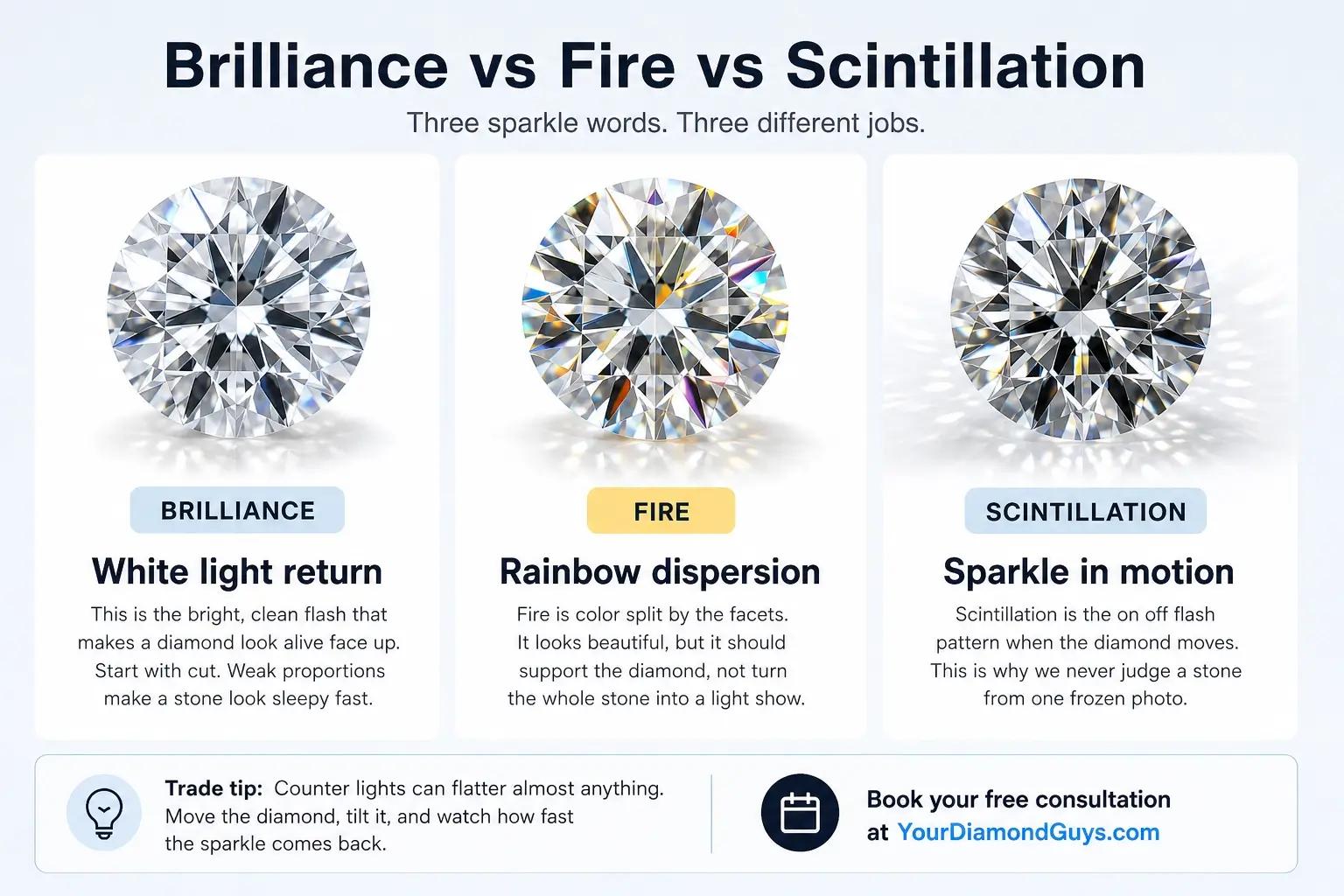
Brilliance is white light return. Fire is colored light. Scintillation is the on and off sparkle pattern you see when the diamond, the light, or your eye moves.
A stone can be bright without throwing much rainbow color. A stone can show fire but still have weak movement. The best diamonds have balance.
| Trait | What You See | What Usually Affects It |
|---|---|---|
| Brilliance | White brightness across the diamond | Light return, table, depth, pavilion angle |
| Fire | Rainbow flashes | Crown height, table size, lighting |
| Scintillation | Sparkle movement and contrast | Facet pattern, symmetry, obstruction, lighting |
Why Cut Changes The Look
Cut proportions decide how light is split, reflected, and returned. This is why two GIA Excellent diamonds can look different next to each other.
For round brilliants, my starting screen is table 56 to 58 percent, depth 60 to 62.4 percent, crown angle 34 to 35 degrees, pavilion angle 40.6 to 41 degrees, Excellent polish, Excellent symmetry, and none to faint fluorescence.
In the trade, a bright 60/60 style diamond can appeal to a buyer who wants a white light look. A smaller table with a higher crown can create more fire. Neither label matters unless the actual stone performs.
How To Choose Your Sparkle Style
Do not choose by vocabulary. Choose by what your eye prefers.
A buyer who wants a crisp, lively round should favor balanced proportions and clean contrast. A buyer who loves rainbow flashes should pay close attention to crown angle and table size. A buyer choosing cushions, radiants, pears, or ovals must look at the facet pattern in video.
- Choose balanced rounds when you want reliable brightness and movement.
- Choose fire friendly proportions when rainbow flashes matter most.
- Choose chunky fancy shape patterns when broad flashes matter more than crushed ice texture.
- Avoid stones that only look alive under spotlighting.
Lighting Can Fool You
Jewelry stores use lighting that makes almost every diamond look better. That does not mean every diamond will perform in daylight, office lighting, or at dinner.
When I review a stone, I want to see whether the diamond still has life outside perfect lighting. That is where weak cut or light leakage shows up.
Reach out to Rob or me at YourDiamondGuys.com, or book your free consultation. We will look at the actual stone with you. No sales pitch.
Where Sparkle Terms Get Expensive
Use these definitions when comparing the look of two stones. One buyer can prefer bold white brightness. Another can want more rainbow fire. The right diamond is the one with strong performance in the style the buyer actually likes.
Mistakes I Would Skip
- Do not use the word sparkle as if every visual effect is the same.
- Do not choose fire at the expense of overall light return unless that is your clear preference.
- Do not judge scintillation from a still photo.
- Do not compare stones under lighting that makes one look artificially better.
Sparkle Style Example
A buyer compares two round diamonds. One is very bright with strong white light. The other throws more rainbow flashes under certain lighting. Both can be well cut, but they do not have the same personality. This is where the buyer's eye matters. I can explain the tradeoff, but the right choice is the one that performs well in the style the buyer actually wants.
Questions I Ask Before Choosing Sparkle Style
- Does this diamond favor brilliance, fire, or fast scintillation?
- Can I compare videos under the same lighting?
- Do the proportions explain the visual style?
- Does the diamond still perform outside spotlighting?
Where I Would Compare Sparkle Videos
Use these sites as comparison tools, not automatic recommendations. I would review live videos on Brilliant Earth and Blue Nile, then judge the actual diamond by movement, brightness, report details, and price. The stone has to earn it.
Why Some Diamonds Sparkle More: Brilliance, Fire & Scintillation Explained
Questions? Reach out directly for a free consultation, or drop them in the Diamond Buyers Academy community — Rob and I answer personally.
Questions Buyers Ask Us
Think of brilliance as the white light returned from a diamond to your eye. Strong brilliance makes a diamond look bright across the face.
Think of fire as the rainbow color you see when light disperses inside the diamond. Crown angle, crown height, table size, and lighting all affect it.
Think of scintillation as the sparkle pattern created by movement. Facet pattern, contrast, symmetry, and obstruction control how clean that movement looks.
Balanced light performance matters most. A diamond that has only one strong trait can still look weak in normal conditions.
Only partly. The report gives proportions. The actual diamond video shows how brightness, fire, and scintillation work together.
*Some links on our site may earn us a small commission at NO EXTRA cost to you, helping us keep our content free*