Diamond Light Leakage: How To Spot A Dead Stone
By Josh Allen, Co-Founder of YourDiamondGuys.com. Fifth generation diamantaire with 30+ years in the global diamond trade. Former supplier to Tiffany & Co., Cartier, and Harry Winston.
Hard truth, diamond light leakage shows up as gray, watery, or dead areas, and a good price does not fix a stone that never wakes up in video.
Most buyers blame the lighting when a diamond looks dark. Sometimes that is true. Many times, the stone is leaking light and the video is showing you exactly what the report will not say.
I always start with GIA for natural diamonds. Not because the cut grade alone is enough, but because GIA gives me proportions I can actually trust. Softer lab reports do not give me the same confidence in those numbers.
Dealers spot this fast because they have watched thousands of stones turn under the same light. Buyers usually notice it later, when the ring is on the hand and the center keeps looking tired.
What Light Leakage Looks Like
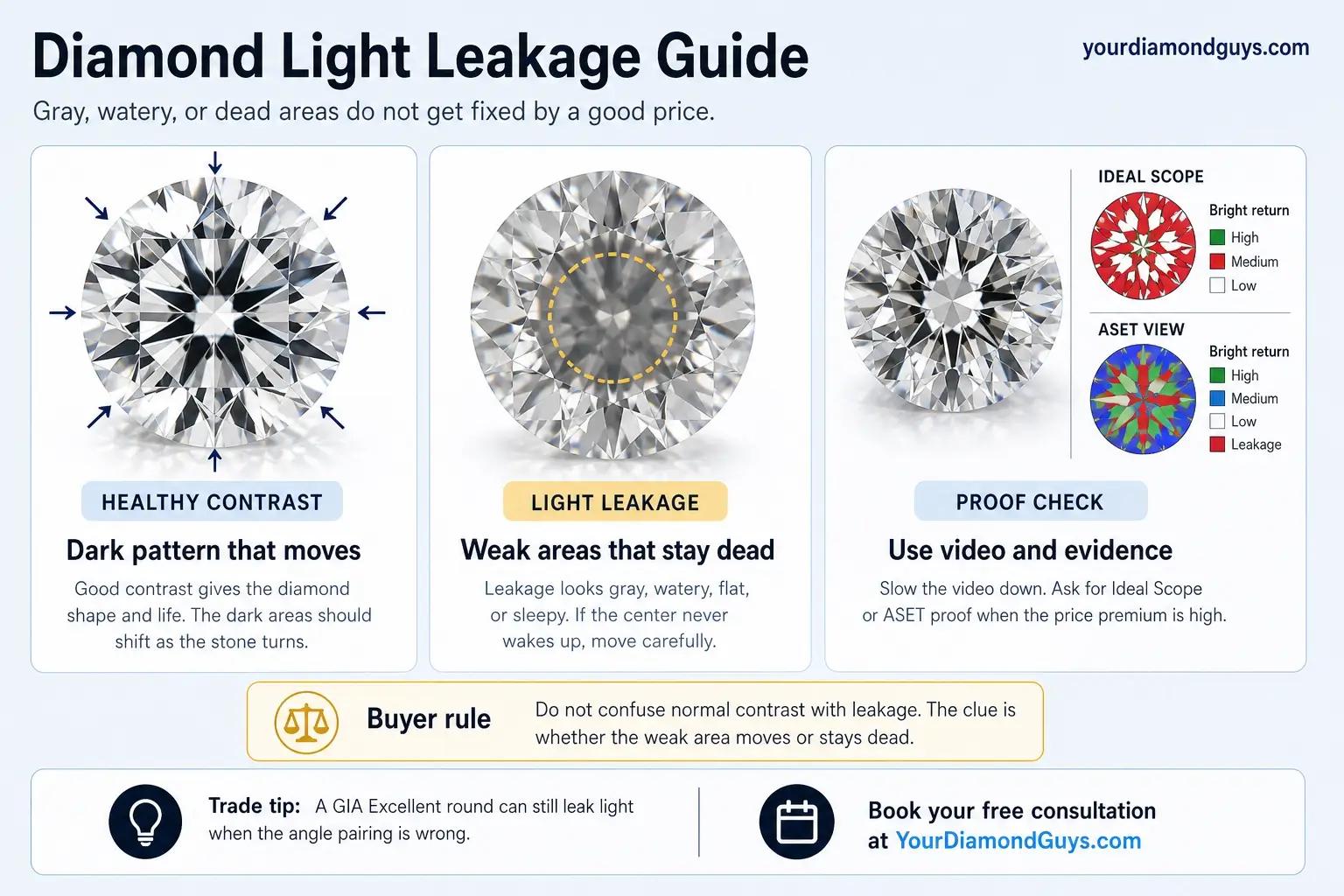
A leaking diamond can look watery, gray, flat, or dead in parts of the stone. The problem can sit under the table, near the edges, or through a large section of a fancy shape.
Good contrast is different. Good contrast gives a diamond pattern and movement. Leakage gives the diamond a weak area that does not wake up as the stone turns.
| What You See | Likely Meaning | Buyer Action |
|---|---|---|
| Gray or watery center | Light is not returning well | Ask for more video or move on |
| Large dark patch that stays dark | Leakage or obstruction issue | Do not approve without expert review |
| Crisp dark arrows in a round | Normal contrast pattern | Check movement before judging |
| See through area in an emerald cut | Windowing | Reject if visible face up |
Why Leakage Happens
Leakage usually comes from poor angle relationships. In round brilliants, the crown angle and pavilion angle have to work as a pair.
For round brilliants, my starting screen is table 56 to 58 percent, depth 60 to 62.4 percent, crown angle 34 to 35 degrees, pavilion angle 40.6 to 41 degrees, Excellent polish, Excellent symmetry, and none to faint fluorescence.
The common problem is a steep deep stone. The certificate can still say Excellent. The diamond can still leak light.
How To Check Leakage In Video
Slow the video down. Watch the dark areas. A diamond with healthy contrast will shift as the stone moves. A leaking area often looks flat or lifeless through several positions.
For fancy shapes, watch the bowtie and center. Ovals, pears, and marquise cuts often show dark bands. Some bowtie is normal. A heavy black bowtie that dominates the stone is not a good buy.
Ideal-Scope And ASET Images
Ideal-Scope and ASET images can help confirm leakage. They are not magic. They are evidence.
Red or bright return is usually favorable. Pale or white areas can show leakage. Black or blue areas can show contrast or obstruction, depending on the system and the stone.
Use these tools when a diamond carries a premium or when the video leaves doubt.
Reach out to Rob or me at YourDiamondGuys.com, or book your free consultation. We will look at the actual stone with you. No sales pitch.
Where Leakage Kills Value
Use leakage review any time a diamond looks gray, watery, or dead in the center. The key is movement. Healthy contrast changes as the diamond turns. Leakage often stays weak.
Mistakes I Would Skip
- Do not confuse healthy contrast with leakage.
- Do not approve a watery center because the price looks good.
- Do not ignore leakage in fancy shapes where no simple cut grade protects you.
- Do not use performance images without understanding what the colors mean.
Dead Center Example
A buyer sends a video of an oval with a bright outline but a gray center. The listing looks good. The carat weight looks good. But the center never wakes up as the stone turns. That is the kind of weakness I do not want to explain away. A discount does not fix a diamond that looks dead in the place everyone will look first.
How Light Leakage Affects Diamond Sparkle
Questions I Ask About Leakage
- Does the weak area move or stay dead?
- Can you provide Ideal-Scope or ASET evidence?
- Is the darkness contrast, obstruction, or leakage?
- Does the center return light in normal movement?
Where I Would Compare Leakage Proof
Use these sites as comparison tools, not automatic recommendations. I would review live videos on Brilliant Earth and Blue Nile, then judge the actual diamond by movement, brightness, report details, and price. The stone has to earn it.
Questions? Reach out directly for a free consultation, or drop them in the Diamond Buyers Academy community — Rob and I answer personally.
Questions Buyers Ask Us
Light leakage means the stone is losing light instead of sending it back to your eye. It makes the diamond look weak, dull, or uneven.
No. Some darkness is normal contrast. The problem is a dark or watery area that stays lifeless as the diamond moves.
Yes. GIA Excellent is broad. A round diamond can receive that grade and still have angle combinations that underperform.
Watch the 360 degree video and ask for Ideal-Scope or ASET evidence when the price is high. Look for flat areas that do not brighten as the diamond turns.
Fancy shapes can be harder to judge because most do not have a simple lab cut grade. Video review matters more for ovals, pears, cushions, radiants, emeralds, and asschers.
*Some links on our site may earn us a small commission at NO EXTRA cost to you, helping us keep our content free*