Diamond Cut Quality Checklist Before You Buy
By Josh Allen, Co-Founder of YourDiamondGuys.com. Fifth generation diamantaire with 30+ years in the global diamond trade. Former supplier to Tiffany & Co., Cartier, and Harry Winston.
Here is the simple move, use this diamond cut quality checklist to kick out weak stones before you fall in love with the price.
Most buyers open the listing and compare carat, color, and clarity first. That is backwards. Cut is the first screen because it decides whether the diamond looks bright in real life or just looks good on paper.
I always start with GIA for natural diamonds. Not because the cut grade alone is enough, but because GIA gives me proportions I can actually trust. Softer lab reports do not give me the same confidence in those numbers.
When I screen stones for a buyer, I am not trying to admire the listing. I am trying to save them from wasting time on the wrong one. That is how you keep a bad diamond from becoming an emotional decision.
The point is not to turn you into a gemologist. The point is to keep bad options from eating your time, your budget, and your patience.
The Fast Cut Quality Screen
This is the checklist I would use before I gave a diamond real attention. It does not approve the stone. It tells us whether the stone deserves more time.
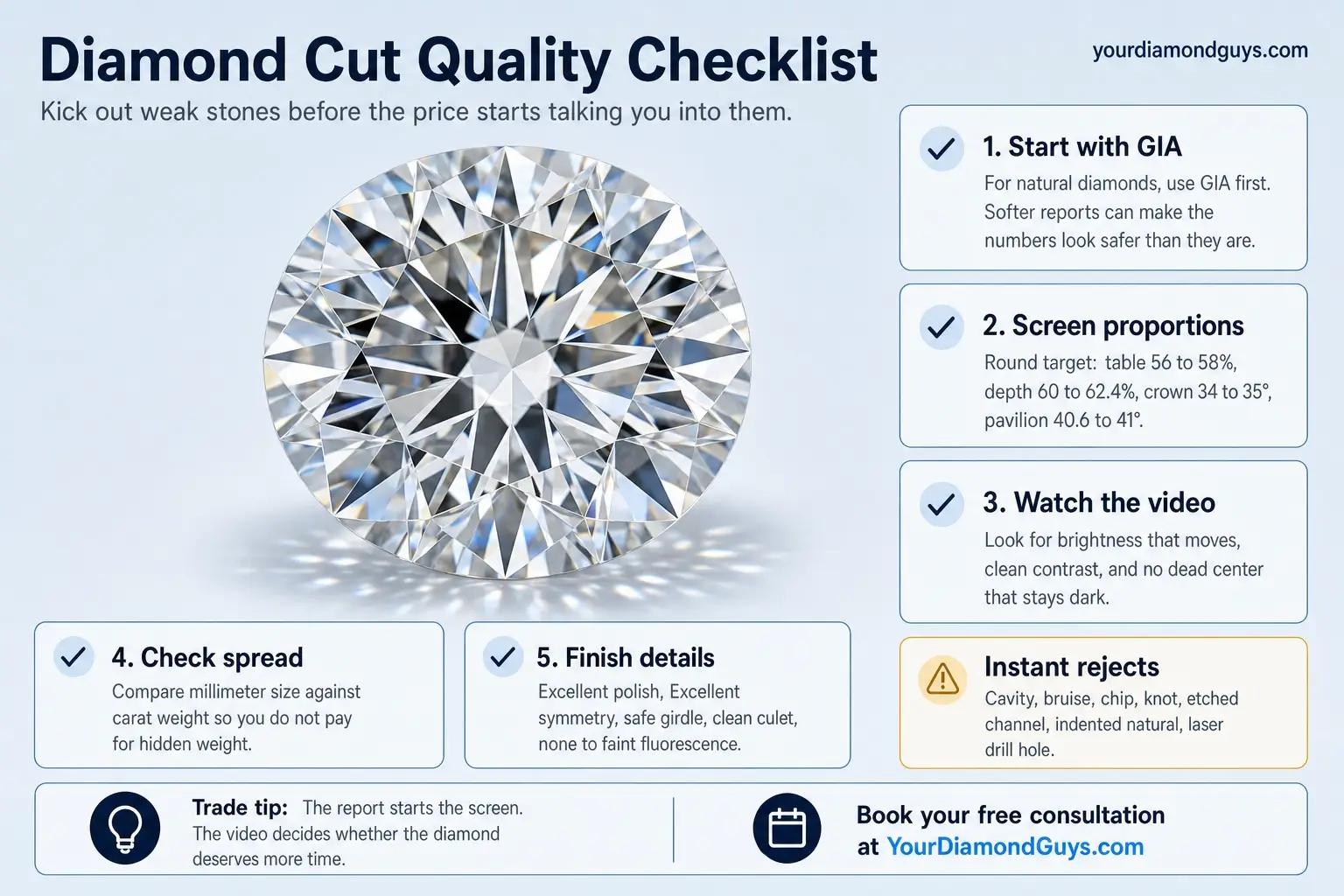
For round brilliants, I still use a tight first screen, table 56 to 58 percent, depth 60 to 62.4 percent, crown 34 to 35 degrees, pavilion 40.6 to 41 degrees, Excellent polish and symmetry, and none to faint fluorescence. Then I watch the video.
- Use GIA only for natural diamonds.
- Confirm the measurements match the carat weight.
- Check table, depth, crown angle, and pavilion angle on round brilliants.
- Reject obvious steep deep combinations.
- Watch the actual diamond video.
- Compare face up millimeters against similar stones.
- Look for light leakage, dull zones, or a messy pattern.
- Check fluorescence, polish, symmetry, girdle, and culet.
Report Fields That Matter
The report gives you the first set of facts. It does not choose the diamond for you.
For natural diamonds, the report should be from GIA. If a natural diamond is graded by a softer lab, the listed color and clarity does not always mean the same thing as a GIA grade.
| Report Field | Good Starting Point | Why It Matters |
|---|---|---|
| Cut grade | GIA Excellent for round natural diamonds | Keeps weak candidates out of the first screen |
| Table | 56 to 58 percent for many strong rounds | Controls brightness and fire balance |
| Depth | 60 to 62.4 percent for many strong rounds | Helps prevent hidden weight |
| Polish and symmetry | Excellent | Supports clean finish and pattern precision |
| Fluorescence | None to Faint | Reduces haze and discount complications |
Video Checks That Matter
The certificate gives you facts. The video shows you whether the diamond has life.
When I am reviewing a diamond for a buyer, I want to see the stone turn. I look for bright return across the face, clean contrast, and no large dead areas that stay dark as the diamond moves.
- Bright areas should move as the diamond turns.
- Dark contrast should look patterned, not blotchy.
- The center should not stay lifeless.
- Fancy shapes should not show a heavy bowtie or watery center.
- Step cuts should show clean flashes, not a see through window.
When To Stop And Move On
Do not fall in love with the paper. If the video looks weak, move on.
I have seen buyers try to rescue a bad diamond because the price looked attractive. Most of the time, the discount exists because the trade already saw the problem.
Reach out to Rob or me at YourDiamondGuys.com, or book your free consultation. We will look at the actual stone with you. No sales pitch.
Where The Checklist Saves Time
Use the checklist before you spend time negotiating, reserving, or showing the diamond to someone else. A stone that fails early should not take up more of your budget or attention.
Mistakes I Would Skip
- Do not skip the lab check on a natural diamond.
- Do not compare price before eliminating weak cut candidates.
- Do not use the report as the final approval.
- Do not ignore dangerous inclusions like cavity, bruise, chip, knot, etched channel, or laser drill holes.
Fast Rejection Example
A buyer finds a diamond with a good price and a clean looking listing. The first check is the lab. For a natural diamond, I want GIA. Then I check proportions, spread, fluorescence, polish, symmetry, and video. If the diamond fails on a major cut factor, I do not keep negotiating. I move to a better candidate.
Why Diamond Cut Matters More Than You Think
Questions I Ask Before The Price Talk
- Is the natural diamond graded by GIA?
- Do the cut proportions pass the first screen?
- Can I review the actual diamond video?
- Are there any instant reject inclusions or laser drill holes?
Where I Would Compare Candidates
Use these sites as comparison tools, not automatic recommendations. I would compare similar stones on Ritani and Blue Nile, then judge each diamond by the report, video, spread, and price. If the stone is weak, the link does not save it.
Questions? Reach out directly for a free consultation, or drop them in the Diamond Buyers Academy community — Rob and I answer personally.
Frequently Asked Questions
Check the grading lab first. For natural diamonds, start with GIA. Then screen cut proportions before comparing color, clarity, or price.
No. The report is a starting point. The actual video and images show whether the diamond has life, leakage, or visual problems.
For round brilliants, my starting screen is table 56 to 58 percent, depth 60 to 62.4 percent, crown angle 34 to 35 degrees, pavilion angle 40.6 to 41 degrees, Excellent polish, Excellent symmetry, and none to faint fluorescence.
No. Fancy shapes need more visual review because most do not have a simple GIA cut grade. Outline, bowtie, windowing, leakage, and spread matter more.
For clarity, I eliminate cavity, bruise, chip, knot, etched channel, and laser drill holes. For cut, I reject obvious leakage, dead centers, and poor spread for the price.
*Some links on our site may earn us a small commission at NO EXTRA cost to you, helping us keep our content free*