Round Brilliant Diamond Guide
By Josh Allen, Co-Founder of YourDiamondGuys.com. Fifth generation diamantaire with 30+ years in the global diamond trade. Former supplier to Tiffany & Co., Cartier, and Harry Winston.
A round brilliant is the safest shape for predictable sparkle, but only when the proportions and video support the grade. GIA Excellent is a starting field, not a final approval.
Round brilliants fool buyers because the report looks simple. Excellent cut sounds finished. It is not. Some Excellent rounds look alive. Some leak light and carry weight where you cannot see it.
For natural diamonds, start with GIA. The report gives the first facts worth trusting, but the actual images and video still decide whether the diamond earns the money.
In the trade, two GIA Excellent rounds with the same color and clarity do not get the same attention. The one with cleaner angles, stronger spread, and better video wins first.
What To Check First
| Check | Buyer Meaning |
|---|---|
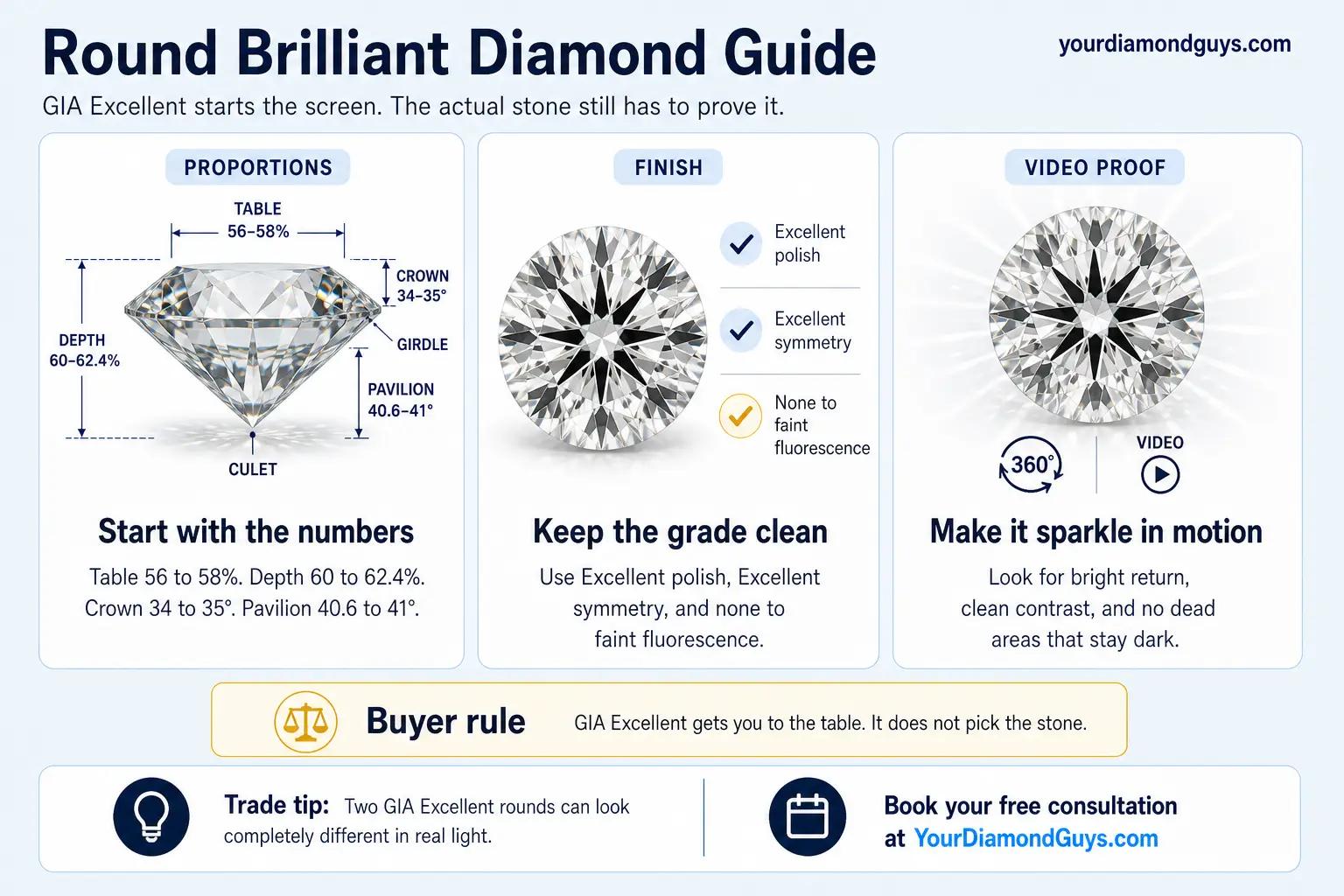
| Table | Start around 56 to 58 percent for many strong round brilliants. |
| Depth | Start around 60 to 62.4 percent so you do not pay for hidden weight. |
| Crown angle | Start around 34 to 35 degrees. |
| Pavilion angle | Start around 40.6 to 41 degrees. |
| Finish | Excellent polish, Excellent symmetry, and none to faint fluorescence keep the decision clean. |
The Round Brilliant Advantage
A strong round gives you the best benchmarking. You can compare proportions, cut grade, face up measurements, video, and light performance more cleanly than with most fancy shapes.
That does not mean every round is good. It means you have better tools to reject weak ones.
Where Round Buyers Overpay
The trap is paying for a paper combination before checking visual life. A higher color round with weak proportions can lose to a lower color round with better cut.
Start with GIA for natural diamonds. Then use the numbers. Then watch the actual diamond move.
My Buying Call
Use round diamond proportions and GIA Excellent filters before you compare prices. If the stone looks like a precision-cut round, check Hearts and Arrows patterning too. The right round should look bright, balanced, and crisp in normal lighting.
Reach out to Rob or me at YourDiamondGuys.com, or book your free consultation. We will look at the actual stone with you. No sales pitch.
How This Connects To The Rest Of The Buy
A round brilliant makes the rest of the buy cleaner because the shape gives you better comparison tools. You can use the diamond shapes guide to confirm the shape choice, then use round diamond proportions, GIA Excellent filters, and the diamond cut quality checklist to decide whether the stone deserves a serious look.
That is the order I like. Shape first. Cut screen second. Video third. Price after the diamond proves it has life.
A Buyer Example
Say a buyer sends me two GIA Excellent rounds. One has the cleaner looking paper. The other has tighter angles, better spread, and a video that actually pops. I slow down on the second stone every time if the price makes sense.
The paper is not the prize. The actual diamond is. That is the trade habit buyers need to borrow before they spend real money.
Mistakes I Would Skip
- Do not buy the report before judging the actual diamond.
- Do not compare price until the shape passes its visual checks.
- Do not ignore video, outline, spread, color visibility, or clarity visibility.
- Do not assume the same spec target works for every shape.
Questions I Ask Before Approval
- Does the diamond match the job of this page: Choose a round brilliant diamond that performs well visually before comparing price or carat.
- Can I see the actual diamond video, not a sample image?
- Does the shape create any durability, bowtie, windowing, color, or clarity issue?
- Is the price right for the stone in front of me?
Discover the Secrets of the Round Brilliant Cut Diamond
Compare Cut Proof Before You Pay The Premium
Use these sites as proof libraries, not automatic recommendations. I would compare ideal cut evidence on Whiteflash and precision cut examples on Brian Gavin Diamonds, then decide whether the actual round earns the premium.
Questions? Reach out directly for a free consultation, or drop them in the Diamond Buyers Academy community — Rob and I answer personally.
Questions Buyers Ask Us
My starting screen is table 56 to 58 percent, depth 60 to 62.4 percent, crown angle 34 to 35 degrees, pavilion angle 40.6 to 41 degrees, Excellent polish and symmetry, and none to faint fluorescence.
No. GIA Excellent is broad. It gets you into the right neighborhood, then the proportions and video decide whether the stone deserves money.
Yes, rounds usually hide warmth and small inclusions better than step cuts because the facet pattern returns more light.
*Some links on our site may earn us a small commission at NO EXTRA cost to you, helping us keep our content free*