Fancy Shape Diamond Cut Guide
By Josh Allen, Co-Founder of YourDiamondGuys.com. Fifth generation diamantaire with 30+ years in the global diamond trade. Former supplier to Tiffany & Co., Cartier, and Harry Winston.
First rule, fancy shape diamond cut starts with your eye, because the outline, bowtie, center, spread, and actual video decide whether the stone is worth buying.
Most buyers want a shortcut for fancy shape cut quality. The shortcut does not exist. For ovals, pears, cushions, radiants, emeralds, and asschers, the video matters more than any simple label.
I always start with GIA for natural diamonds. Not because the cut grade alone is enough, but because GIA gives me proportions I can actually trust. Softer lab reports do not give me the same confidence in those numbers.
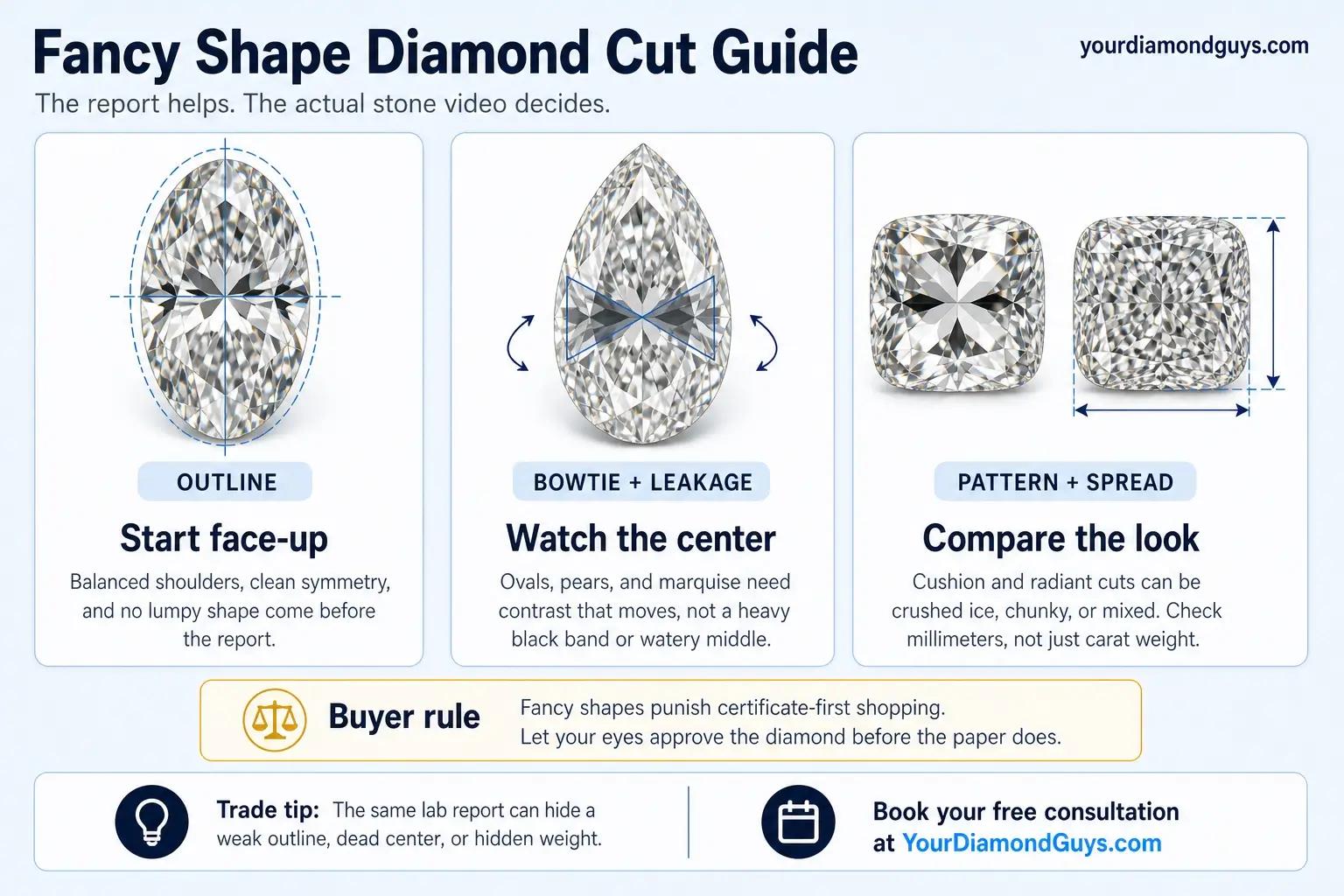
Fancy shapes punish certificate first shopping. The report can look clean while the actual stone has a heavy bowtie, weak corners, or a lumpy outline. That is why I want the buyer watching the diamond, not just reading the paper.
Why Fancy Shapes Need More Visual Review
Round brilliants have a more standardized cut system. Fancy shapes do not give buyers the same simple path.
That means you have to judge outline, ratio, light return, bowtie, leakage, pattern, and spread. The report is still useful. It is not enough.
The Checks That Change By Shape
I start with the face up look. A fancy shape has to look right before the numbers matter.
For an oval, I am looking hard at the bowtie and the outline. For a cushion, I want to know whether the buyer likes crushed ice, chunky, or a mixed pattern. For an emerald cut, I care about the hall of mirrors look and whether the center windows. Same word, diamond. Different review.
| Check | What To Look For | Common Problem |
|---|---|---|
| Outline | Balanced shape and pleasing shoulders | Lumpy or uneven outline |
| Ratio | Shape that matches buyer preference | Too short, too long, or awkward |
| Bowtie | Controlled contrast in elongated shapes | Heavy dark band |
| Leakage | Bright face with no watery center | Dead or see through zones |
| Spread | Good millimeter size for carat weight | Hidden weight |
Shape Specific Watchouts
Ovals, pears, and marquise cuts need bowtie review. Cushions and radiants need facet pattern review because crushed ice and chunky looks are very different. Emerald and asscher cuts need windowing review because step cuts are more transparent.
For pointed shapes, I also check girdle and setting protection. A beautiful pear with a vulnerable point is not a clean buy.
My Call Before A Client Pays
Do not buy a fancy shape without seeing the actual stone video. Not a sample video. The actual stone.
The right fancy shape is the one with the best visual tradeoff for your budget. The certificate only helps you understand the stone after your eyes approve it.
Reach out to Rob or me at YourDiamondGuys.com, or book your free consultation. We will look at the actual stone with you. No sales pitch.
Where Fancy Shapes Fool Buyers
Use this guide after the basic cut quality checklist any time the diamond is not a round brilliant. Fancy shapes have to win with your eye first. The report helps you understand the stone, but the face up outline, movement, bowtie, leakage, and spread decide whether it deserves the money.
One of the easiest mistakes is buying the better paper diamond. I see it with ovals all the time. The higher color stone has a heavy bowtie. The slightly lower color stone has a cleaner outline and better spread. The second stone often wins on the hand.
Mistakes I Would Skip
- Do not buy a fancy shape from the report alone.
- Do not ignore bowtie in ovals, pears, and marquise cuts.
- Do not accept a lumpy outline because the carat weight looks attractive.
- Do not compare fancy shapes without checking face up millimeters.
Oval Desk Example
Suppose a buyer is choosing between two ovals. One has better color on paper. The other has a cleaner outline, less bowtie, and better face up spread. I would usually take the better looking oval, assuming the price is fair and the clarity is safe. Fancy shapes punish buyers who shop the certificate first. The eye has to approve the outline and pattern before the report details matter.
Questions I Ask Before Approving A Fancy Shape
- Can I see the actual diamond video, not a sample video?
- Does the shape have a heavy bowtie, window, or dead center?
- What are the face up measurements for the carat weight?
- Is the outline balanced from end to end and side to side?
Where I Would Compare Fancy Shape Videos
Use these sites as comparison tools, not automatic recommendations. For fancy shapes, I would compare actual stone videos on Brilliant Earth and Ritani, then judge the outline, bowtie, leakage, and spread for myself. The logo does not make the diamond better.
How to Choose the Right Diamond Shape
Questions? Reach out directly for a free consultation, or drop them in the Diamond Buyers Academy community — Rob and I answer personally.
Questions Buyers Ask Us
Most fancy shapes do not have the same simple GIA cut grade system that round brilliants have. That makes visual review more important.
Think of the actual video as the most important check. Look for outline, bowtie, leakage, pattern, and face up size.
No. Some bowtie is normal in elongated shapes. A heavy black bowtie that dominates the diamond is the problem.
Emerald and asscher cuts are most associated with windowing because step cuts are more transparent.
No. Measurements and ratio help, but the face up appearance decides whether the diamond works.
*Some links on our site may earn us a small commission at NO EXTRA cost to you, helping us keep our content free*