Star Facets and Lower Half Length Explained
By Rob Cornfield, Co-Founder of YourDiamondGuys.com. Fifth generation diamantaire with 30+ years in the global diamond trade. Former supplier to Tiffany & Co., Cartier, and Harry Winston.
Keep the order straight, star facets and lower half length explain sparkle texture only after table, depth, crown, pavilion, and video performance already pass.
Most buyers never look at star facets or lower half length. For the first screen, that is fine. When two round diamonds both pass the major proportion checks, these small numbers can explain why one flashes differently from the other.
I always start with GIA for natural diamonds. Not because the cut grade alone is enough, but because GIA gives me proportions I can actually trust. Softer lab reports do not give me the same confidence in those numbers.
This is not the first number I check. It is the number I use after a stone already passes the serious screens and the buyer wants to understand why one good diamond has a different sparkle texture from another.
What Star Facets Are
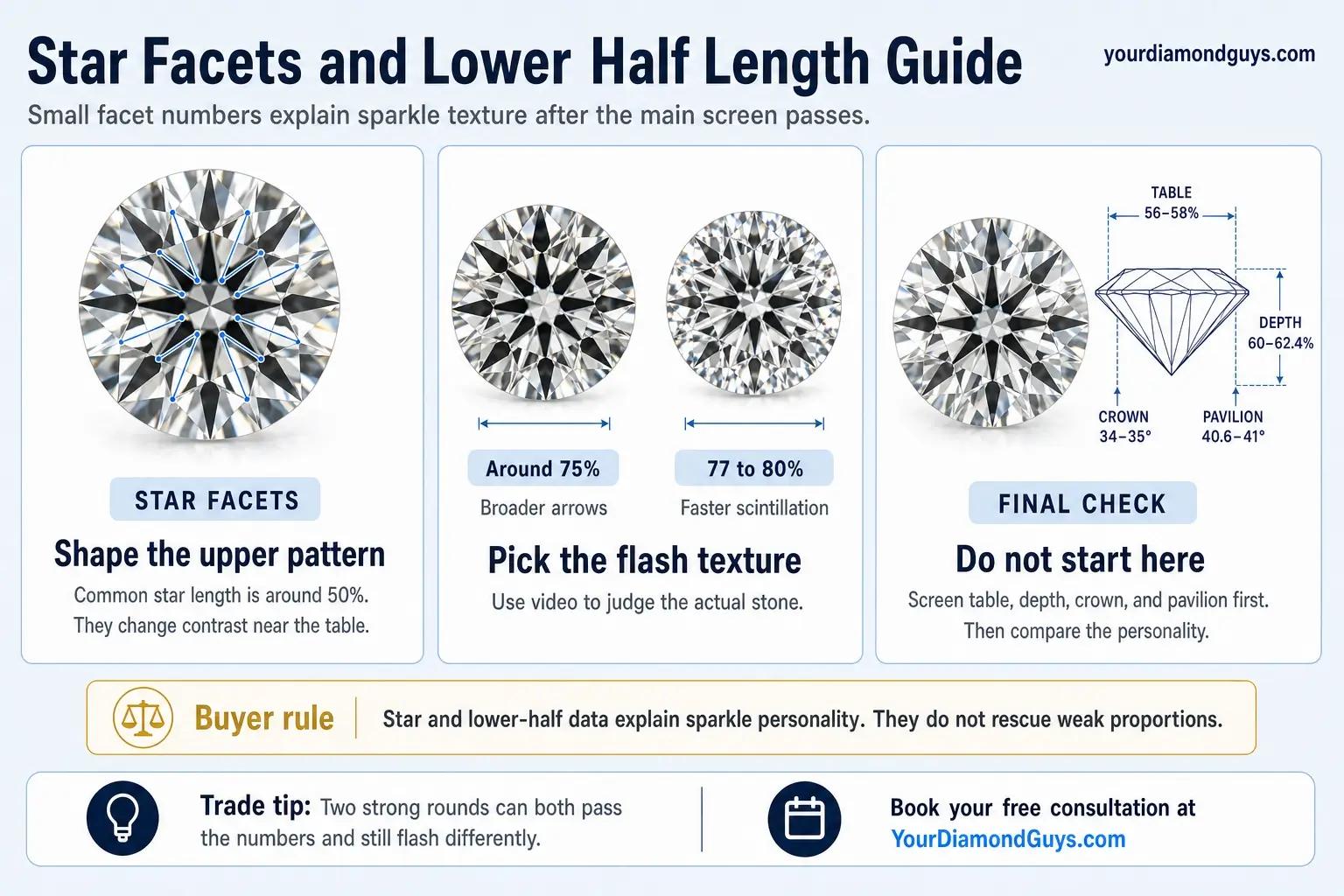
Star facets sit on the crown near the table. They help shape the upper half pattern and how light breaks near the center of the stone.
A common star length is around 50 percent. Shorter or longer star facets can change the way the diamond handles contrast near the table.
What Lower Half Length Means
Lower half facets sit on the pavilion. Their length affects arrows thickness and sparkle texture.
Lower halves around 75 percent can create broader arrows and chunkier flashes. Lower halves around 80 percent can create thinner arrows and a faster, more splintery look.
| Lower Half Length | Common Visual Effect | Buyer Note |
|---|---|---|
| Around 75 percent | Broader arrows and chunkier flashes | Can look bold and patterned |
| Around 77 to 80 percent | Balanced to faster scintillation | Common in many strong modern rounds |
| Above 80 percent | Thinner arrows and smaller flashes | Needs video review |
When These Details Matter
Do not start here. Start with GIA, cut grade, table, depth, crown angle, pavilion angle, polish, symmetry, fluorescence, and video.
Once those pass, star and lower half data can help you understand the personality of the stone. They are not a rescue tool for a bad proportion set.
For round brilliants, my starting proportion screen is table 56 to 58 percent, depth 60 to 62.4 percent, crown angle 34 to 35 degrees, pavilion angle 40.6 to 41 degrees, Excellent polish, Excellent symmetry, and none to faint fluorescence.
How I Use This In Real Reviews
When a buyer is comparing two strong stones, I look at the video first. Then I use lower half length to explain why one diamond has broader flashes and another has faster pin fire movement.
That is the right order. Eye first. Report second.
Reach out to Rob or me at YourDiamondGuys.com, or book your free consultation. We will look at the actual stone with you. No sales pitch.
Where These Small Numbers Matter
Use star and lower half data only after the main cut factors already pass. These numbers explain sparkle texture. They do not rescue a diamond with weak table, depth, crown angle, pavilion angle, or video performance.
Mistakes I Would Skip
- Do not start your diamond search with star and lower half percentages.
- Do not use lower half length to justify weak main proportions.
- Do not choose sparkle texture from numbers alone.
- Do not pay a premium for advanced data when the video does not support it.
Two Strong Rounds Example
Two round diamonds can both pass the main proportion screen. One can have broader arrows and slower flashes. The other can have thinner arrows and faster sparkle. Lower half length helps explain that difference. I would never use it before the main cut screen, but it can help a buyer choose between two already strong stones based on visual personality.
Questions I Ask About Sparkle Texture
- What are the star facet and lower half percentages?
- Does the video show broad flashes or faster sparkle?
- Are the arrows thick, thin, even, or uneven?
- Do the main proportions pass before we study these details?
Where I Would Compare Texture
Use these sites as comparison tools, not automatic recommendations. I would compare similar stones on Ritani and Blue Nile, then judge each diamond by the report, video, spread, and price. If the stone is weak, the link does not save it.
Watch: Finding the Perfect Diamond
Questions? Reach out directly for a free consultation, or drop them in the Diamond Buyers Academy community — Rob and I answer personally.
Questions Buyers Ask Us
Think of star facets as crown facets near the table of a round brilliant. They influence the upper pattern and how light breaks near the center.
Lower half length describes the pavilion lower half facets. It affects arrow thickness, contrast, and sparkle texture.
It can be good when the rest of the cut supports it. Around 75 percent often creates broader arrows and chunkier flashes.
No. Around 80 percent can create faster scintillation and thinner arrows. It needs video review.
No. Beginners should start with the main cut screen. Star and lower half details are useful after the stronger candidates are already identified.
*Some links on our site may earn us a small commission at NO EXTRA cost to you, helping us keep our content free*