AGS Diamond Cut Grading System
Use a legacy AGS report alongside a current look at the stone.
By Rob Cornfield, Co-Founder of YourDiamondGuys.com. Cofounder and diamond sourcing specialist focused on cut quality, light performance, and trade value.
AGS treated cut as a light performance problem, not just a proportion label. That was the difference. The system modeled how light moved through the actual facet arrangement and expressed the result on a zero to ten scale, with zero as Ideal.
AGS Laboratories closed in 2022. The science did not disappear. GIA acquired the technology and now offers the AGS Ideal supplemental report for eligible diamonds.
The American Gem Society says AGS Laboratories served the trade for 27 years and closed in 2022. It also explains that the current AGS Ideal Report is available from GIA as a supplement to eligible GIA reports.
What made the AGS cut system different?
AGS graded cut through modeled light performance, proportions, finish, and durability on a zero to ten scale. Grade zero meant Ideal, so lower numbers represented stronger results.
An AGS document is still a diamond grading report, not a promise that every buyer will prefer the stone.
For a natural diamond purchase today, start with GIA. Use old AGS information or the current AGS Ideal supplement as added cut evidence.
How did the zero to ten scale work?
AGS reversed the instinct most buyers bring from school. Zero was the top grade. Higher numbers represented increasing deductions and weaker overall results.
An AGS 0 cut grade became shorthand for Ideal in the market, but the document needs a full read. Color and clarity also used AGS numerical notation on legacy reports, and sellers sometimes translate those grades into familiar letter terms.
Always use the original report legend. Do not assume every zero on the page describes cut or every translated listing preserves the exact AGS wording.
| AGS concept | Plain English meaning | Buyer use |
|---|---|---|
| 0 cut grade | Ideal result under the AGS system | Strong cut starting point |
| Higher cut number | More deductions | Read the reason and images |
| Light performance map | Modeled return, leakage, and contrast | Inspect distribution, not just total score |
| Finish | Polish and symmetry execution | Confirm physical craftsmanship |
| Durability | Thin areas or risky geometry | Keep beauty from creating fragility |
How did AGS evaluate light performance?
AGS used ray tracing and three dimensional models of the measured diamond. The method examined how light entered, moved through, and exited the stone across viewing conditions.
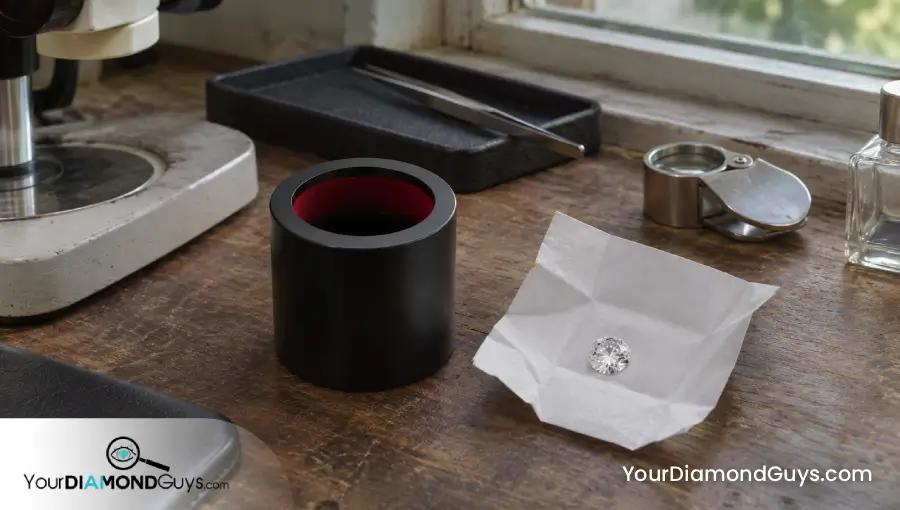
Round brilliant diamond set beside a red reflector viewing scope.
That let the system evaluate brightness, contrast, leakage, dispersion, and distribution rather than relying only on a narrow table and depth recipe. The actual facet arrangement mattered.
Numbers still mattered. Images made the numbers useful. That combination is why cut focused buyers still respect the AGS approach.
What does an ASET image add?
See GIA’s ASET map and color key to see how the map represents light return and contrast.
ASET maps the angular sources of light reaching the viewer. In common ASET presentation, red represents higher angle light, green lower angle light, blue contrast, and white or black can indicate leakage depending on the setup.
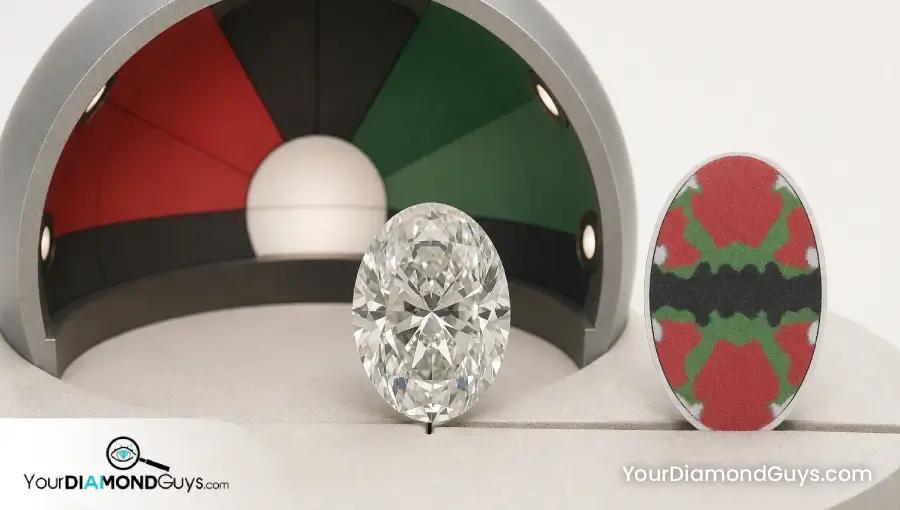
Oval diamond beside an angular light dome and matching flat oval ASET style map.
Do not judge an ASET image by chasing one color. Distribution and shape context matter. Fancy shapes can have different successful patterns than round brilliants.
A manipulated image, inconsistent background, or unknown setup can mislead. The report or trusted imaging process needs to connect the map to the actual diamond.
What happened after AGS laboratories closed?
AGS Laboratories stopped accepting grading submissions in 2022. GIA acquired its technology and intellectual property, and the organizations combined research efforts.
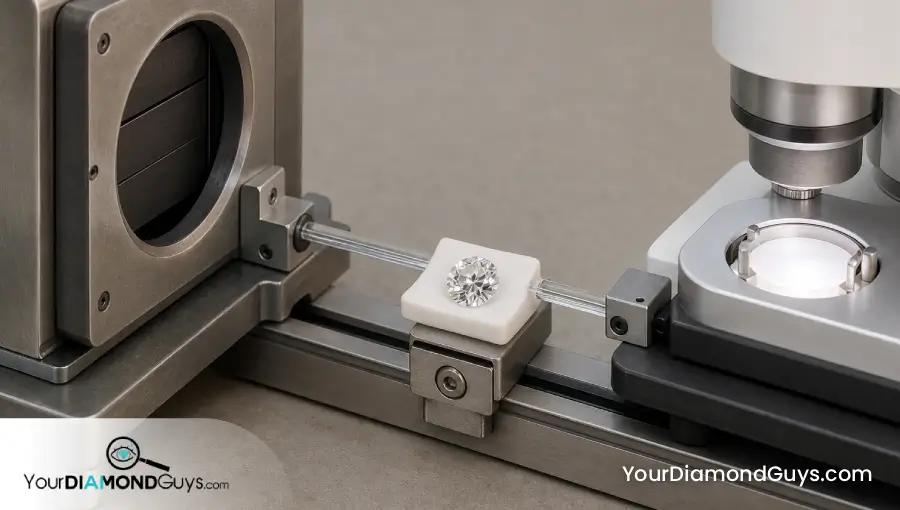
Round diamond crossing from an inactive legacy analyzer to a modern main and supplemental grading station.
Original AGS reports remain historical documents. They do not expire simply because the laboratory closed. Condition, identity, market familiarity, and report age still need review.
Current eligible diamonds can receive an AGS Ideal supplemental report through GIA. It measures light performance, including brightness, fire, and contrast, and can include an ASET map. It supplements the GIA grading report.
How should you buy a diamond with an old AGS report?
Verify the report through the current AGS resource path when possible. Match the inscription, measurements, grades, and clarity characteristics to the stone.
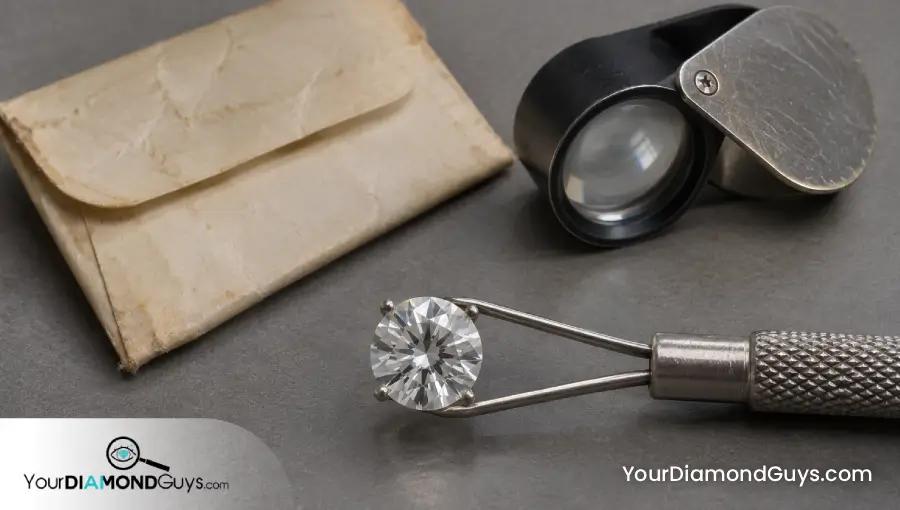
Round diamond in an inspection holder beside an old document sleeve.
Inspect for chips, wear, repolishing, and setting damage that occurred after grading. A strong old cut result does not describe every event in the diamond’s life.
Use the legacy report regrading guide when sale, insurance, estate division, or a large purchase would benefit from a current GIA file. The cut terminology guide keeps AGS 0 separate from modern seller labels.
How does an AGS grade fit into a current shortlist?
A clean AGS 0 report with matching identity and strong current video deserves attention. It gives real cut information, especially when the light performance map is clear.
For a current natural diamond purchase, I still want the GIA market reference. An old AGS report can add evidence. It should not make price comparison harder than it needs to be.
A legacy AGS decision in practice
A 1.35 carat round has an AGS Diamond Quality Document from 2018 with a cut grade of 0 and an ASET image. The inscription and measurements match, and an independent inspection finds no damage.
The cut evidence is strong. I then compare the translated color and clarity, current GIA market prices, and the cost of updating the report.
If the seller wants full current GIA money, ask for a current GIA report. If the price fairly reflects the legacy file and the stone looks excellent, the old AGS document can remain useful.
Legacy AGS traps that confuse modern buyers
- Thinking ten is better than zero.
- Calling AGS an active grading laboratory today.
- Using an ASET color count without pattern context.
- Assuming an old report proves current condition.
- Ignoring the GIA natural diamond market reference.
- Treating AGS Ideal by GIA as a replacement for the main report.
Evidence to request with an AGS diamond
- Is this an original AGS report or a current AGS Ideal supplement by GIA?
- Can I verify the document and inscription?
- Does the ASET image belong to this exact diamond?
- Has the stone been repolished or damaged since grading?
- How were color and clarity translated in the listing?
- Would a current GIA report improve price confidence?
My bottom line on AGS reports
Respect the AGS cut science. Verify the document and current stone.
Use legacy AGS as meaningful cut evidence and current AGS Ideal by GIA as a valuable supplement. For natural diamond grade and price comparison, keep GIA at the center.
Old AGS 0 reports still get attention across the trade because they exposed cut performance instead of hiding behind one broad label. Condition and identity still need a current check.
GIA vs. Other Labs: Why Grading Consistency Changes Your Diamond’s Value
Questions? Reach out directly for a free consultation, or drop them in the Diamond Buyers Academy community — Rob and Josh answer personally.
What do buyers ask about the AGS cut system?
← Browse all diamond grading guides
Want another set of eyes on the diamond?
Send the listing, grading report, price, and any video you have. We can look at the lab report, measurements, video, and price to make sure the evidence supports the price.
*Some links on our site may earn us a small commission at NO EXTRA cost to you, helping us keep our content free*