Natural vs. Lab Grown Diamond Reports
Confirm origin first. Then compare what each report actually measures.
By Rob Cornfield, Co-Founder of YourDiamondGuys.com. Cofounder and diamond sourcing specialist focused on cut quality, light performance, and trade value.
The biggest report difference is origin, not color or clarity. A natural report documents a geological diamond. A lab grown report must make manufactured origin clear and can include growth process, post growth treatment, and a distinct inscription.
GIA lab grown assessments no longer use the natural diamond color and clarity nomenclature. That changes how buyers compare papers.
GIA’s current lab grown service classifies colorless to near colorless stones as Premium or Standard, while the FTC Jewelry Guides require clear disclosure that a laboratory grown diamond is not mined.
How are natural and lab grown reports different?
Natural reports focus on 4Cs, measurements, treatments, and identity. Lab grown reports add clear manufactured origin and can include growth process, post growth treatment, and distinctive inscription language.
Both report types are grading and identification files. Neither one is a beauty guarantee. Read the certified diamond guide before treating either document as a purchase decision.
For a natural diamond, start with GIA. For a lab grown diamond, first identify the lab, date, report format, and exact origin language.
What origin language should appear?
The report should state natural diamond or laboratory grown diamond clearly. A listing should make the same disclosure close to the product name and description.
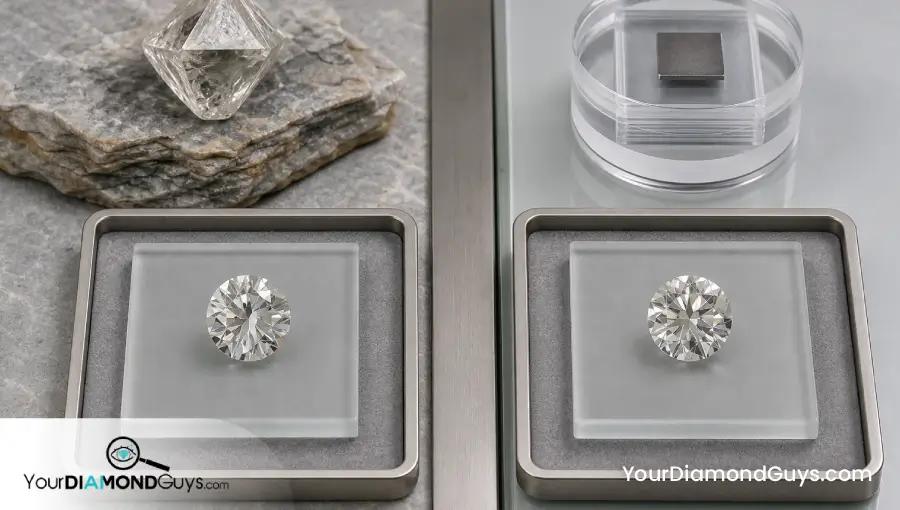
Natural and lab-grown round diamonds on separate evidence trays with distinct origin materials.
Laboratory created, laboratory grown, and a manufacturer name followed by created can communicate manufactured origin when used clearly. Simulated describes a different category such as cubic zirconia or another imitation. Do not let a seller blur those words.
The inscription can reinforce origin. Current GIA lab grown assessments include Laboratory Grown and the quality assessment number on the girdle. IGI reports and inscriptions use their own report language, which should match the official record.
| Report area | Natural diamond | Lab grown diamond |
|---|---|---|
| Origin | Natural diamond identification | Laboratory grown disclosure |
| Quality language | GIA color and clarity scales | Depends on lab and report date |
| Growth process | Not applicable | CVD or HPHT can be stated |
| Post growth treatment | Treatment disclosure when detected | Can describe as grown or possible treatment |
| Inscription | Report number when included or requested | Often includes origin wording and report number |
What changed on current GIA lab grown assessments?
Open GIA’s sample lab grown quality assessment to see how Premium and Standard are presented.
GIA groups eligible colorless to near colorless lab grown diamonds into two overall quality categories. Premium requires the top stated criteria across clarity, color, polish, symmetry, and round cut. Standard covers qualifying combinations down to stated minimum criteria.
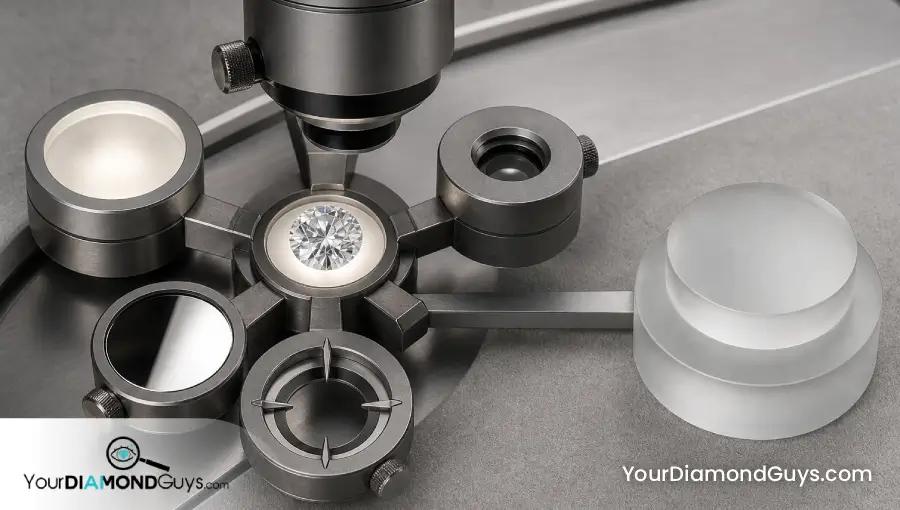
Lab-grown round diamond evaluated by five quality modules feeding one overall assessment pedestal.
A diamond outside the Standard criteria does not receive that GIA assessment. Existing older GIA lab grown reports with the previous detailed grades remain valid.
Do not compare a current GIA Premium assessment directly with an IGI D VVS1 report. One is an overall category. The other gives separate familiar grades. Compare measurements, finish, cut evidence, tint, transparency, video, and price.
What do IGI lab grown reports usually show?
IGI commonly provides shape, measurements, carat, color, clarity, cut information when applicable, polish, symmetry, fluorescence, comments, and an inscription reference.
Its official material says the growth process and presence of treatments are noted in comments upon request. That wording matters. A missing growth line does not prove deception, but it means the buyer should ask what service and report version was ordered.
Use the IGI lab report guide to read CVD, HPHT, as grown, and post growth treatment language without turning every technical note into a rejection.
Why do growth process and treatment notes matter?
CVD and HPHT are manufacturing methods. Neither method automatically produces the better diamond. Each can produce clean material and each can produce tint, strain, graining, inclusions, or unusual glow that needs inspection.
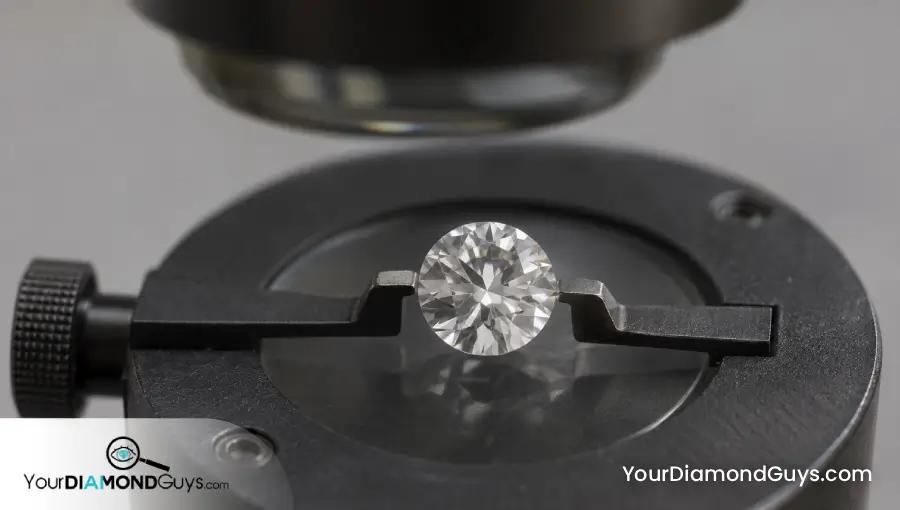
Faceted round diamond positioned beneath a microscope objective.
Post growth treatment changes color after growth. Disclosure helps you understand the production history, but the line alone does not tell you how the diamond looks.
I care when the report wording, seller explanation, and video do not line up. A vague answer around a very high grade lab diamond is more important than the fact that treatment exists.
How do you compare natural and lab grown diamonds fairly?
Do not use the same value model. Natural and lab grown diamonds have different supply, pricing, resale, and report markets.
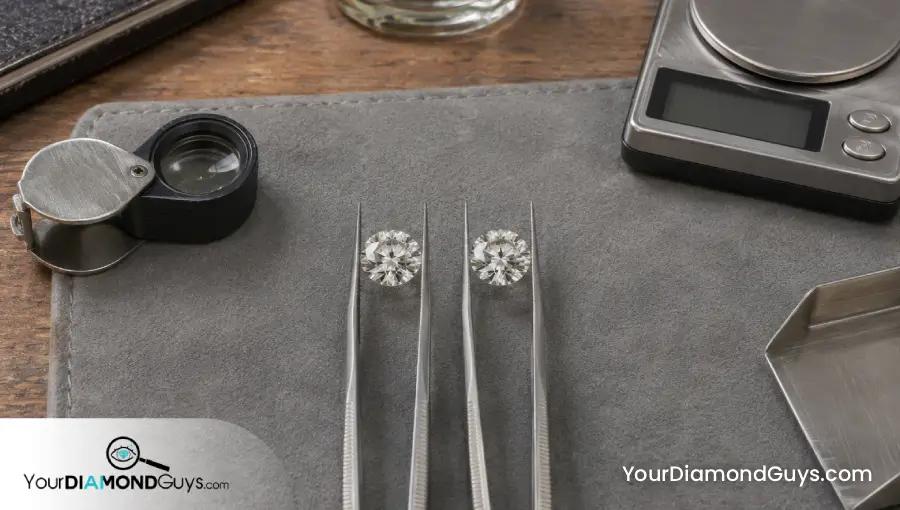
Two round diamonds in matching clips on an appraisal mat.
Use the same quality habits. Verify identity, compare face up dimensions, inspect cut, check tint and transparency, read comments, and confirm the inscription. The stone still has to look good.
Then compare each product within its own current market. The lab choice and price guide explains why the printed report affects natural diamond pricing differently.
Which report fields decide the next step?
Origin mismatch ends the review. Missing growth detail triggers a question. A treatment note triggers visual inspection. A strong grade with weak video loses.
With natural diamonds, the report anchors market quality and price. With lab grown diamonds, rapidly changing product economics make cut, appearance, return policy, and price discipline even more important.
A current natural and lab report comparison
Stone A is a natural GIA round with G color, VS2 clarity, and Excellent cut. Stone B is a current GIA lab grown round classified Premium. Stone C is an IGI lab grown round graded D VVS1 with a CVD comment.
Those are three different report stories. I can compare diameter, table, depth, crown, pavilion, polish, symmetry, video, and price. I cannot convert Premium into D VVS1 or use Stone A’s natural market value to justify Stone B or C.
The report tells me how to organize the inspection. It does not erase the origin and market difference.
Origin and format traps that confuse buyers
- Comparing Premium directly with a letter color and clarity grade.
- Assuming all GIA lab grown reports use the current format.
- Treating CVD or HPHT as a beauty grade.
- Confusing laboratory grown with simulated.
- Ignoring post growth treatment language.
- Using natural diamond resale logic for lab grown pricing.
The origin and treatment questions that matter
- Is the diamond natural or laboratory grown?
- Which lab, report date, and service produced this document?
- Does the inscription include origin wording?
- Is the growth process stated?
- Does the report mention post growth treatment?
- Can I see neutral video for tint, strain, haze, and cut?
My rule for comparing the two report types
Read origin first. Then read the grading language that applies to that origin and report date.
For natural, start with GIA. For lab grown, use the report to verify identity and production disclosures, then let cut, video, price, and return protection make the buying decision.
At the sourcing desk, I never convert a current GIA Premium assessment into an IGI letter grade. I compare the measurements, finish, optical proof, tint, transparency, and price instead.
Natural and lab grown diamond buying differences
Questions? Reach out directly for a free consultation, or drop them in the Diamond Buyers Academy community — Rob and Josh answer personally.
What do buyers ask about natural and lab grown reports?
← Browse all diamond grading guides
Want another set of eyes on the diamond?
Send the listing, grading report, price, and any video you have. We can look at the lab report, measurements, video, and price to make sure the evidence supports the price.
*Some links on our site may earn us a small commission at NO EXTRA cost to you, helping us keep our content free*