Crown Angle and Pavilion Angle: What Works
By Rob Cornfield, Co-Founder of YourDiamondGuys.com. Fifth generation diamantaire with 30+ years in the global diamond trade. Former supplier to Tiffany & Co., Cartier, and Harry Winston.
Watch this, crown angle and pavilion angle only matter as a pair, because the right match returns light and the wrong match can turn a clean looking GIA Excellent into a leaker.
Here is something most buyers get wrong before they even open a diamond listing. They find the crown angle, they find the pavilion angle, and they treat them like two separate checkboxes. That is not how this works.
I always start with GIA for natural diamonds. Not because the cut grade alone is enough, but because GIA gives me proportions I can actually trust. Softer lab reports do not give me the same confidence in those numbers.
These two numbers only mean something together. One angle can rescue the other. Or it can ruin it. That is why I never approve a round brilliant from one angle alone.
What Each Angle Does
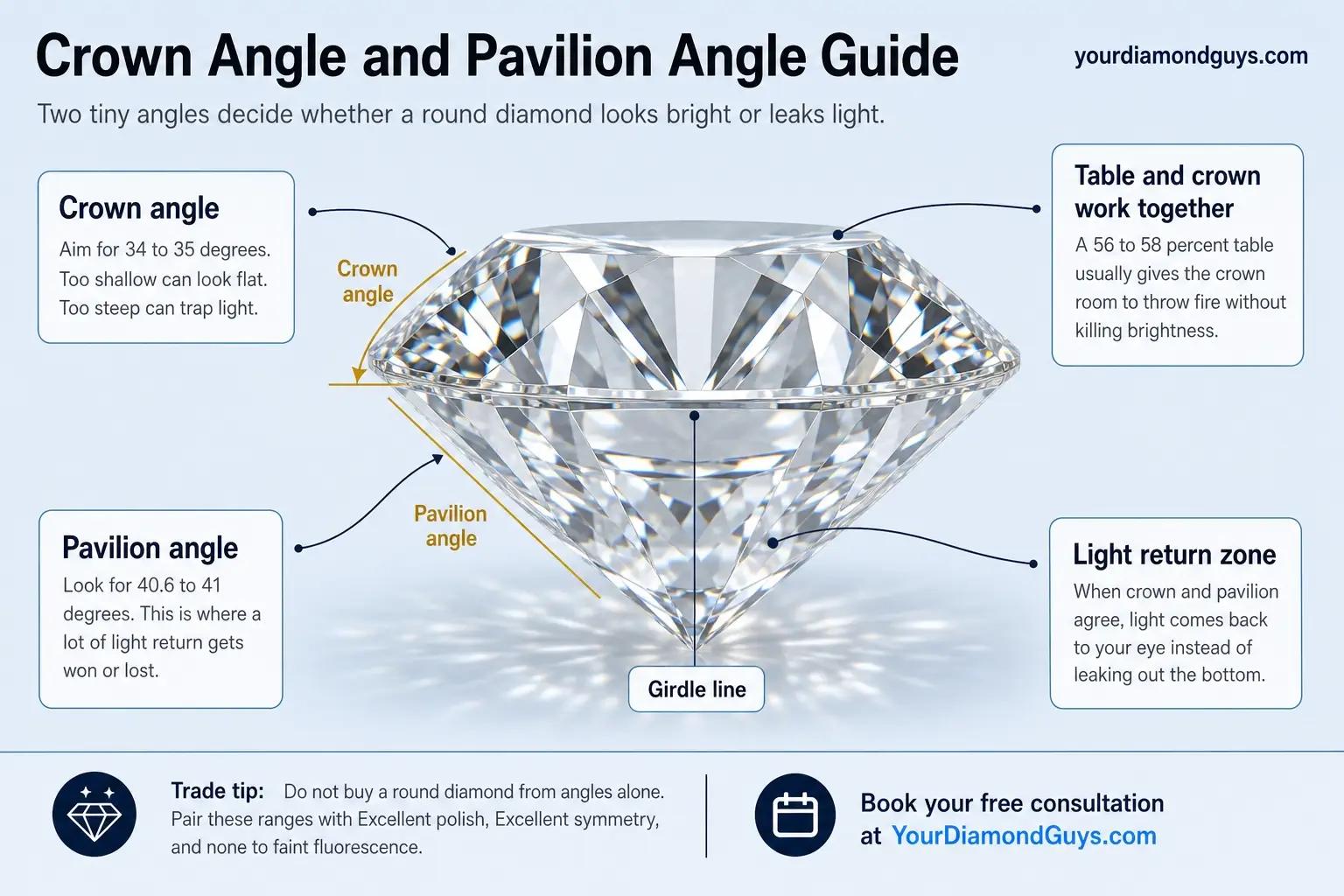
The crown is the upper part of the diamond. It affects fire, pattern, and how the diamond handles light after it returns upward.
The pavilion is the lower part of the diamond. It has a major effect on whether light returns to your eye or leakage.
A strong round brilliant usually starts around crown angle 34 to 35 degrees and pavilion angle 40.6 to 41 degrees.
Pairings I Watch Closely
A 35 degree crown can work with a pavilion near 40.6 or 40.8. The same crown with a pavilion near 41.2 can become a problem.
A lower crown can sometimes pair with a slightly higher pavilion. The point is not one perfect number. The point is balance.
| Crown And Pavilion Pattern | Buyer Read | Next Step |
|---|---|---|
| 34 to 35 crown with 40.6 to 41 pavilion | Strong first screen | Check video and spread |
| High crown with high pavilion | Steep deep risk | Look for leakage and darkness |
| Low crown with shallow pavilion | Flat or glassy risk | Check fire and contrast |
| Outside normal range but priced well | Possible tradeoff | Do not approve without performance evidence |
Sample Report Fields To Check
On a report or listing, look for crown angle and pavilion angle in the proportions area. Do not approve the stone from those fields alone, but use them as the first screen before you judge video, table, depth, and light performance evidence.
The Steep Deep Trap
The steep deep trap is common. The diamond can carry a GIA Excellent grade. The price can look attractive. But the stone can leak light because the crown and pavilion angles are working against each other.
I have seen many of these stones pushed because the certificate looks clean. Dealers know the difference when the stone is in hand.
How To Confirm The Pair
Do not stop with the numbers. Check the video. Look for brightness under the table, crisp contrast, and no dead area that stays dark through movement.
When the diamond carries a premium, ask for Ideal-Scope, ASET, or another light performance image.
Reach out to Rob or me at YourDiamondGuys.com, or book your free consultation. We will look at the actual stone with you. No sales pitch.
Where The Angle Pair Gets Real
Use crown and pavilion pairing before you trust the cut grade. A single angle does not tell the story. The pair decides whether the diamond has a strong chance of returning light cleanly.
Mistakes I Would Skip
- Do not judge crown angle without pavilion angle.
- Do not trust a steep deep stone because the grade says Excellent.
- Do not ignore video darkness under the table.
- Do not compare angle pairs without checking depth and table size.
Steep Deep Desk Example
A 35 degree crown can perform beautifully with the right pavilion. Pair that same crown with a pavilion that runs too steep and the stone can start bleeding light. That is why I never read these angles separately. I look at the pair, then I watch the video. The stone has to prove the numbers are doing what they should.
Questions I Ask About The Angle Pair
- What are the crown angle and pavilion angle together?
- Does the pair create steep deep risk?
- Does the video show darkness or leakage under the table?
- Can performance images confirm light return?
Where I Would Compare Angle Proof
Use these sites as comparison tools, not automatic recommendations. I would compare similar stones on Ritani and Blue Nile, then judge each diamond by the report, video, spread, and price. If the stone is weak, the link does not save it.
Watch: Finding the Perfect Diamond
Questions? Reach out directly for a free consultation, or drop them in the Diamond Buyers Academy community — Rob and I answer personally.
Questions Buyers Ask Us
Think of crown angle as the angle of the upper facet structure above the girdle. It affects fire, pattern, and how the diamond returns light.
Think of pavilion angle as the angle of the lower facet structure below the girdle. It strongly affects light return and leakage.
For many round brilliants, I start with crown angle 34 to 35 degrees and pavilion angle 40.6 to 41 degrees. The pair must be checked together.
A steep deep diamond has crown and pavilion relationships that often reduce light return. It can still receive a GIA Excellent grade.
Yes. Video helps show whether the angle pair produces brightness, contrast, and movement in the actual stone.
*Some links on our site may earn us a small commission at NO EXTRA cost to you, helping us keep our content free*