Diamond Depth Percentage: Avoid Hidden Weight

By Rob Cornfield, Co-Founder of YourDiamondGuys.com. Fifth generation diamantaire with 30+ years in the global diamond trade. Former supplier to Tiffany & Co., Cartier, and Harry Winston.
Here is the money trap, diamond depth percentage tells you whether carat weight shows on the hand or hides in the body of the stone.
Most buyers think carat weight tells them how large a diamond will look. It does not. Depth percentage can hide weight in the body of the stone where nobody sees it.
I always start with GIA for natural diamonds. Not because the cut grade alone is enough, but because GIA gives me proportions I can actually trust. Softer lab reports do not give me the same confidence in those numbers.
Hidden weight is one of the easiest ways for buyers to overpay without noticing. The invoice says one carat. The finger sees a smaller stone.
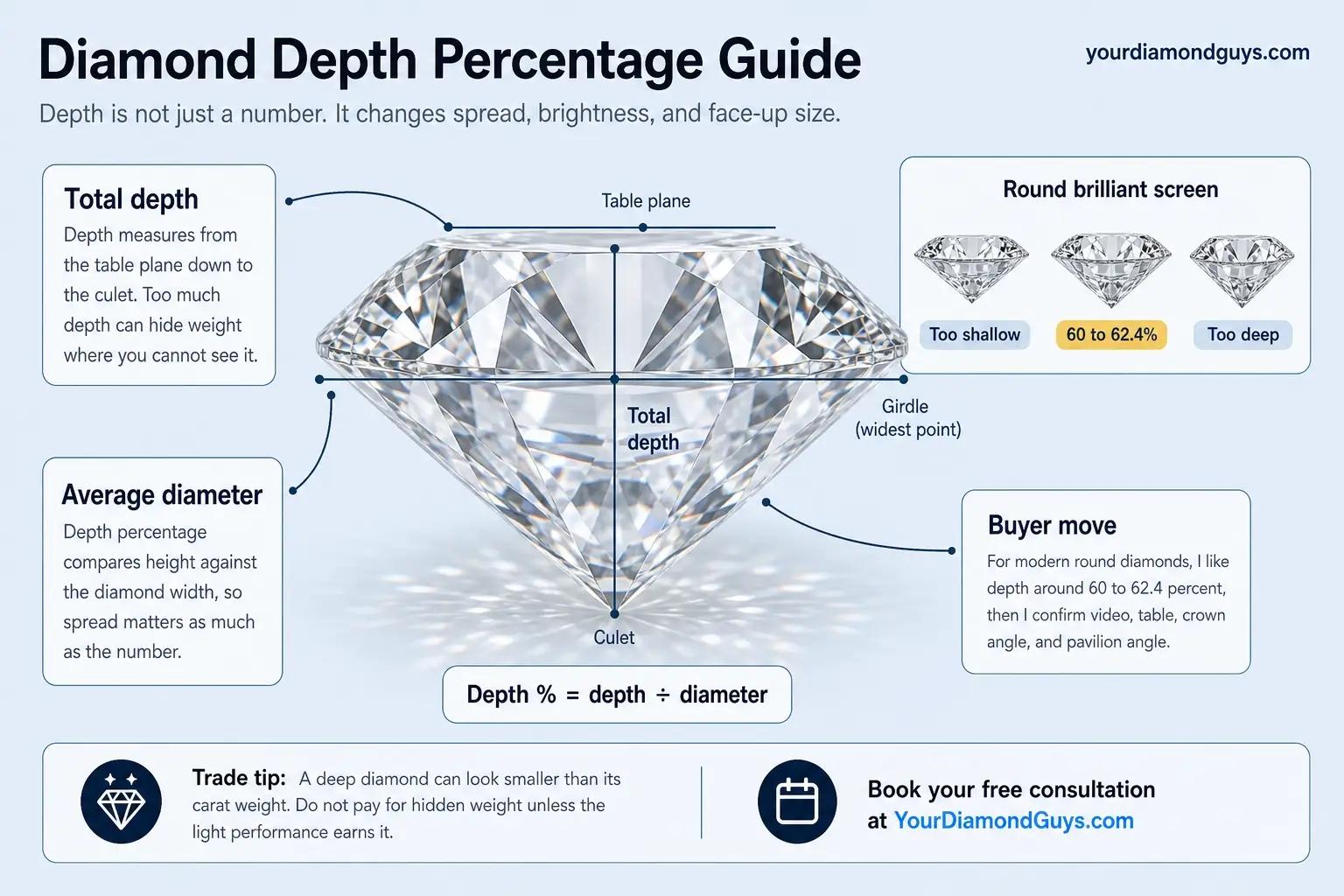
What Depth Percentage Means
Depth percentage compares the diamond's total depth to its average diameter. In plain English, it tells you how much of the diamond's weight sits vertically.
For round brilliants, I start with 60 to 62.4 percent depth. That range helps protect face up size while keeping room for strong light return.
Hidden Weight Costs Real Money
A deep diamond can weigh 1.00 carat and face up like a smaller stone. The extra weight sits in the belly of the diamond.
I have watched buyers get excited about hitting the 1.00 carat mark, then compare millimeter measurements and realize the stone does not look like a full one carat diamond. The trade sees that immediately.
| Depth Pattern | What It Can Mean | Buyer Action |
|---|---|---|
| 60 to 62.4 percent round | Strong first screen | Check angles and video |
| Over 62.4 percent round | Possible hidden weight | Compare millimeter spread |
| Shallow depth | Possible leakage or flat look | Check video and light return |
| Fancy shape depth | Shape specific judgment needed | Use video and measurements |
Compare Millimeters, Not Only Carat
Two diamonds with the same carat weight can have different face up measurements. That matters more than most buyers realize.
If one 1.00 carat round measures close to 6.5 mm and another measures smaller because of depth, the smaller looking stone needs a price reason to stay in the running.
Depth And Light Return Work Together
Depth is not only a size issue. It connects to pavilion angle, crown angle, and leakage. A stone can be deep and dark. It can also be shallow and glassy.
Use depth as a warning system. Then confirm with the actual diamond.
Reach out to Rob or me at YourDiamondGuys.com, or book your free consultation. We will look at the actual stone with you. No sales pitch.
Where Depth Costs You Money
Use depth percentage before you compare two stones by price. A diamond that carries weight too deep can look smaller than the carat weight suggests. That means the cheaper stone is not always cheaper once you compare visible size.
Mistakes I Would Skip
- Do not compare carat weight without comparing millimeter spread.
- Do not buy a deep stone just because it hits a popular carat threshold.
- Do not ignore shallow stones that look glassy or leaky.
- Do not treat depth as separate from pavilion angle and table size.
One Carat Desk Example
A buyer sees a 1.00 carat round diamond at a tempting price. The depth is high, and the face up measurement is smaller than other 1.00 carat stones. That discount is not always a deal. The buyer is paying for weight hidden in the body of the diamond. I would compare it against a 0.95 carat stone with better spread. The smaller carat weight can look just as large.
Questions I Ask About Depth
- What is the depth percentage?
- What are the face up millimeter measurements?
- How does the spread compare with similar carat weights?
- Is the price adjusted for any hidden weight?
Where I Would Compare Spread
Use these sites as comparison tools, not automatic recommendations. I would compare similar stones on Ritani and Blue Nile, then judge each diamond by the report, video, spread, and price. If the stone is weak, the link does not save it.
What Happens When Diamond Depth Is Wrong?
Questions? Reach out directly for a free consultation, or drop them in the Diamond Buyers Academy community — Rob and I answer personally.
Questions Buyers Ask Us
Diamond depth percentage compares total depth to average diameter. It helps show whether weight is placed in visible spread or hidden depth.
For many round brilliants, I start with 60 to 62.4 percent depth. Then I check table, crown angle, pavilion angle, and video.
Yes. A deep diamond can carry weight vertically and face up smaller than another diamond with the same carat weight.
No. But shallow stones need careful review because they can have leakage or a flat look.
Yes. Compare face up measurements along with carat weight. Millimeters tell you what the eye actually sees.
*Some links on our site may earn us a small commission at NO EXTRA cost to you, helping us keep our content free*