Diamond Table Percentage: What Buyers Should Know
By Rob Cornfield, Co-Founder of YourDiamondGuys.com. Fifth generation diamantaire with 30+ years in the global diamond trade. Former supplier to Tiffany & Co., Cartier, and Harry Winston.
Start here, diamond table percentage shapes brightness, fire, and face up personality, so I usually screen round brilliants at 56 to 58 percent before checking the rest.
Most buyers see table percentage and treat it like a small report detail. It is not small. The table changes the personality of the diamond, and it can push the stone toward more white brightness or more balanced fire.
I always start with GIA for natural diamonds. Not because the cut grade alone is enough, but because GIA gives me proportions I can actually trust. Softer lab reports do not give me the same confidence in those numbers.
In the market, a large table can make a stone look bright in a quick comparison. That does not mean it has the best balance. I still want to see crown height, pavilion angle, and video before I call it a good buy.
What Table Percentage Means
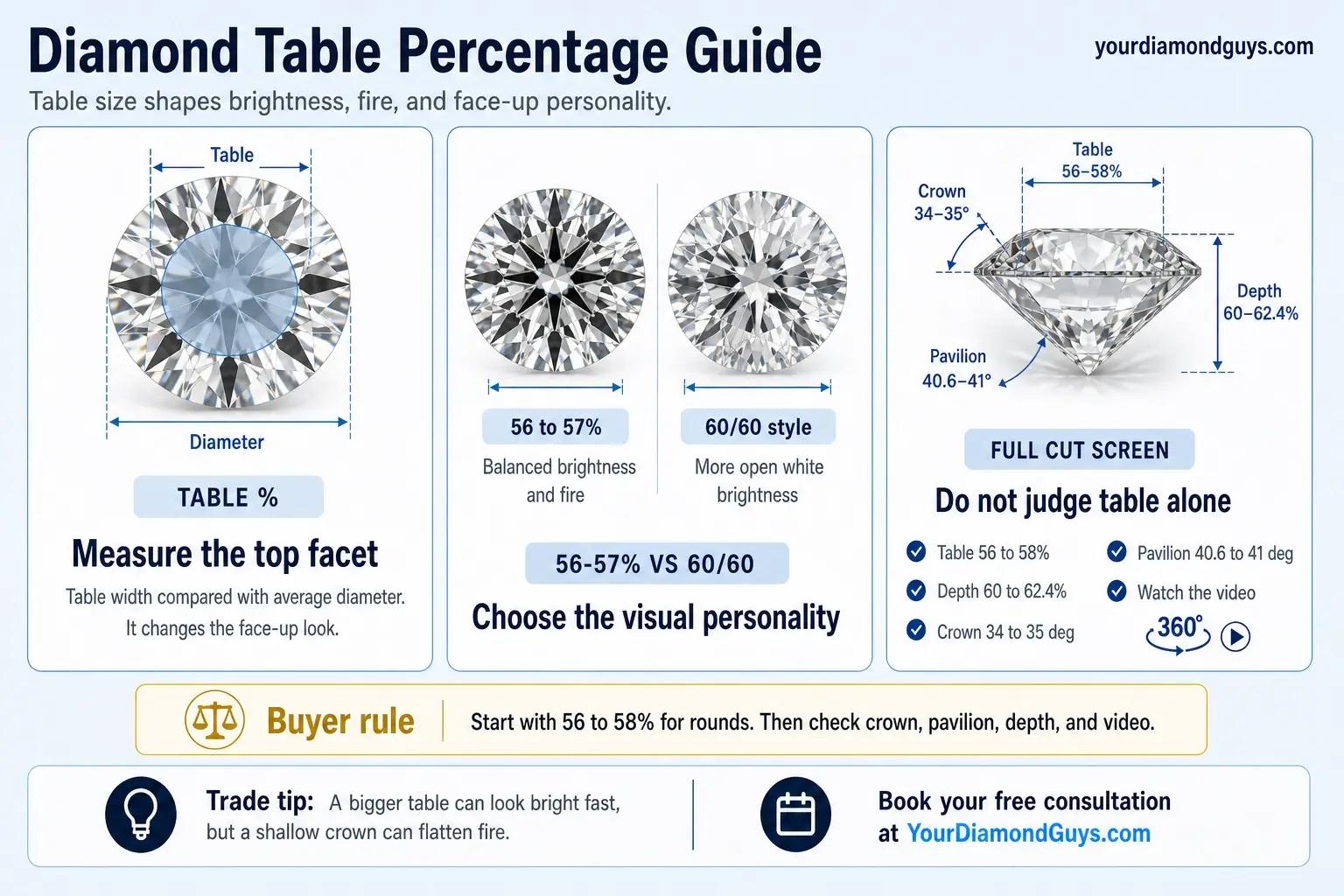
The table is the large flat facet on top of the diamond. Table percentage compares that facet to the diamond's average diameter.
For round brilliants, I usually start with table 56 to 58 percent. Many of my favorite stones sit around 56 to 57 percent because they balance brightness and fire well.
55 To 57 Percent vs 60/60 Diamonds
A 56 to 57 percent table often gives you more balanced fire and brightness. A 60/60 style diamond often favors white brightness and spread.
That does not make every 60/60 diamond bad. It means the buyer should know what look they are choosing.
| Table Style | Common Look | Buyer Watchout |
|---|---|---|
| 56 to 57 percent | Balanced brightness and fire | Still needs angle and video review |
| 58 to 60 percent | More open white light look | Can lose fire if crown is too low |
| Over 60 percent | Larger table appearance | Higher risk of flat look |
| Very small table | Potential fire emphasis | Can look unusual or heavy if paired poorly |
Table Percentage Does Not Work Alone
A table number only matters with depth, crown angle and pavilion angle .
A 56 percent table can still sit on a weak stone. A 60 percent table can still perform if the rest of the cut supports it. The table is one clue, not the verdict.
For round brilliants, my starting screen is table 56 to 58 percent, depth 60 to 62.4 percent, crown angle 34 to 35 degrees, pavilion angle 40.6 to 41 degrees, Excellent polish, Excellent symmetry, and none to faint fluorescence.
My Call On Table Size
Start with 56 to 58 percent for a round brilliant. Then check crown and pavilion angle. Then watch the video.
Reject the stone when the table is large, the crown is shallow, and the video looks flat. That combination usually means you are paying for a report that sounds better than the diamond looks.
Reach out to Rob or me at YourDiamondGuys.com, or book your free consultation. We will look at the actual stone with you. No sales pitch.
Where Table Size Changes The Look
Use table percentage to understand the diamond's visual personality. Then check the crown angle, pavilion angle, depth, and video. A table number by itself does not approve or reject a stone.
Mistakes I Would Skip
- Do not approve or reject a diamond from table percentage alone.
- Do not assume a bigger table means a better looking diamond.
- Do not ignore crown angle when judging fire.
- Do not compare 60/60 style stones without watching the video.
Table Size Desk Example
A 56 percent table round and a 60 percent table round can both be attractive. The 56 percent table can give a more balanced fire and brightness look. The 60 percent table can look brighter and more open. I would not choose from that number alone. I would check crown angle, pavilion angle, depth, spread, and video before deciding which look is worth the price.
Questions I Ask About Table Size
- What is the table percentage?
- What are the crown angle and pavilion angle?
- Does the stone favor white brightness or fire?
- Does the video show a flat look or balanced performance?
Where I Would Compare Table Tradeoffs
Use these sites as comparison tools, not automatic recommendations. I would compare similar stones on Ritani and Blue Nile, then judge each diamond by the report, video, spread, and price. If the stone is weak, the link does not save it.
Questions? Reach out directly for a free consultation, or drop them in the Diamond Buyers Academy community — Rob and I answer personally.
Questions Buyers Ask Us
Think of diamond table percentage as the width of the top table facet compared with the diamond's average diameter. It affects brightness, fire, and the face up look.
For many round brilliants, I start with 56 to 58 percent. A 56 to 57 percent table often gives a strong balance of brightness and fire.
No. A 60 percent table can work. It needs the right depth, crown angle, pavilion angle, and video performance.
Yes. Table size and crown structure affect how much rainbow fire the diamond shows. Larger tables can reduce fire when paired with a shallow crown.
No. Reject based on the full cut picture. Table, depth, angles, images, and video should all be read together.
*Some links on our site may earn us a small commission at NO EXTRA cost to you, helping us keep our content free*