Diamond Obstruction and Head Shadow Guide
By Josh Allen, Co-Founder of YourDiamondGuys.com. Fifth generation diamantaire with 30+ years in the global diamond trade. Former supplier to Tiffany & Co., Cartier, and Harry Winston.
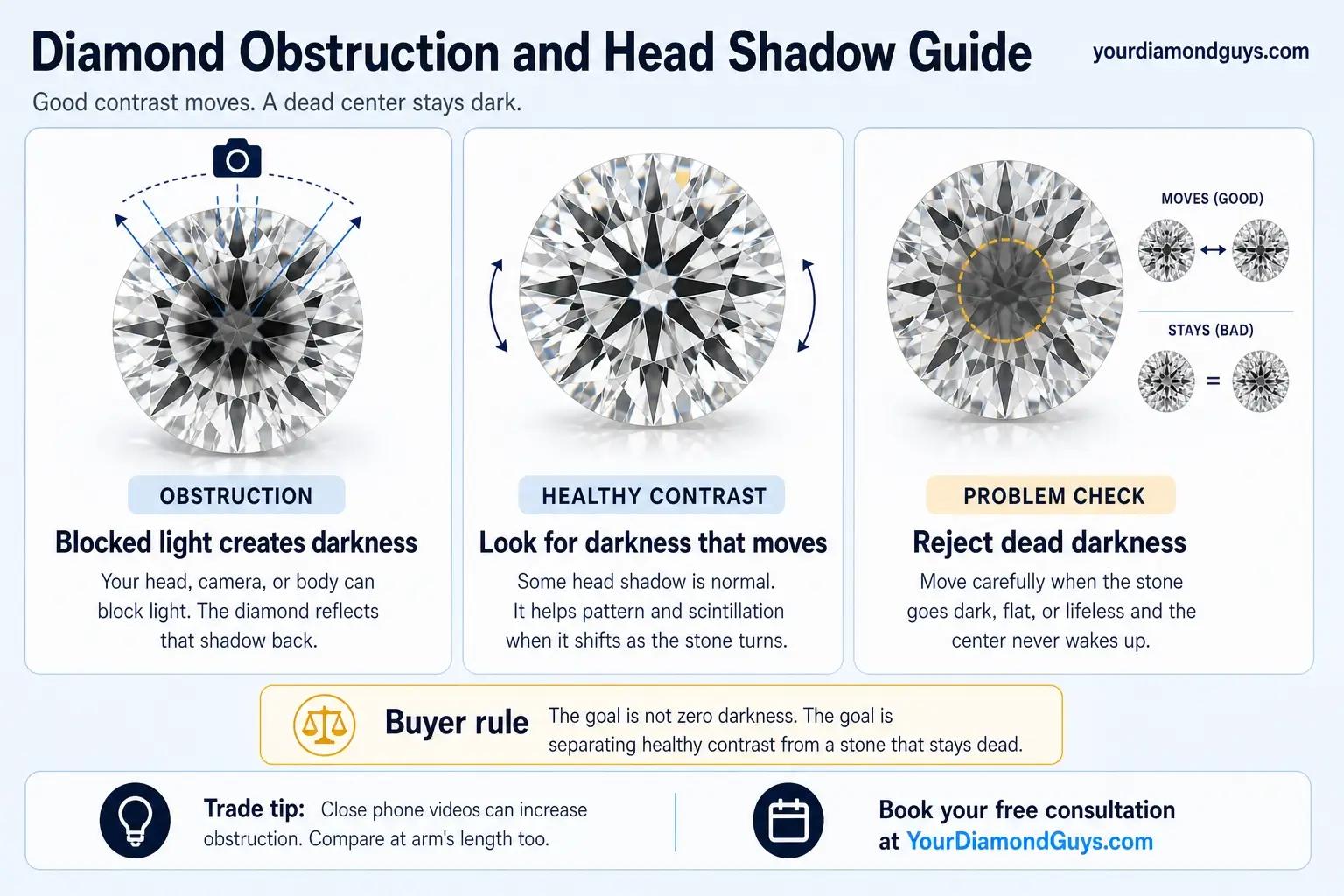
Here is the difference, diamond obstruction creates good contrast when it moves, but it becomes a problem when the stone goes dark and stays dead.
Most buyers think a diamond that goes dark up close must be poorly cut. Not always. Some darkness is obstruction. The real question is whether that darkness creates pattern or kills the stone.
I always start with GIA for natural diamonds. Not because the cut grade alone is enough, but because GIA gives me proportions I can actually trust. Softer lab reports do not give me the same confidence in those numbers.
A close phone video can make a good round diamond look darker than it really is. That does not mean I ignore it. I compare distance, movement, and whether the dark areas turn into pattern or stay dead.
What Obstruction Means
Obstruction happens when your head, camera, or body blocks light from reaching the diamond. The diamond reflects that blocked light back as darkness.
This is normal to some degree. Every diamond has to deal with the viewer being in the way.
Obstruction vs Leakage
Obstruction is blocked light. Leakage is escaped light. They can both look dark, but they are not the same problem.
| Issue | Cause | What To Look For |
|---|---|---|
| Obstruction | Viewer or camera blocks light | Darkness changes with position |
| Leakage | Cut sends light away | Area stays weak or watery |
| Good contrast | Healthy patterning | Dark and bright areas move together |
| Bad darkness | Weak performance | Large area stays lifeless |
The Phone Camera Problem
Close viewing increases obstruction. That is why a diamond can look darker in a phone video than it does at arm's length.
A well cut stone handles that better. The darkness becomes pattern. A weak stone becomes dead.
My Call When A Buyer Sends A Dark Video
Do not reject every dark pattern. Reject lifeless darkness.
Watch the diamond at different viewing distances when possible. If the pattern wakes up as the stone moves, that is very different from a center that never returns light.
Reach out to Rob or me at YourDiamondGuys.com, or book your free consultation. We will look at the actual stone with you. No sales pitch.
The Distance Test
Use obstruction review when a diamond looks dark in video, up close, or under different lighting. The goal is not to eliminate all darkness. The goal is to separate healthy contrast from a stone that goes dead when your head or camera blocks light.
I like two looks at the same stone. One close video. One a little farther back. If the darkness turns into crisp pattern as the camera backs up, that is a very different story from a center that stays lifeless.
Mistakes I Would Skip
- Do not reject normal arrow contrast in a round brilliant.
- Do not approve a diamond with a center that stays dead through the whole video.
- Do not confuse phone camera darkness with true leakage without checking movement.
- Do not buy a stone that only looks good from one distance or one angle.
Close Video Example
A buyer sends a close phone video of a round diamond and says the center looks dark. I do not reject it from that clip alone. I ask whether the darkness changes as the camera moves. If the dark areas form clean arrows and shift with movement, that can be normal contrast. If the middle stays dead from every angle, that is a different conversation. The same dark look can mean two different things. This is why I like comparing one video at close range and another at a more normal viewing distance.
Questions I Ask Before Calling It Leakage
- Does the dark area move as the diamond turns?
- Can you provide a video from a slightly greater viewing distance?
- Is the darkness normal contrast or a leakage problem?
- Can performance images confirm what I am seeing in video?
Where I Would Compare Video Behavior
Use these sites as comparison tools, not automatic recommendations. For fancy shapes, I would compare actual stone videos on Brilliant Earth and Ritani, then judge the outline, bowtie, leakage, and spread for myself. The logo does not make the diamond better.
Watch: Finding the Perfect Diamond
Questions? Reach out directly for a free consultation, or drop them in the Diamond Buyers Academy community — Rob and I answer personally.
Questions Buyers Ask Us
Think of obstruction as darkness caused when the viewer, camera, or nearby object blocks light from entering the diamond.
Some head shadow is normal. It becomes a problem when the stone goes dark in a way that looks lifeless rather than patterned.
Obstruction is blocked light. Leakage is light escaping through the diamond instead of returning to your eye.
The phone and the viewer can block light at close range. Review movement and distance before judging the stone.
Yes. Dark arrows in a round brilliant can be normal contrast. They should look crisp and move with the diamond.
*Some links on our site may earn us a small commission at NO EXTRA cost to you, helping us keep our content free*