Diamond Cut Grade Terms By Lab
Check which field earned Excellent, then ask for video.
By Rob Cornfield, Co-Founder of YourDiamondGuys.com. Cofounder and diamond sourcing specialist focused on cut quality, light performance, and trade value.
Excellent is a label inside a system. It is not a universal unit of sparkle. GIA Excellent, IGI Ideal, retailer Super Ideal, GCAL 8X, and AGS 0 describe different rules and different amounts of proof.
Read who assigned the term, what they measured, and how the actual diamond performs.
GIA explains that its round brilliant cut system evaluates brightness, fire, scintillation, weight ratio, durability, polish, and symmetry. Its five cut grades run from Excellent to Poor.
Does excellent mean the same thing on every report?
No. Excellent, Ideal, 8X, and AGS 0 belong to different grading systems. Compare criteria, eligible shapes, proportions, finish, and light performance evidence before comparing labels.
A diamond grading report creates system specific information. It does not translate itself across other labs.
For natural diamonds, start with GIA. Then use proportions, images, video, ASET, Ideal Scope, or other reliable proof to narrow the grade range.
What does GIA excellent actually cover?
See the illustrations in GIA’s cut grading research for examples of the appearance factors researchers evaluate.
GIA assigns an overall cut grade to standard round brilliants in the D to Z color range. Excellent sits at the top of a five grade scale.
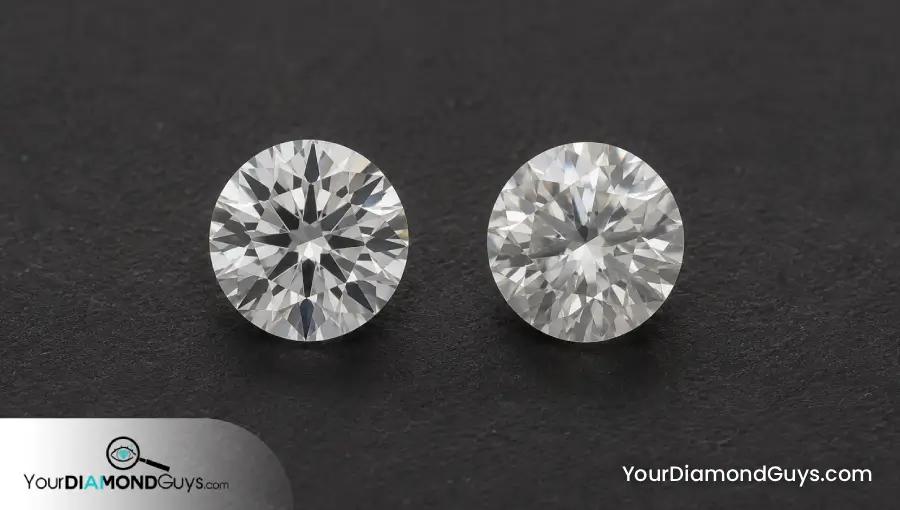
Two round diamonds showing different facet contrast in the same light.
The grade combines appearance, design, craftsmanship, and durability factors. That breadth makes it useful, but it also creates a range. Two GIA Excellent rounds can show different diameter, contrast, leakage, and optical symmetry.
For a clean search, I narrow around a 56 to 58 percent table, 60 to 62.4 percent depth, 34 to 35 degree crown angle, and 40.6 to 41 degree pavilion angle. Excellent polish and symmetry keep finish strong. The GIA cut grade guide explains the base system. Then I look.
| Term | Who can assign it | What it proves | What remains |
|---|---|---|---|
| GIA Excellent | GIA for eligible rounds | Top GIA cut category | Performance within the range |
| Triple Excellent | Market shorthand | Excellent cut, polish, symmetry | Optical precision and leakage |
| Ideal | Lab or seller specific | Whatever that system defines | Criteria and independent proof |
| AGS 0 | Legacy AGS system | Ideal result under AGS rules | Current condition and identity |
| GCAL 8X | GCAL | Excellent in eight cut factors | Preference, origin, and price |
| Super Ideal | Usually retailer language | No universal standard | Independent images and measurements |
Why is triple excellent not a separate GIA grade?
Triple Excellent is trade shorthand for Excellent cut, Excellent polish, and Excellent symmetry on a GIA round report. GIA does not print a separate Triple Excellent grade.
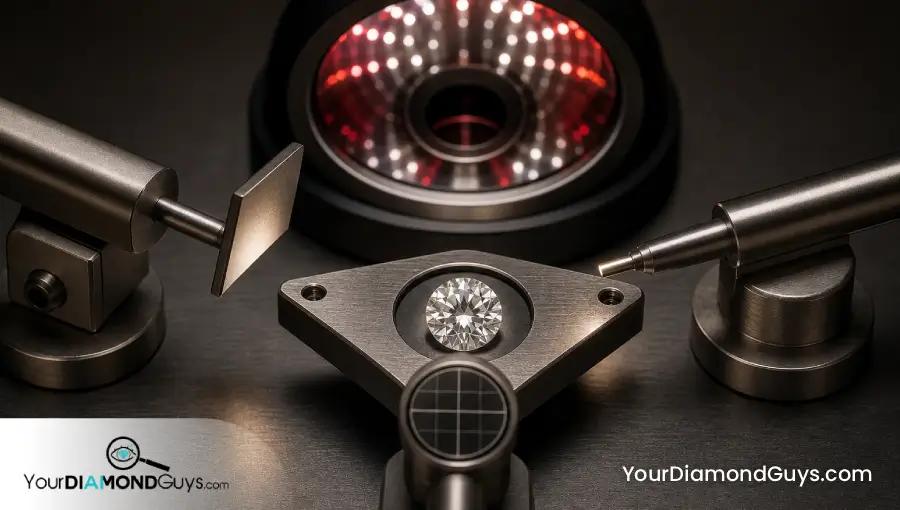
Single round diamond checked by three finish and cut instruments before a separate light-performance test.
The phrase sounds elite. In a broad inventory it can still include steep and deep combinations, weak spread, painting or digging, and inconsistent optical symmetry.
I have rejected piles of Triple Excellent stones because the arrows broke up or the center leaked. The three words save search time. They do not finish the selection.
What does ideal mean on IGI or a retail listing?
Ideal only means something inside the lab or seller’s stated criteria. Ask whether it is an independent lab grade, a retailer filter, or a branded collection name.
Round diamond on a premium display pedestal disconnected from empty proportion symmetry and light-performance tests.
Then read the proportions and images. A retailer can label a stone Ideal or Super Ideal without giving Hearts and Arrows, Ideal Scope, ASET, or another consistent performance image.
Retail language can be useful curation. It is not proof until the seller shows how the candidate qualified.
How do AGS 0 and GCAL 8x differ?
AGS 0 came from the legacy AGS zero to ten system and emphasized modeled light performance. Current GIA supplemental AGS Ideal reports continue that light performance heritage for eligible stones.
GCAL 8X requires Excellent in eight categories spanning physical cut, light performance, and optical precision. It uses GCAL’s own certificate and guarantee framework.
Both give more cut context than a basic headline. Their terms are not interchangeable. Read the AGS system guide and GCAL 8X guide before comparing premiums.
What proof is safer than the label alone?
Start with exact measurements and proportions. Add a neutral rotating video. For precision rounds, add Hearts and Arrows plus an Ideal Scope or ASET style light map from a controlled setup.
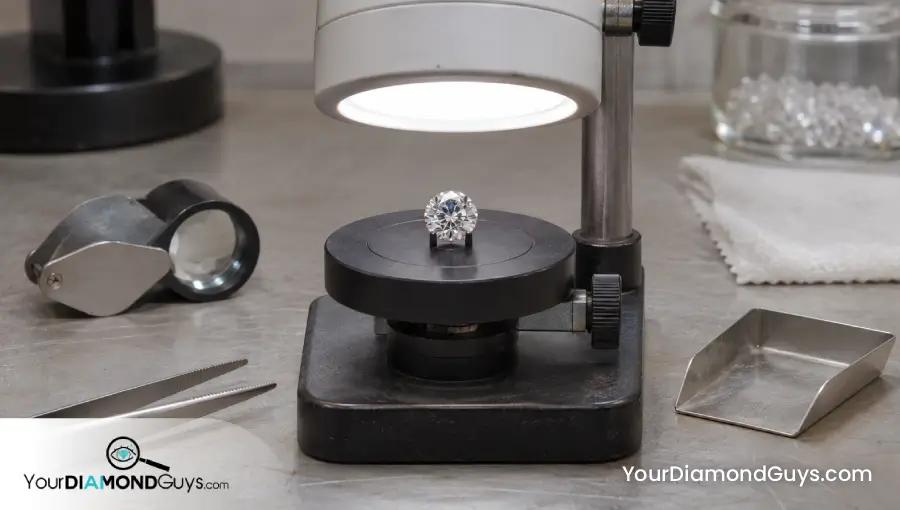
Round diamond on a rotating stage under neutral light.
Check spread, center brightness, arrow contrast, leakage, scintillation, and whether the stone stays lively away from spotlights. Fancy shapes need outline, bow tie, windowing, and facet texture checks that no round label solves.
The hierarchy is simple. Independent report, measured geometry, controlled performance image, neutral video, and return protection. A seller adjective sits below all of them.
How should cut language change your search?
Use GIA Excellent as the first natural round filter, not the last decision. Translate every other cut label back into its criteria and proof.
When two diamonds carry different labels, compare what was measured. If one seller cannot show the evidence behind a premium term, remove the premium before comparing price.
Excellent versus ideal in a real comparison
Stone A is a GIA Triple Excellent round with a 41.2 degree pavilion and 35.5 degree crown. Stone B is also GIA Triple Excellent with a 40.8 degree pavilion, 34.5 degree crown, balanced arrows, and minimal leakage.
The label ties. The evidence does not. Stone B gets the stronger cut recommendation.
Stone C is retailer labeled Super Ideal but has no scope images or qualification standard. I treat the term as marketing until the seller provides proof.
Cut label traps that hide weak performance
- Comparing Excellent across labs as one grade.
- Calling Triple Excellent a separate GIA grade.
- Paying for Super Ideal without qualification evidence.
- Using round proportion rules on fancy shapes.
- Treating Hearts and Arrows as the whole cut grade.
- Ignoring face up diameter and hidden weight.
Proof to request beyond the cut label
- Who assigned this term?
- Which published criteria define it?
- Which shapes qualify?
- What are the exact crown and pavilion measurements?
- Can I see controlled light performance images?
- How does the premium compare with a proven alternative?
My bottom line on cut terminology
Treat every cut word as a doorway into the evidence. Never treat it as the evidence itself.
For a natural round, GIA Excellent, tight proportions, Excellent polish and symmetry, and strong visual proof create the cleanest path. For fancy shapes, the actual face up pattern decides.
Get Your Free GIA Report Analysis
Questions? Reach out directly for a free consultation, or drop them in the Diamond Buyers Academy community — Rob and Josh answer personally.
What do buyers ask about cut grade terms?
← Browse all diamond grading guides
Want another set of eyes on the diamond?
Send the listing, grading report, price, and any video you have. We can look at the lab report, measurements, video, and price to make sure the evidence supports the price.
*Some links on our site may earn us a small commission at NO EXTRA cost to you, helping us keep our content free*