Diamond Lab Report Buying Checklist
Pause when the report, seller listing and actual diamond disagree.
By Josh Allen, Co-Founder of YourDiamondGuys.com. Fifth generation diamantaire with 30+ years in the global diamond trade. Former supplier to Tiffany & Co., Cartier, and Harry Winston.
Print this before the seller’s lighting and countdown clock get inside your head. The checklist has one job. Prove identity, expose grading and condition risk, and make sure the actual diamond supports the paper.
A blank box means you need evidence. It does not mean you need a sales explanation.
GIA advises online buyers to get an independent grading report, verify it through Report Check, and look for a laser inscription. Those three checks form the identity backbone below.
What must you check on a diamond report before buying?
Use your browser’s Print command to keep a copy of this checklist.
Verify laboratory, report number, origin, listing match, inscription, measurements, grades, cut data, comments, clarity evidence, treatment, video, price, return terms, and independent inspection rights.
Read Diamond Certification 101 first if the seller uses certified as the whole pitch.
For a natural diamond, start with GIA. For a lab grown diamond, confirm current report format, manufactured origin, growth and treatment wording, and inscription.
Can you prove the report is real and current?
Open the issuing laboratory’s official lookup yourself. Match the live record with the report and seller listing. Save all three before payment.
Use the report verification guide when a PDF is cropped, a field differs, or a seller sends a lookup screenshot instead of the official record.
- ☐ Laboratory name and report type are clear.
- ☐ Report number loads on the official laboratory domain.
- ☐ Report date and current report format make sense.
- ☐ Origin says natural or laboratory grown clearly.
- ☐ Complete PDF or original document matches the live record.
- ☐ Seller listing matches the archived record.
Does the physical diamond match the file?
A valid record is not a physical match. Use the girdle inscription, dimensions, weight, clarity features, and independent inspection to connect the stone to the report.
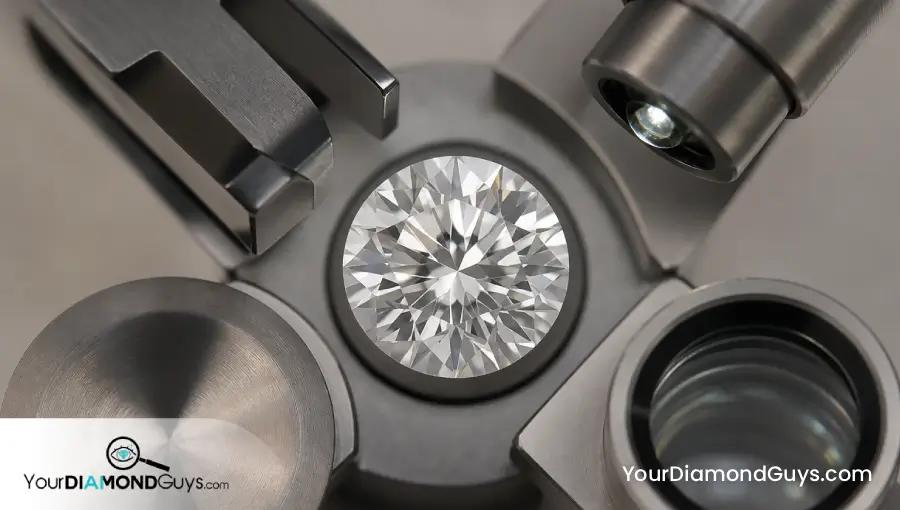
Single round diamond surrounded by diameter, weight, inscription, and inclusion verification tools.
The laser inscription guide explains what to do when a prong blocks the number or no inscription exists.
- ☐ Full inscription matches every recorded character.
- ☐ Shape and cutting style match.
- ☐ Length, width, and depth match.
- ☐ Carat weight matches.
- ☐ Plotted or described clarity features align with the stone.
- ☐ Seller confirms no recut, repair, or damage after grading.
Do the grades and proportions pass the first filter?
For a natural round, start with GIA Excellent cut. I narrow around table 56 to 58 percent, depth 60 to 62.4 percent, crown angle 34 to 35 degrees, and pavilion angle 40.6 to 41 degrees.
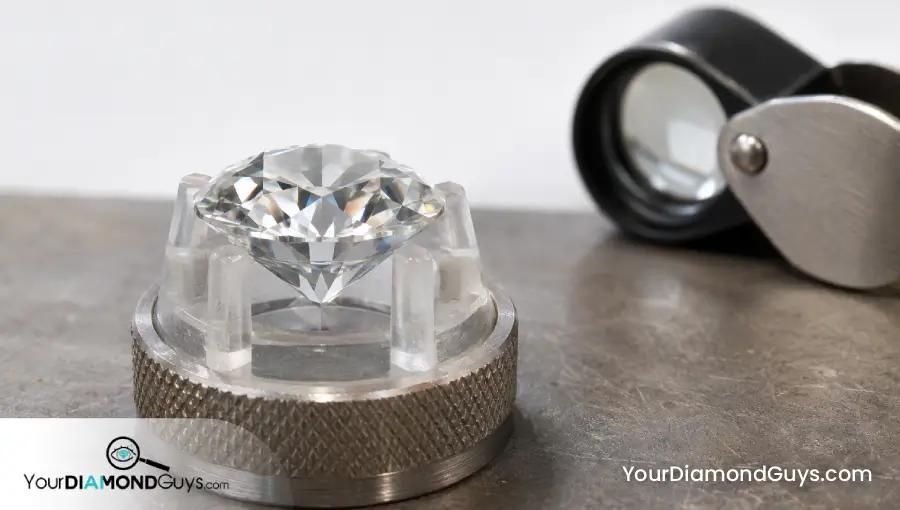
Round diamond in a holder showing its crown and pavilion.
Excellent polish and symmetry keep finish clean. None to faint fluorescence makes comparison simple. The cut terminology guide explains why those words need a named system.
- ☐ Face up millimeters make sense for shape and weight.
- ☐ Round proportions sit in a clean search zone or have stronger proof.
- ☐ Fancy shape outline, bow tie, windowing, and facet texture pass video.
- ☐ Color works for shape, size, metal, and budget.
- ☐ Clarity is eye clean under an agreed viewing standard.
- ☐ Fluorescence and transparency pass the relevant lighting test.
Have you read comments and clarity evidence?
Compare the clarity plot with GIA’s example before asking the seller to show the feature on the actual diamond.
Read the comments section and clarity plot together. One tells you what the diagram can omit. The other tells you where selected features sit.
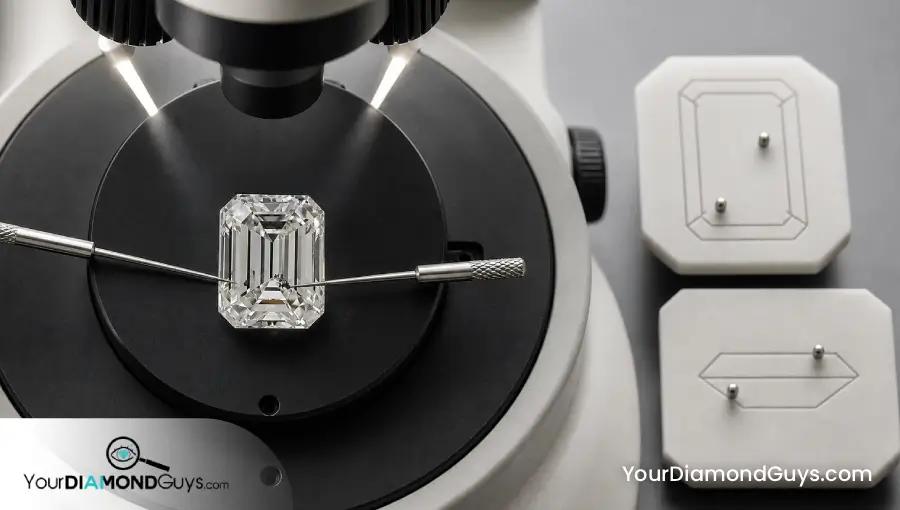
Emerald cut diamond under a microscope with locator pins marking a crystal cluster and side inclusion.
Bruise, chip, cavity, knot, etched channel, and indented natural require direct inspection. Clarity based on clouds not shown requires a transparency test.
- ☐ Comments contain no unexplained treatment or origin issue.
- ☐ Grade setting feature is identified.
- ☐ Surface reaching features have a durability opinion.
- ☐ Clouds and graining pass a transparency comparison.
- ☐ Step cuts and SI or I grades have enough location evidence.
- ☐ Missing plot information is replaced with images and inspection.
Does the video prove the diamond looks good?
The report narrows risk. The video shows the actual face. Ask for neutral lighting, normal speed, locked exposure, straight top view, side profile, and a slow rotation.
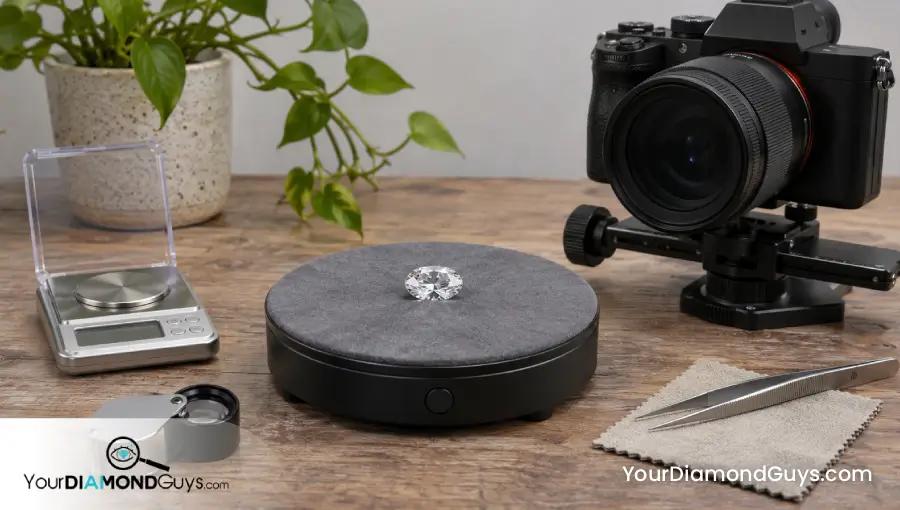
Oval diamond on a rotating stage in front of a macro camera.
Jewelry store spotlights make almost any polished diamond flash. Watch for persistent dark zones, weak center, haze, tint, windowing, broken symmetry, and outline problems away from the spotlight.
- ☐ Video shows the exact report number candidate.
- ☐ Exposure and zoom stay consistent.
- ☐ Face up and side views are available.
- ☐ Diamond stays crisp in neutral light.
- ☐ No persistent bow tie, window, or dead center dominates.
- ☐ Seller will provide additional proof for any report concern.
Are price and seller terms safe?
Use the lab choice price guide before comparing different reports as equal. A discount can already reflect grade or liquidity risk.
Keep the purchase contingent on identity and independent inspection. Save the exact return deadline, restocking terms, insured shipping instructions, and who carries risk.
| Result | What it means | Next action |
|---|---|---|
| Pass | Identity, quality, evidence, price, and terms agree | Complete independent sign off |
| Investigate | One answer is missing but objective proof is available | Pause and request the proof |
| Skip | Identity conflicts, risk is confirmed, or protection fails | Choose another diamond |
- ☐ Price compares with the same lab, origin, shape, and quality.
- ☐ Non GIA natural diamond price protects conservative GIA outcomes.
- ☐ Return window allows independent inspection.
- ☐ No hidden restocking or setting exclusion blocks return.
- ☐ Insured return shipping responsibility is written.
- ☐ Invoice identifies the report number and complete item.
Which findings mean pass, investigate, or skip?
Pass means the report, listing, inscription, stone, video, price, and terms agree. Investigate means one answer is missing but the seller can provide objective proof.
Skip means origin or identity conflicts, treatment is hidden, the seller refuses verification, the video confirms a report risk, or return protection cannot cover an independent check.
A completed buying checklist in practice
A 1.25 carat GIA natural round passes official lookup, inscription, measurements, proportions, comments, eye cleanliness, and neutral video. The invoice lists the report number and the return window allows an appraiser.
One box remains open because the seller has not shown the inscription. That is investigate, not pass. The seller sends a microscope image and the independent appraiser confirms it after delivery.
Now the identity chain closes. Price still needs comparison, but the file is strong enough to make a real decision.
Checklist shortcuts that let bad evidence through
- Checking boxes from seller claims without evidence.
- Letting a high grade cancel a mismatch.
- Using round filters on fancy shapes.
- Calling missing information harmless before inspection.
- Waiting until after sizing to verify the stone.
- Missing the return deadline while gathering proof.
Evidence to demand before a blank box becomes a yes
- Complete official report lookup and PDF.
- Microscope image of the full inscription.
- Neutral video and high resolution stills.
- Written identification of the grade setting inclusion.
- Treatment, growth, and origin explanation.
- Independent inspection and return rights in writing.
The final sign off rule
Do not sign off while an identity box is blank. Do not sign off while a risk box has only a sales answer.
A good diamond can survive a checklist. A good seller will help you complete it.
After decades of seeing deals cross the counter, I trust the seller who helps close the weak box. Pressure around missing proof is the answer.
Get Your Free GIA Report Analysis
Questions? Reach out directly for a free consultation, or drop them in the Diamond Buyers Academy community — Rob and Josh answer personally.
What do buyers ask about the lab report checklist?
← Browse all diamond grading guides
Want another set of eyes on the diamond?
Send the listing, grading report, price, and any video you have. We can look at the lab report, measurements, video, and price to make sure the evidence supports the price.
*Some links on our site may earn us a small commission at NO EXTRA cost to you, helping us keep our content free*