Diamond Laser Inscription Buyer Guide

Use the girdle inscription as one piece of the identity check.
By Josh Allen, Co-Founder of YourDiamondGuys.com. Fifth generation diamantaire with 30+ years in the global diamond trade. Former supplier to Tiffany & Co., Cartier, and Harry Winston.
The inscription is a license plate, not a force field. It helps connect a diamond to a grading report. It does not stop someone from copying a number, damaging a stone, or pairing the right report with the wrong listing.
Use it as one strong identity check inside a bigger verification chain.
GIA explains that a laser inscription sits on the diamond’s girdle and is visible under 10 times magnification. It can contain a report number, message, symbol, or logo.
What is a diamond laser inscription?
A laser inscription is microscopic text placed on the girdle, often a grading report number. Match the full inscription to the official lab record and the physical diamond.
The certified diamond guide explains the report’s role. The inscription helps show that the stone in front of you belongs with that report.
For a natural diamond, start with GIA. Diamond Dossier reports include a GIA report number inscription. Other report types and older stones need a case by case check.
Where is the inscription and what does it look like?
See GIA’s micrographs of girdle inscriptions for a close view of lettering against the surrounding facets.
Look along the girdle, the narrow outside edge between crown and pavilion. The text is tiny and usually invisible without magnification.
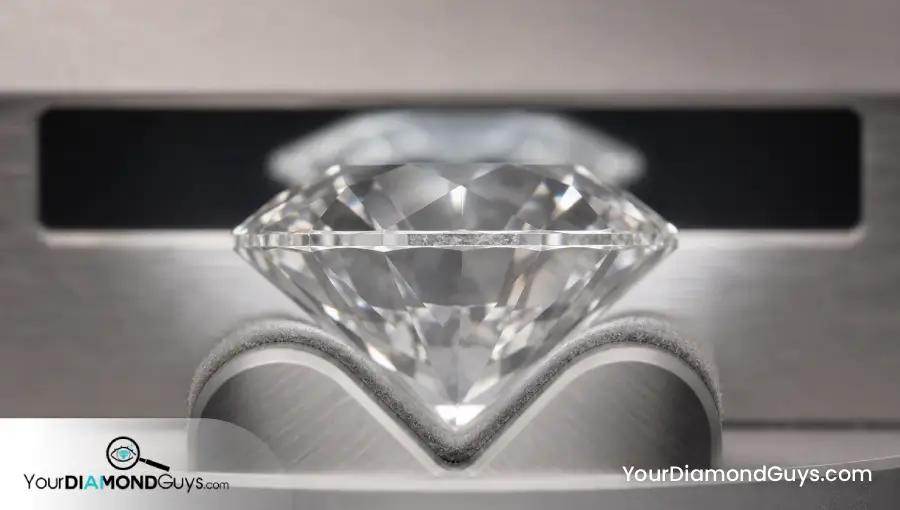
Side-profile round diamond with its thin girdle held in a razor-sharp focal band.
A loose diamond is easier to rotate and focus. In a ring, prongs can block the inscription, the setting can limit angle, and dirt can make the letters disappear. That does not mean the number was never there.
The characters can look gray, frosted, or dark depending on lighting and focus. Do not scrape or polish the girdle to make them clearer. Clean the diamond safely and change the viewing angle.
How do you read the inscription at home?
A good 10 times loupe can work, but a jeweler’s microscope is easier. Use bright diffused light and keep both the loupe and diamond steady.
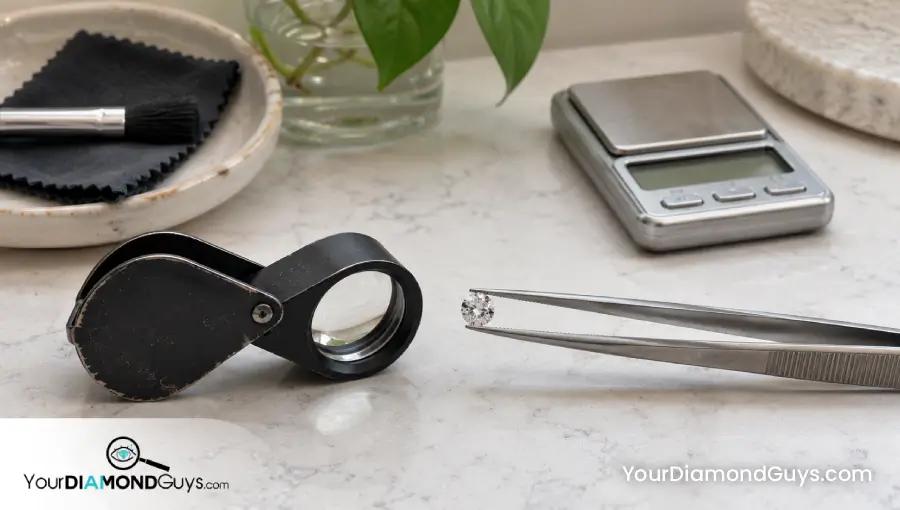
Jeweler’s loupe positioned toward a loose diamond held in tweezers.
Start at one prong or a visible girdle section and move around the circumference slowly. Refocus as the curved edge changes distance. Phone macro cameras often struggle without a loupe or microscope adapter.
If you cannot find it, ask a jeweler or independent appraiser. Do that before the return window closes, not after the ring has been resized or altered.
- Clean the diamond and dry it completely.
- Use 10 times magnification or a microscope.
- Focus on the girdle edge, not the table.
- Rotate the stone slowly through every open section.
- Photograph the full inscription when possible.
- Compare it with the lab’s official online record.
What exactly should match the report?
Match every character, including any prefix such as GIA or LG. A partial number is not enough when the remaining characters sit behind a prong.
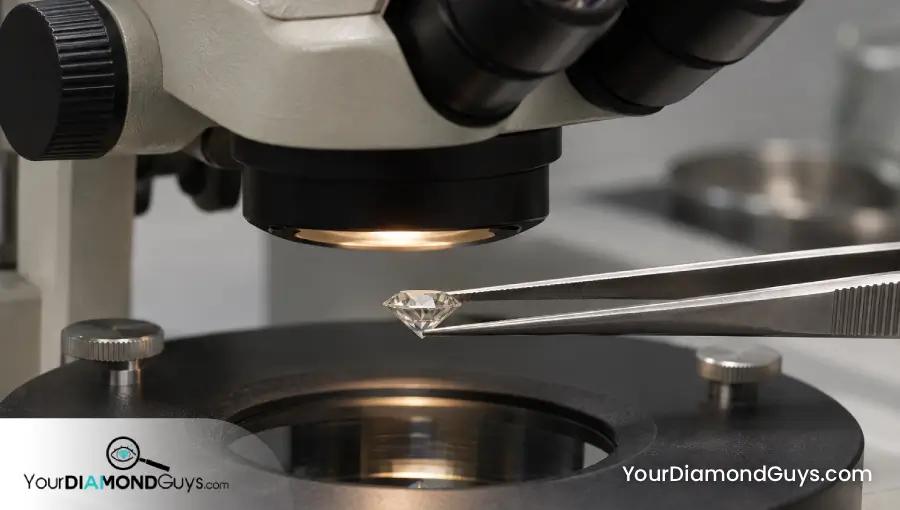
Diamond in tweezers beneath a gem microscope.
Then match the report number, shape, measurements, carat, color, clarity, finish, fluorescence, comments, and recorded inscription line. An inscription match without a data match still needs an explanation.
The report number verification guide shows how a copied real number can appear in a false listing. The physical and digital records need to agree.
| Evidence | What it supports | What it does not prove |
|---|---|---|
| Matching inscription | Stone to report connection | Current condition or fair price |
| Official report lookup | Lab record authenticity | Seller possession of the stone |
| Matching measurements | Physical identity consistency | Complete light performance |
| Clarity feature match | Stronger individual identification | Future durability |
What if the diamond has no inscription?
No inscription is not an automatic skip. Many older reports, some full report services, antique stones, and diamonds graded under different programs can be legitimate without one.
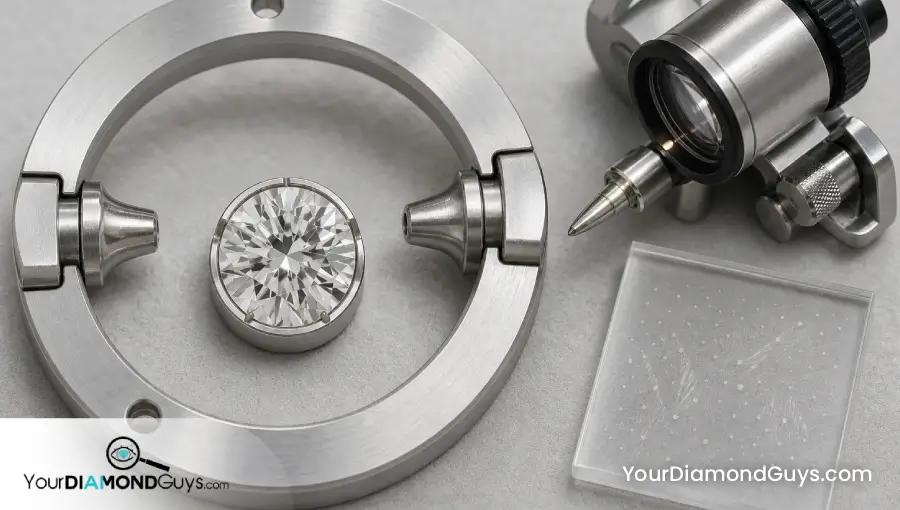
Uninscribed round diamond checked with a diameter collar and natural inclusion locator.
The proof standard changes. Match exact measurements, weight, proportions, clarity characteristics, comments, and any old photographs. For a valuable stone, use a qualified independent appraiser or the laboratory’s verification service.
A seller should not advertise an inscription that nobody can find. If the report says one exists and the girdle is fully visible, treat the absence as an identity question until resolved.
Can an inscription be removed or copied?
Yes. Polishing or recutting the girdle can remove an inscription. A number can also be copied onto another diamond. That is why the number alone never completes authentication.
Check whether the diamond was repaired, repolished, or recut after the report date. Compare current weight and measurements. A material change can make the old file inaccurate even when it once belonged to the stone.
On the trading floor, we use several identifiers because any single one can fail. Inscription, dimensions, weight, plot, comments, and direct examination create the stronger file.
When should a missing inscription change the purchase?
A missing optional inscription calls for stronger identification. A missing inscription that the report explicitly records calls for a pause.
A prong blocking the number is a practical problem. A seller refusing independent verification is a trust problem. Treat them differently.
A proper inscription check in practice
A GIA Dossier lists report number 1234567890 and records that number as the inscription. The ring arrives with one prong over part of the girdle.
A jeweler finds GIA 12345 on one side of the prong and the remaining digits after rotating the ring. Measurements and grades match Report Check. That is a clean identity chain.
If the visible text ends in different digits or the stone measures materially smaller than the report, stop. Do not let a matching GIA prefix create false comfort.
Inscription shortcuts that create false confidence
- Looking through the table instead of along the girdle.
- Accepting a partial number as a full match.
- Using a seller photo without checking the physical stone.
- Assuming no inscription means fake.
- Assuming an inscription means the stone is unchanged.
- Waiting until after resizing to verify identity.
Evidence to request before shipping
- Does the report record an inscription?
- Can the seller provide a microscope image of the full text?
- Will the setting block any part of the girdle?
- Has the diamond been polished or recut since grading?
- Can an independent appraiser verify it during the return period?
- What happens if the inscription or measurements do not match?
My inscription verification rule
Use the inscription to connect stone and report, then confirm the rest of the identity file.
A number match is strong. A number, measurement, plot, and official lookup match is much stronger. Finish with the report buying checklist.
Has Your Diamond Been Laser Drilled? Here’s How to Tell #highjewelry #diamonds
Questions? Reach out directly for a free consultation, or drop them in the Diamond Buyers Academy community — Rob and Josh answer personally.
What do buyers ask about laser inscriptions?
← Browse all diamond grading guides
Want another set of eyes on the diamond?
Send the listing, grading report, price, and any video you have. We can look at the lab report, measurements, video, and price to make sure the evidence supports the price.
*Some links on our site may earn us a small commission at NO EXTRA cost to you, helping us keep our content free*