Verify A Diamond Report Number Safely
Match the lab record, the listing and the stone.
By Josh Allen, Co-Founder of YourDiamondGuys.com. Fifth generation diamantaire with 30+ years in the global diamond trade. Former supplier to Tiffany & Co., Cartier, and Harry Winston.
A real report number can still sit on a fake PDF or beside the wrong diamond. The online lookup proves that the laboratory issued a record. It does not prove the seller owns that stone or that the package contains it.
Verification needs three matches: lab record, seller listing, and physical diamond.
For GIA reports, use GIA Report Check, which lets you confirm that report information matches the data archived in GIA’s database. Use the issuing lab’s own lookup for every other report.
How do you verify a diamond report number?
Look up the number on the issuing lab’s official site, match every key field to the listing, then match the recorded inscription and physical stone through magnification or independent inspection.
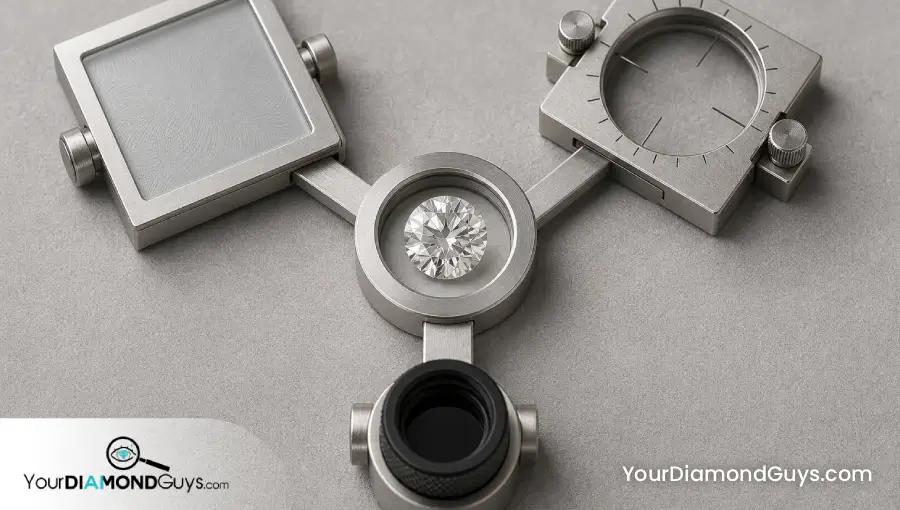
One round diamond centered where archive measurement and optical verification tools converge.
Start by understanding what a certified diamond report proves and what it leaves unproven.
Never verify through a link supplied inside an unfamiliar PDF without checking the domain yourself. Type or navigate to the laboratory’s official website.
What is the safest verification order?
Use the lab record as the source of truth. Enter the report number directly. Confirm the report date and document type before comparing grades.
Then match shape, cutting style, measurements, carat, color, clarity, cut grade when present, polish, symmetry, fluorescence, comments, and inscription. Small formatting differences are normal. Different measurements, grades, or comments are not.
Finally, inspect the stone. A loupe, microscope, or independent appraiser can locate the inscription and compare identifying clarity characteristics when the report has a plot.
- Open the official laboratory lookup page.
- Enter the report number manually.
- Compare the archived record with the PDF.
- Compare the archived record with the seller listing.
- Match the girdle inscription and physical stone.
- Save evidence before the return window closes.
Which fields must match exactly?
Report number, origin disclosure, carat weight, color, clarity, and listed inscription should match. Shape, measurements, finish, fluorescence, and comments should match as well.
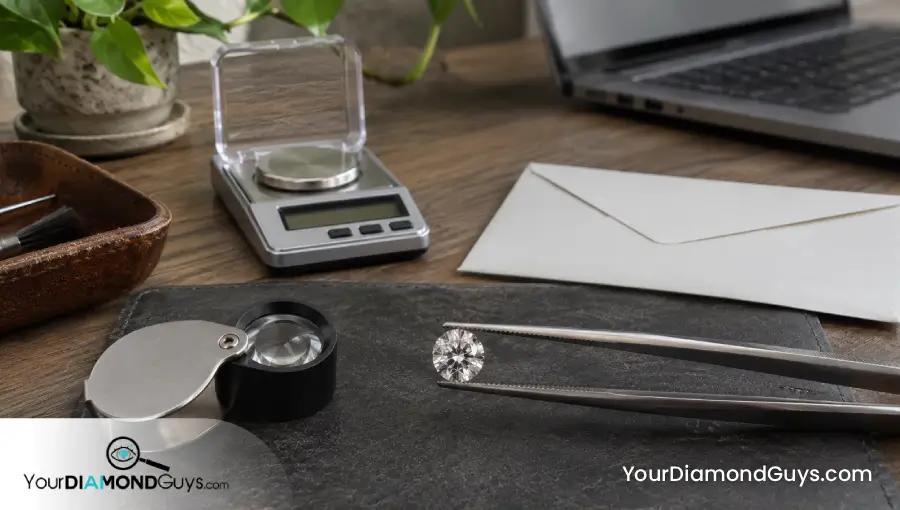
Loupe, loose diamond and a report envelope at a computer desk.
Retail listings sometimes round millimeters or shorten comments. That does not excuse a conflict. Ask the seller to explain and correct any difference in writing before payment.
A report PDF can look polished and still be altered. Archived data wins. GIA also warns that a PDF facsimile is not the original report and that current grading information appears through Report Check.
| Check | Normal result | Red flag |
|---|---|---|
| Official lookup | Record loads on lab domain | No record or copied lookup page |
| Measurements | Same values or honest rounding | Different footprint or depth |
| Grades | Every grade agrees | Color, clarity, or cut changed |
| Comments | Same disclosures | Treatment or origin wording missing |
| Inscription | Number and wording match | Wrong, altered, or unreadable number |
| Stone | Features align with report | Plot and diamond do not correspond |
What do fake or altered PDFs usually get wrong?
Altered PDFs often fail on typography, spacing, security artwork, QR destination, report date, or a field that no longer matches the lab database. You do not need to become a document examiner to catch them.
A real report number copied from another diamond is harder. The lookup works, but the seller’s stone, photos, or measurements do not match. That is why database verification alone is incomplete.
Watch for cropped pages, missing terms, blurry grade blocks, a QR code that opens a seller controlled page, and pressure to accept a screenshot instead of the live lab result.
How do you check a laser inscription?
Compare the two inscription micrographs in GIA’s case study to see why a number match alone cannot establish identity.
A report number inscription sits on the girdle and usually needs 10 times magnification. It can be faint, dirty, blocked by a prong, or positioned where a beginner struggles to find it.
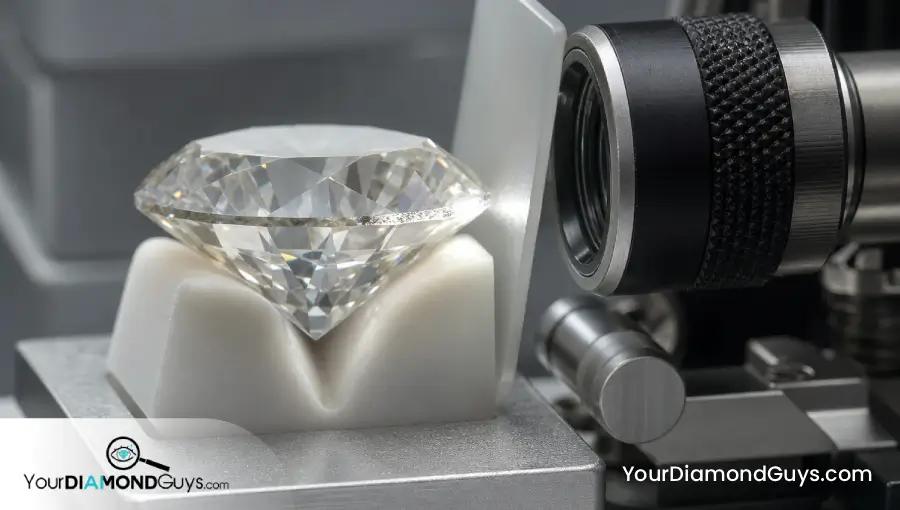
Round diamond viewed side-on in a cradle while a loupe inspects its girdle edge.
Ask the seller for a clear microscope image before shipping. After delivery, have an independent jeweler or appraiser confirm it while you are inside the return period.
No inscription does not automatically make a diamond fake. It changes the proof plan. Use the laser inscription guide to decide when the plot, measurements, or a laboratory verification service needs to carry more weight.
What should you save before and after purchase?
Save the listing, invoice, report lookup, complete PDF, videos, seller promises, return policy, shipping terms, and any inscription image. Files disappear and listings change.
On arrival, record the unopened package, condition, unboxing, ring, report, and inscription check. This is not drama. It is clean documentation while your return rights still protect you.
Then use the lab report buying checklist to close the remaining quality and risk checks before sizing or altering the ring.
When should a verification problem end the purchase?
A mismatch in origin, report number, carat, color, clarity, treatment, or measurements stops the deal until the seller resolves it with the issuing lab.
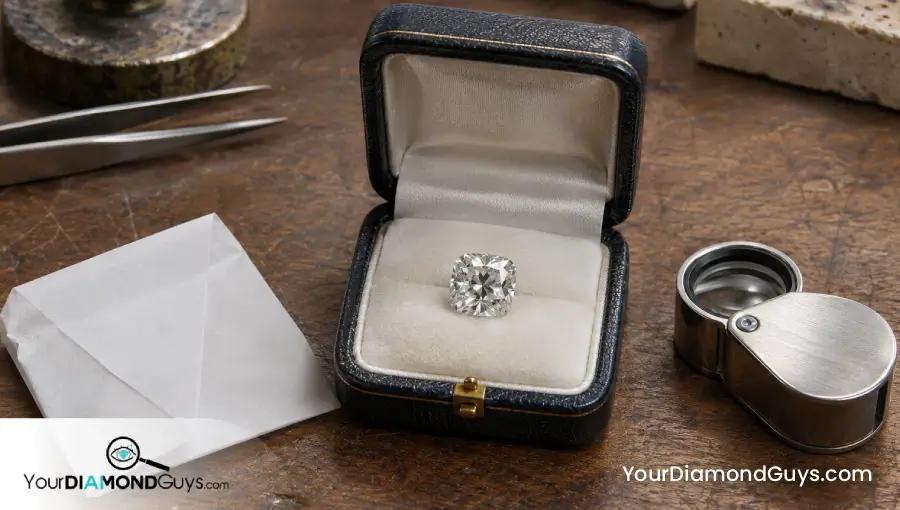
Loose cushion diamond back in its padded box beside a folded loupe.
A blocked inscription or minor listing rounding triggers an inspection, not an accusation. The difference is simple. Missing proof can be fixed. Conflicting identity cannot be ignored.
A fake certificate check in practice
A seller sends a GIA PDF for a 1.08 carat round, G color, VS2 clarity. Report Check loads a real record, but the archived measurements are 6.55 by 6.59 millimeters while the listing says 6.82 by 6.86.
That is not a typo I wave through. The size difference suggests a different diamond. I ask for a live inscription image and written explanation, then pause payment or return the stone.
If all fields match and an independent jeweler confirms the inscription, the identity chain becomes much stronger. You still need to judge cut, appearance, and value.
Verification shortcuts that break the identity chain
- Clicking a lookup link without checking the domain.
- Stopping after the report number returns a result.
- Comparing only carat, color, and clarity.
- Accepting a cropped or blurry PDF.
- Waiting until after sizing to inspect the inscription.
- Failing to save the listing and return terms.
Proof the seller needs to produce
- Can you send the complete report and official lookup result?
- Can you confirm every listing field matches the lab record?
- Can you provide a microscope image of the inscription?
- Will you allow independent inspection during the return window?
- Who pays return shipping if identity does not match?
- Has the diamond been recut, repaired, or altered since grading?
My report verification rule
Trust a chain, not a PDF. Official lab record, matching listing, matching inscription, matching stone.
When one link is missing, get stronger independent proof. When two links conflict, stop the purchase.
After decades in the trade, I treat a report number as a lead, not an identity verdict. Measurements and the physical stone still have to close the loop.
The Most Important Number on a GIA Report 🕵️♂️💎
Questions? Reach out directly for a free consultation, or drop them in the Diamond Buyers Academy community — Rob and Josh answer personally.
What do buyers ask about report number verification?
← Browse all diamond grading guides
Want another set of eyes on the diamond?
Send the listing, grading report, price, and any video you have. We can look at the lab report, measurements, video, and price to make sure the evidence supports the price.
*Some links on our site may earn us a small commission at NO EXTRA cost to you, helping us keep our content free*