Responsible Sourcing And Country Of Origin
By Josh Allen, Co-Founder of YourDiamondGuys.com. Fifth generation diamantaire with 25 years of experience in the global diamond trade. Former supplier to Tiffany & Co., Cartier, and Harry Winston.
Natural diamond origin claims need proof.
Canada, Botswana, South Africa, and other origin labels can matter to a buyer, but the label only helps when the seller can explain how the claim is documented.
For natural diamonds, start with GIA for grading. Then ask what the origin claim proves and what it does not prove.
In the trade, the cleanest sourcing stories have paperwork, not just polished language.
Country Of Origin Is A Specific Claim
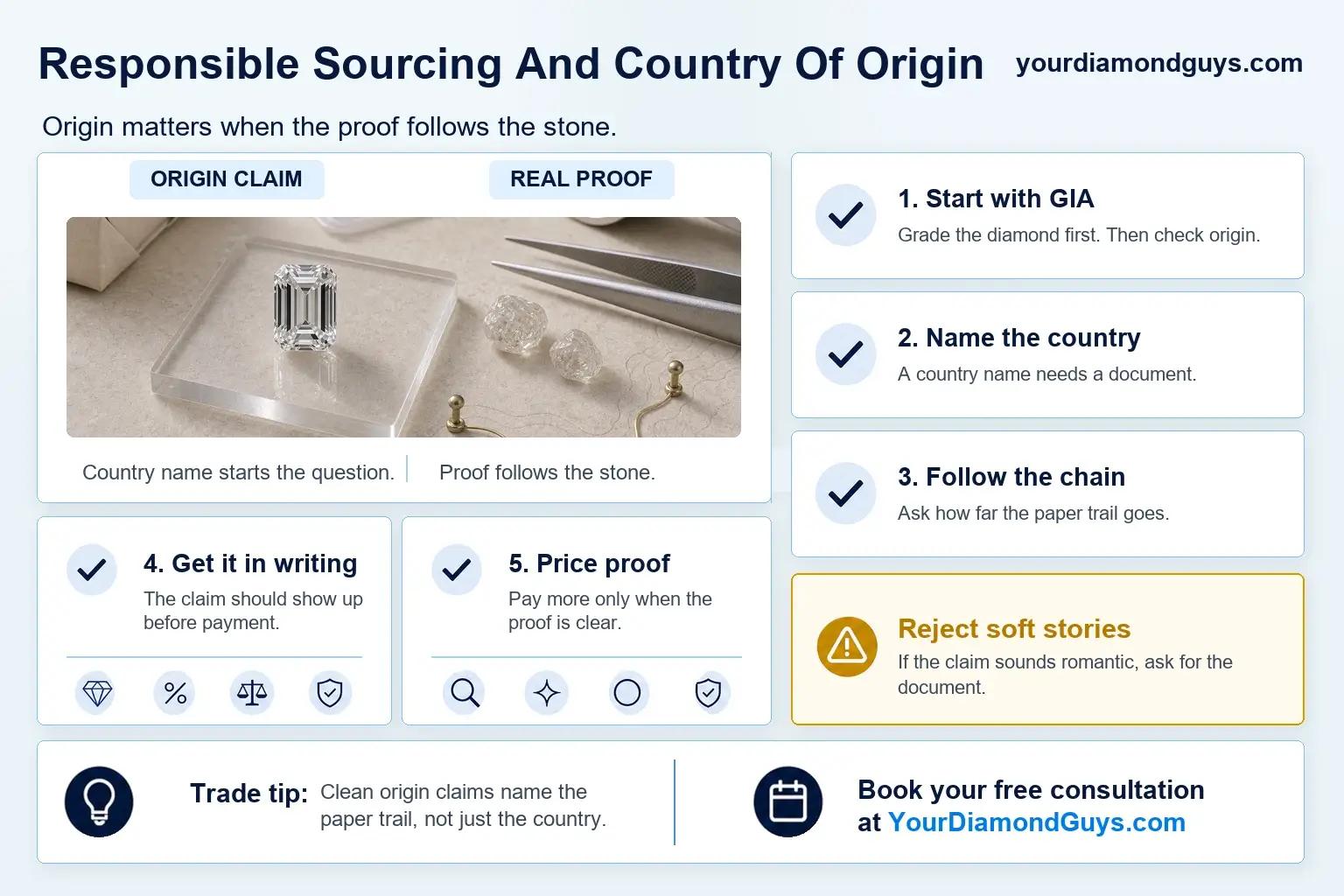
Country of origin should mean more than a romantic sentence on a product page. Ask whether the diamond has documentation that follows the stone, not just a general retailer policy.
If the seller cannot explain the claim clearly, treat it as marketing until proven otherwise.
Traceability Has Levels
Some diamonds have stronger chain of custody than others. Some programs document mine, sorting, cutting, and sale paths. Others give a broader sourcing assurance.
Use the conflict free diamond guide for the baseline claim, then ask for traceability details when origin matters.
The Buyer Filter
Use this table to separate real proof from comfort language.
| Seller Language | Buyer Meaning | Follow Up |
|---|---|---|
| Conflict free | Baseline sourcing claim | Ask what standard applies |
| Canadian origin | Country specific claim | Ask for documentation |
| Traceable | Chain of custody claim | Ask how far back it goes |
| Responsibly sourced | Broad policy claim | Ask for written standards |
My Buyer Recommendation
If origin matters to you, get it in writing. A clean sourcing story should be easy to explain before the sale.
Reach out to Rob or me at YourDiamondGuys.com, or book your free consultation. We will look at the actual stone with you.
How This Fits Into A Real Buying Decision
A buyer choosing between two similar natural diamonds can use documented origin as a tie breaker. I would not use it to excuse weak cut, bad video, or a messy report.
Mistakes I Would Avoid
- Do not accept origin language without documentation.
- Do not assume all conflict free claims mean full traceability.
- Do not pay a premium unless the proof supports it.
- Do not ignore cut quality because the sourcing story sounds good.
A Practical Example
A seller says the diamond is Canadian. I would ask which document follows the stone, what it identifies, and whether that origin claim appears in the sales paperwork.
What To Ask Before You Buy
- What country of origin is claimed?
- Which document supports the claim?
- Does the claim follow the specific stone?
- Does the price reflect a documented premium or a vague story?
Where I Would Compare Origin Proof
Use these sites as comparison tools, not automatic recommendations. I would compare origin and traceability details on Brilliant Earth and Ritani, then make sure quality, price, and documentation still justify the stone.
The Birth of a Diamond: A Marvel of Nature and Craftsmanship
Questions? Reach out directly for a free consultation, or drop them in the Diamond Buyers Academy community — Rob and Josh answer personally.
Questions Buyers Ask Us
*Some links on our site may earn us a small commission at NO EXTRA cost to you, helping us keep our content free*