Diamond Fluorescence 101
By Josh Allen, Co-Founder of YourDiamondGuys.com. Fifth generation diamantaire with 30+ years in the global diamond trade. Former supplier to Tiffany & Co., Cartier, and Harry Winston.
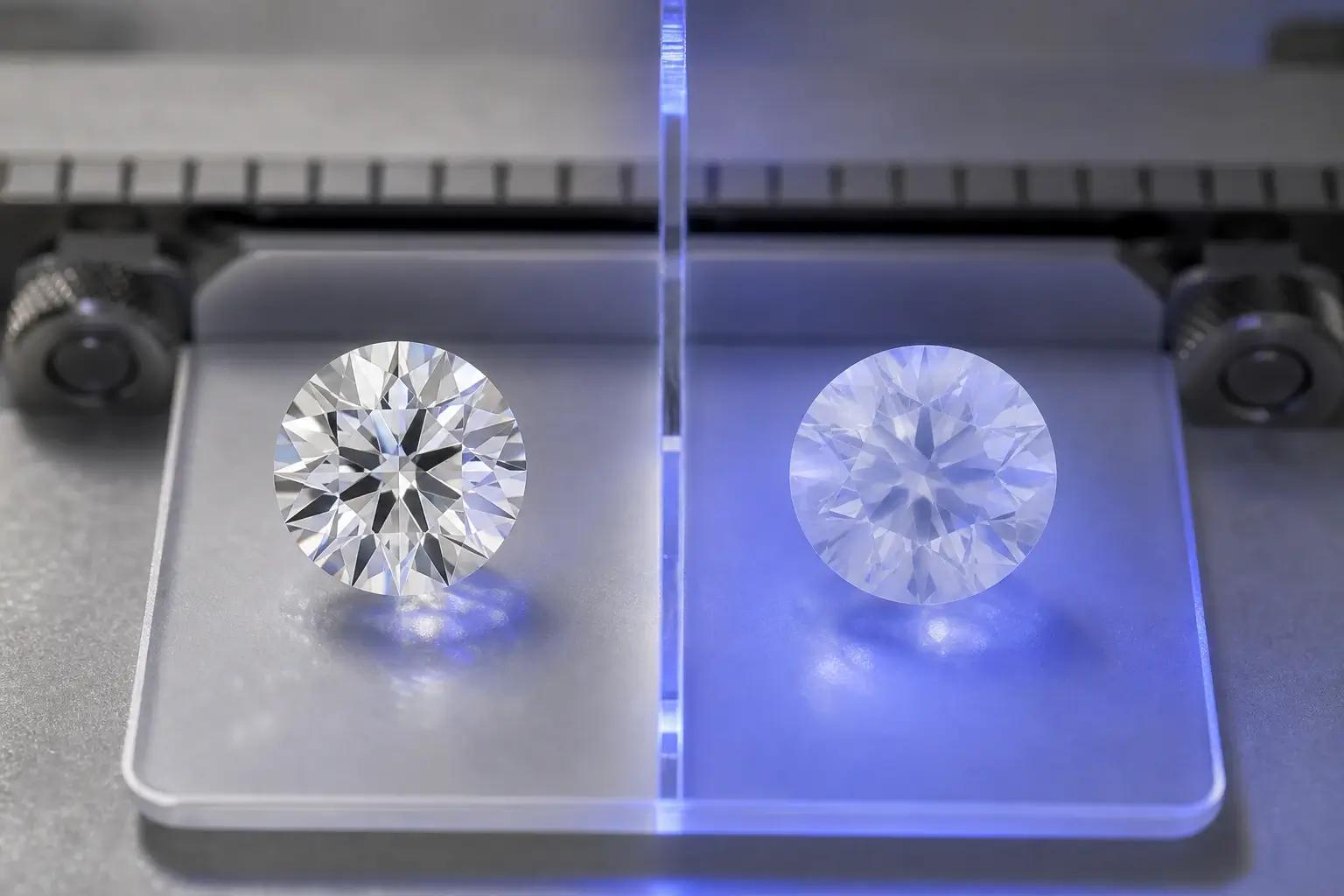
Fluorescence is not a defect. It is not a treatment. It is simply a diamond reacting to ultraviolet light.
Most of the time, that reaction has no visible effect in the lighting where you live. The buyer mistake is treating one word on the report as an automatic yes or an automatic no.
I have watched fluorescent diamonds trade for decades. We never bought the report label by itself. We looked at whether the stone stayed crisp, bright, and normal when it moved from the office to daylight.
The reaction is common, not suspicious. GIA reports that about 25 to 35 percent of diamonds show some fluorescence, and more than 95 percent of fluorescent diamonds show blue as the reaction color.
What Should You Know First About Diamond Fluorescence?
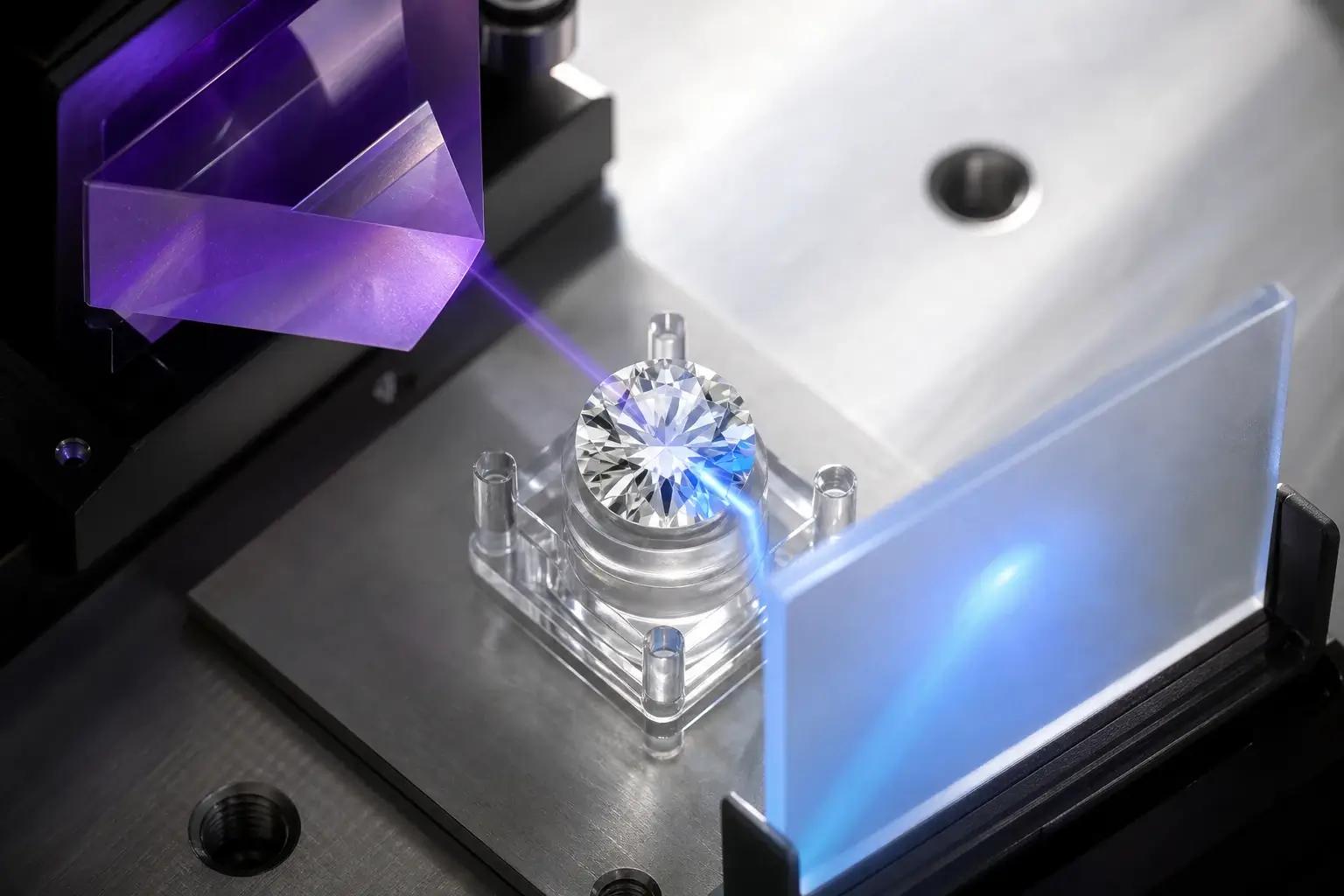
Diamond fluorescence is visible light emitted while the diamond receives ultraviolet energy. Blue is the usual color. The glow stops when the UV source goes away, which separates fluorescence from a lingering afterglow called phosphorescence.
None to Faint keeps the decision easy for most natural diamond buyers. Medium can be a value play, especially in a warmer color. Strong and Very Strong need better proof, but intensity alone does not prove the diamond is milky or hazy.
What Makes A Diamond Fluoresce
A diamond crystal can contain atomic scale defects and trace elements that absorb ultraviolet energy. That energy leaves as visible light. The N3 center, which involves nitrogen in the crystal structure, produces the blue reaction seen in most fluorescent natural diamonds.
This reaction does not weaken the diamond. It does not change the carat weight, clarity grade, or cut. Think of fluorescence as an identifying characteristic that becomes active under the right light, not as a permanent body color.
A fluorescence color can be blue, yellow, white, orange, green, or another rare hue. Color matters because blue can offset yellow visually, while yellow fluorescence can add warmth under UV rich light.
How GIA Describes The Reaction
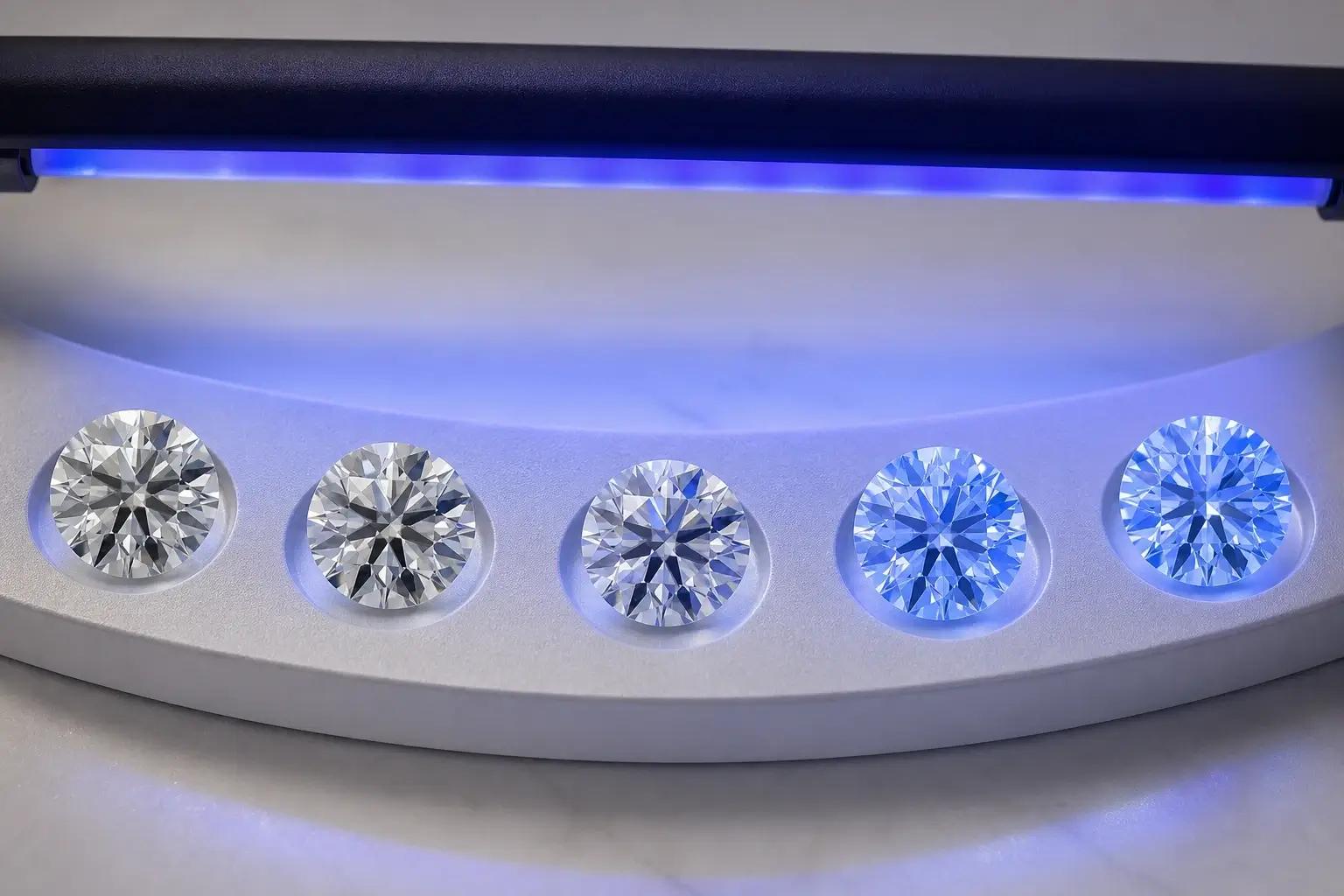
For natural diamonds, start with GIA. The fluorescence field describes intensity under long wave ultraviolet light. The GIA fluorescence scale runs from None through Faint, Medium, Strong, and Very Strong.
None does not promise that the diamond has zero measurable reaction. It means the reaction falls below GIA's Faint threshold. Medium and stronger descriptions include the observed fluorescence color on the report.
Fluorescence is not one of the 4Cs. It sits on the report because it helps identify the diamond and can affect appearance or market preference in certain stones.
| Report description | Normal buyer read | Next move |
|---|---|---|
| None | No reportable reaction beyond the None range | Keep judging cut, clarity, and video |
| Faint | Usually invisible outside testing | Treat as a clean decision |
| Medium | Can show in UV rich daylight | Check color and transparency |
| Strong | Reaction can become obvious | Require daylight and neutral video |
| Very Strong | Highest report intensity | Inspect every lighting condition before approval |
Where You Can Actually See It
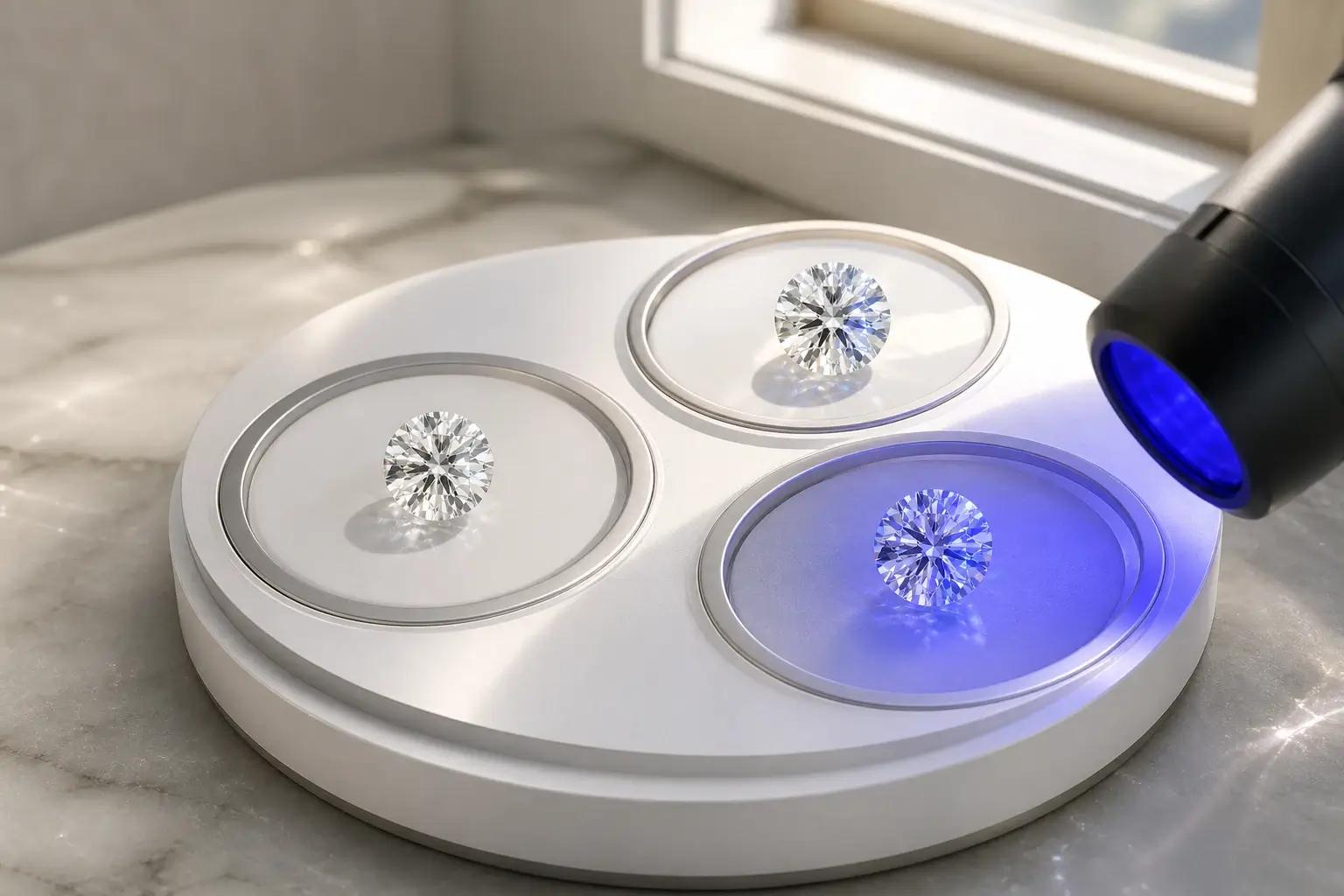
Direct sunlight contains ultraviolet radiation, so a fluorescent diamond can look different outdoors. Blacklights can make the glow obvious. Many indoor LEDs contain very little UV, so the same diamond can look completely normal at home or in an office.
That lighting gap explains why a store viewing can miss the reaction. Bright spotlights create flashes, but they do not always contain enough UV to show how the stone behaves outdoors. Use the sunlight versus indoor test before you accept a stronger grade.
Fluorescence stops when the UV source stops. A glow that remains afterward is phosphorescence, a different behavior that matters more in some lab grown diamonds.
The Appearance Question That Matters
Do not ask only, does it fluoresce. Ask, does the diamond stay transparent. Crisp facet edges, clean contrast, and lively movement matter more than the word Strong.
True fluorescence related haze is rare. Cloud inclusions, internal graining, strain, dirt, oil, weak cut, and bad video lighting can create similar complaints. The milkiness, haze, and cloudiness guide separates those looks before you blame the UV reaction.
A clean looking stone with Medium blue fluorescence can be a smart buy. A dull stone with None fluorescence is still a dull stone. The actual diamond wins every argument with the report.
The Fast Buyer Rule
Keep None to Faint when you want the simplest resale and appearance decision. Consider Medium blue when the color grade and price make sense. Treat Strong and Very Strong as inspection grades, not automatic rejection grades, and use the fluorescence myths guide whenever someone gives you a blanket rule.
Use a slow neutral video, a shaded outdoor view, direct daylight, and ordinary indoor light. Then follow the buy or skip decision tree. If the stone turns soft, oily, oddly blue, or flat, move on.
- Start with a GIA report for a natural diamond.
- Confirm intensity and color in the fluorescence field.
- Check transparency before chasing a discount.
- Compare the same diamond in UV rich and UV poor light.
- Keep a return window that allows your own inspection.
How Does Diamond Fluorescence Affect A Real Buying Decision?
Fluorescence comes after cut, but before final approval. I first decide whether the diamond has the right shape, cut, spread, clarity risk, and color. Then I use fluorescence to decide how much lighting proof I need.
A beautiful GIA graded J color diamond with Medium blue fluorescence and a useful discount can stay on the list. A D color stone with Very Strong blue and vague video gets no benefit of the doubt. Better paper never replaces better evidence.
What Does A Real Diamond Fluorescence Example Look Like?
Diamond A is a GIA graded 1.20 carat J color, VS2 round with Medium blue fluorescence. It looks crisp in diffused indoor light and slightly whiter in shaded daylight. The return policy gives the buyer time to verify it at home.
Diamond B is a similar G color round with Very Strong blue fluorescence. The listing shows only intense spotlight video and the retailer will not provide outdoor footage. Diamond A gives the cleaner decision even though Diamond B has the higher color grade.
Which Diamond Fluorescence Mistakes Should You Avoid?
- Rejecting every fluorescent diamond without seeing it.
- Buying Strong fluorescence only because the price is lower.
- Assuming fluorescence always improves a warm color.
- Blaming fluorescence for haze before checking inclusions and transparency.
- Using a blacklight reaction as proof of diamond origin or beauty.
What Should You Ask About Diamond Fluorescence Before Buying?
- What intensity and color appear on the GIA report?
- Does the diamond look crisp in ordinary indoor light?
- Can I see it in shaded and direct daylight?
- Do you confirm that it has no milky, oily, or hazy appearance?
- Can I return it after checking the stone in my own lighting?
Where Can You Compare Evidence For Diamond Fluorescence?
Use Ritani and Blue Nile as comparison tools, not automatic recommendations. Compare matched natural diamonds with the same shape, color, clarity, cut, and fluorescence range, then judge the verified GIA report, normal light video, price, and return terms. The actual diamond has to earn the yes.
What Is The Buyer Recommendation On Diamond Fluorescence?
Fluorescence is usually a secondary characteristic. Keep the stone when it looks crisp everywhere and the price fits the evidence.
For the easiest natural diamond search, stay with None to Faint. Move into Medium, Strong, or Very Strong only when the visual proof gets better with the risk.
Use the diamond fluorescence guide when you are ready to move from the definition into intensity, color, haze, reports, testing, and the final decision.
If you want another set of eyes on the stone, book your free consultation with Your Diamond Guys.
Fluorescence Can Be Scary!
Questions? Reach out directly for a free consultation, or drop them in the Diamond Buyers Academy community — Rob and Josh answer personally.
Questions Buyers Ask Us
*Some links on our site may earn us a small commission at NO EXTRA cost to you, helping us keep our content free*