Hearts And Arrows Precision Metrics
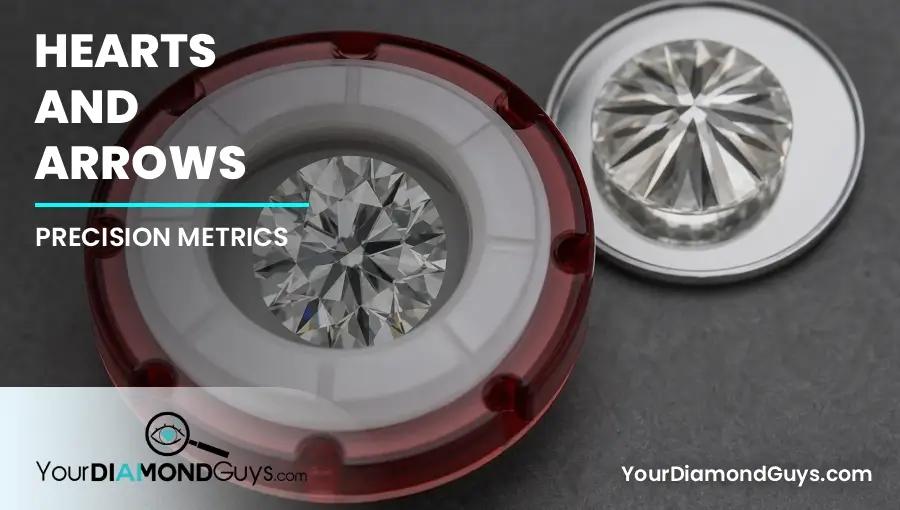
Hearts and arrows is a symmetry claim. The pattern has to prove it.
By Rob Cornfield, Co-Founder of YourDiamondGuys.com. 30+ years in the global diamond trade. Specialist in diamond cut and light performance.
How we evaluate proportions: We pair tight GIA proportions with centered hearts and arrows viewer images, then check pattern alignment, clefts, arrow shafts, and capture quality. The label is marketing until the optical proof appears.
Here is the Hearts and Arrows proof, centered viewer images should show eight matching hearts and eight matching arrows, and without those images the precision claim has no teeth.
Tight proportions help create the pattern. Optical symmetry requires the corresponding facets to align so precisely that eight hearts appear from the pavilion view and eight arrows appear from the crown view.
I have seen Excellent symmetry rounds with weak hearts. I have seen premium labels attached to sloppy clefts and split arrows. The viewer ends the argument.
For natural Hearts and Arrows diamonds, start with GIA. GIA traces Hearts and Arrows viewing to reflectivity tools that reveal facet alignment, but a report still cannot prove the complete pattern.
The Short Answer
Start natural rounds with GIA Excellent cut, Excellent polish, and Excellent symmetry. I prefer table 56 to 58 percent, depth 60 to 62.4 percent, crown angle 34 to 35 degrees, and pavilion angle 40.6 to 41 degrees.
Then require separate, centered hearts and arrows images plus a light performance image. Numbers can place the diamond in the right neighborhood. Only images prove optical symmetry and leakage control.
Proportions Create The Opportunity
Hearts and Arrows patterns depend on table, crown, pavilion, star length, lower half length, girdle, and facet indexing. Tight main angles are necessary, but minor facet alignment decides whether the pattern locks together.
Use the table guide, crown guide, and pavilion guide as the numeric foundation.
A seller's super ideal label is not a laboratory term. Ask for the standard behind it and the images for the actual diamond.
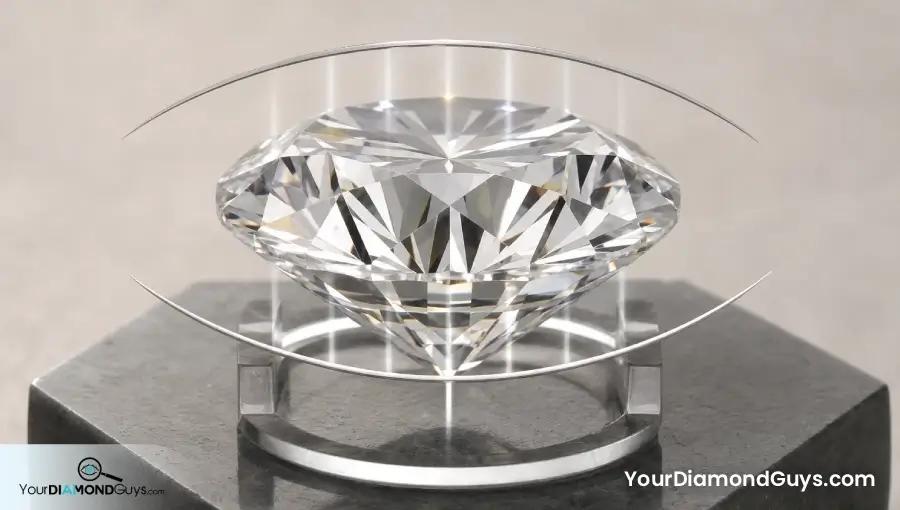
Tight main angles set the stage. Precise minor facet alignment determines whether the pattern locks together.
The Precision Metrics Worth Checking
The best pattern is centered, complete, evenly spaced, and consistent across all eight sectors. Small deviations need context. Large repeated deviations show real optical alignment problems.
GIA symmetry and optical symmetry overlap in craftsmanship, but they are not interchangeable grades. The hearts viewer examines a specific reflection pattern.
| Precision check | Strong evidence | Warning sign |
|---|---|---|
| Eight hearts | Similar size and shape | Missing, distorted, or uneven hearts |
| Heart clefts | Clean and consistent | Deep uneven clefts or split shapes |
| Heart tips | Aligned and similarly separated | Twisted or touching tips |
| Eight arrows | Even shafts and heads | Split, bent, or mismatched arrows |
| Pattern centering | Table and culet centered | Shifted image or off center pattern |
| Light map | Even return with controlled leakage | Pale ring, asymmetric leakage, or dead center |
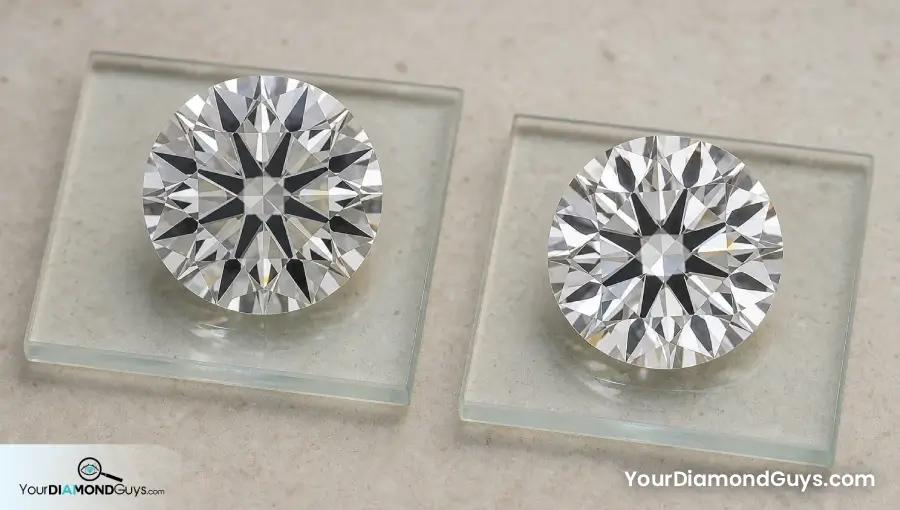
Eight arrow sectors should repeat evenly around a centered crown view.
Image Capture Quality Can Fake A Failure
A tilted diamond, off center camera, wrong focus, or uneven viewer can distort hearts and arrows. Demand a centered capture with the girdle level.
Check that the hearts and arrows images belong to the same report number. Generic sample images prove a product line at best. They do not prove your diamond.
A clean arrows image alone is not enough. You need the pavilion side hearts image to inspect the more sensitive pattern.
Image exposure matters too. An overexposed capture can wash out leakage and make weak boundaries look cleaner than they are. Ask for the seller's standard capture method when the pattern is close.
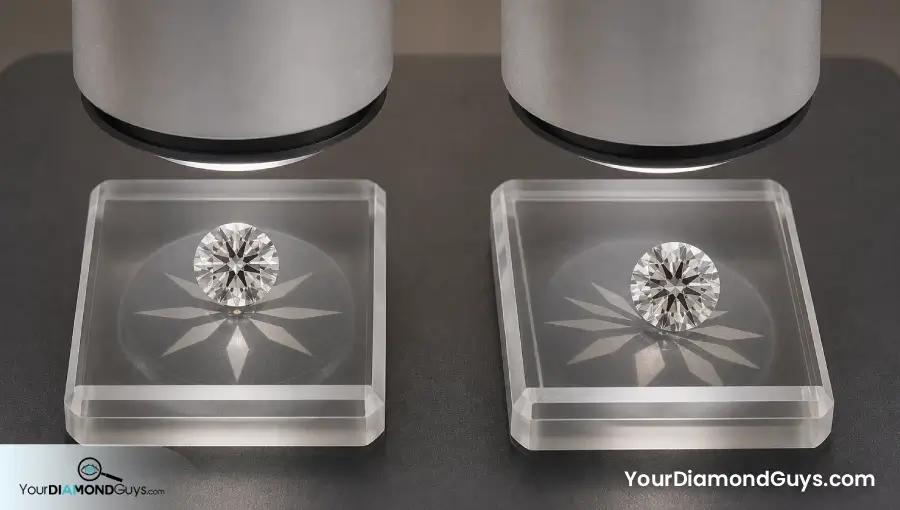
A tilted or off center capture can distort a sound pattern before you judge it.
Precision And Beauty Are Related, Not Identical
Optical symmetry creates orderly contrast and consistent facet switching. Many buyers love that crisp look. Others prefer a different flavor of fire or pattern.
Hearts and Arrows precision does not replace color, clarity, fluorescence, spread, or value. It does not make a bruise, chip, cavity, knot, etched channel, or indented natural safe.
Use the spread score and full GIA report beside the pattern images. Precision should improve the whole purchase, not distract from another compromise.
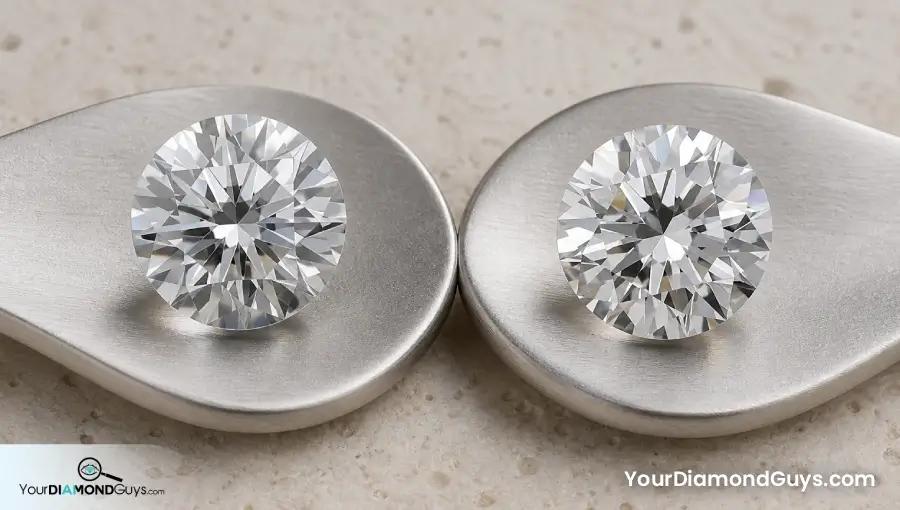
Orderly contrast has a distinct look. A different light pattern can still be beautiful.
How I Verify Hearts And Arrows
I run the proportion red flags checklist first, then inspect hearts, arrows, and a separate light map. I match every image to the report number.
A premium makes sense only when the pattern is materially tighter, the light return is strong, and the rest of the diamond stays competitive. Paying for a label without proof makes no sense.
A Pattern Precision Example
Round A and Round B both have 57 percent tables, 34.5 degree crowns, 40.8 degree pavilions, and Excellent symmetry. Round A shows eight consistent hearts. Round B shows uneven clefts and two distorted hearts.
The report proportions tie. The optical precision does not. Round A earns the Hearts and Arrows claim. Round B needs to be priced as a normal Excellent cut round.
Mistakes I Would Avoid
- Treating Excellent symmetry as proof of Hearts and Arrows.
- Accepting a generic sample image.
- Judging a tilted or off center viewer capture.
- Using arrows without hearts or a light map.
- Paying a precision premium while ignoring spread, clarity risk, or fluorescence.
Questions To Ask Before Buying
- Are these hearts and arrows images for the exact GIA report number?
- Are all eight hearts complete and consistent?
- Are the arrow shafts, heads, and spacing even?
- Was the diamond centered and level during capture?
- Does a separate light map confirm controlled leakage?
Where To Compare The Proof
Affiliate disclosure: Your Diamond Guys can earn a small commission if you buy through a partner link. It does not change what you pay or which diamond we recommend.
Study actual Hearts and Arrows and light performance images on Whiteflash and Brian Gavin Diamonds. Match every image to its report, then compare pattern precision instead of the collection name.
The Precision Proof I Would Require
Use tight round proportions to find candidates. Require centered hearts, arrows, and light images to prove the claim.
Precision earns a premium when you can see it in the exact stone and the rest of the diamond remains strong. No images, no premium.
If you want another set of eyes on the stone, book your free consultation with Your Diamond Guys.
Separate The Label From The Proof
Use the Hearts and Arrows diamond guide for the broad pattern standard and the super ideal comparison for seller terminology. Then test the actual crown, pavilion, and table pairing.
The diamond proportions and measurements guide connects optical symmetry proof with the table, crown, pavilion, depth, and red flag screen.
What Makes Hearts and Arrows Diamonds So Special?
Questions? Reach out directly for a free consultation, or drop them in the Diamond Buyers Academy community — Rob and Josh answer personally.
Questions Buyers Ask Us
*Some links on our site may earn us a small commission at NO EXTRA cost to you, helping us keep our content free*