Diamond Table And Crown Pairing, Brightness Versus Fire
By Rob Cornfield, Co-Founder of YourDiamondGuys.com. 30+ years in the global diamond trade. Specialist in diamond cut and light performance.
How we evaluate proportions: We start with the GIA table percentage, pair it with crown and pavilion angles, then inspect brightness, fire, and contrast in motion. One percentage never earns the yes by itself.
Here is the table pairing rule for a natural round, start around 56 to 58 percent, then judge it with a 34 to 35 degree crown and 40.6 to 41 degree pavilion because the table alone cannot predict brightness or fire.
The table is the large top facet. Its size changes the balance of table reflection, crown area, contrast, brightness, and fire. The pavilion still decides whether the whole system sends light back to you.
I have rejected plenty of rounds with the table number buyers were told to chase. The angle pairing was wrong. The video showed the truth in seconds.
For natural diamonds, start with GIA. GIA explains that round diamond proportions work as a combination, so never treat table percentage as a cut grade by itself.
The Short Answer
Table percentage compares table width with the average girdle diameter on a round. I use 56 to 58 percent as a clean search range for natural round brilliants, then I check crown angle, pavilion angle, depth, polish, symmetry, and video.
A smaller table usually leaves more crown surface and can support more fire. A larger table can favor a broader white return look. Those are tendencies, not guarantees, because the surrounding facets control the result.
What The Table Percentage Measures
For a round brilliant, table percentage equals table width divided by average girdle diameter, multiplied by 100. A 3.65 mm table on a 6.40 mm average diameter is about 57 percent.
GIA rounds and reports the proportion value, so do not reverse engineer a disputed tenth of a percent from a listing image. Use the report number and the lab value.
The measurements guide explains the diameter used in that relationship. The table percentage then shows how much of the top view belongs to the table facet.
A Strong Round Search Zone
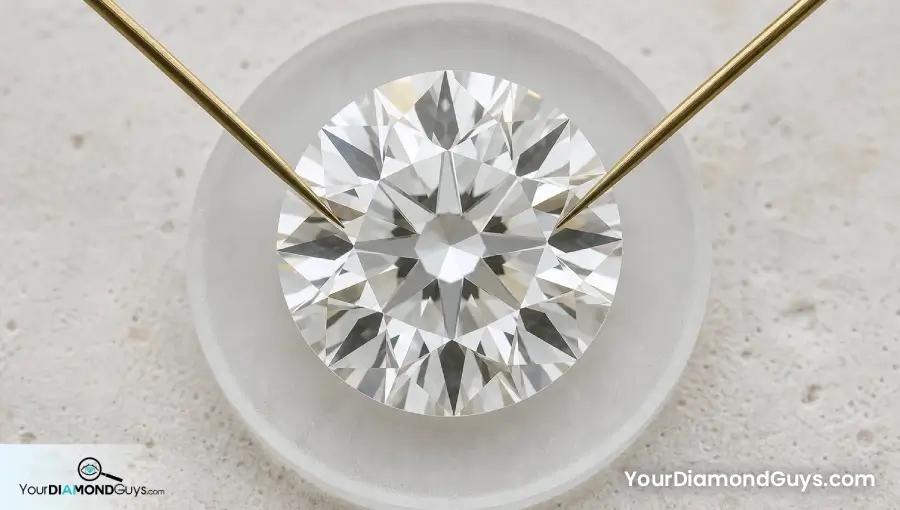
For the kind of round brilliant I want to show a client, 56 to 58 percent is the cleanest table starting zone. It pairs well with 60 to 62.4 percent depth, a 34 to 35 degree crown angle, and a 40.6 to 41 degree pavilion angle.
That range is narrower than the full set of combinations that can receive GIA Excellent. I use it to reduce noise, not to rewrite the GIA system. The actual angle pairing and light pattern still make the decision.
| Round table range | What I expect | Buyer move |
|---|---|---|
| Under 54 percent | Smaller table and more crown area | Check crown height, obstruction, and pattern |
| 54 to 55 percent | Can be attractive with the right angles | Review video and scope images |
| 56 to 58 percent | Clean YDG search zone | Verify crown and pavilion pairing |
| 59 to 60 percent | Larger table look | Watch fire, contrast, and crown height |
| Over 60 percent | Increasing table dominance | Demand strong visual proof |
Table, Crown, And Pavilion Work Together
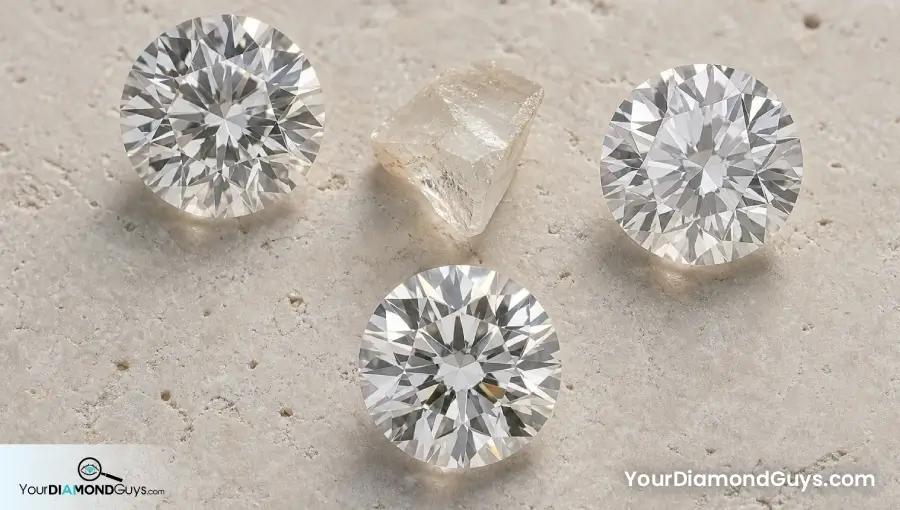
The table changes the size of the window through which you see the pavilion pattern. The crown angle changes the route and dispersion of returning light. The pavilion angle controls whether much of that light returns or leaks.
A 58 percent table with a shallow crown can look flatter and show less fire than the table number suggests. The same table with a balanced crown and pavilion can look crisp and lively.
This is the insider mistake I see online: one number gets called ideal because it is easy to filter. Diamonds do not perform one column at a time.
Fancy Shape Tables Need A Different Standard
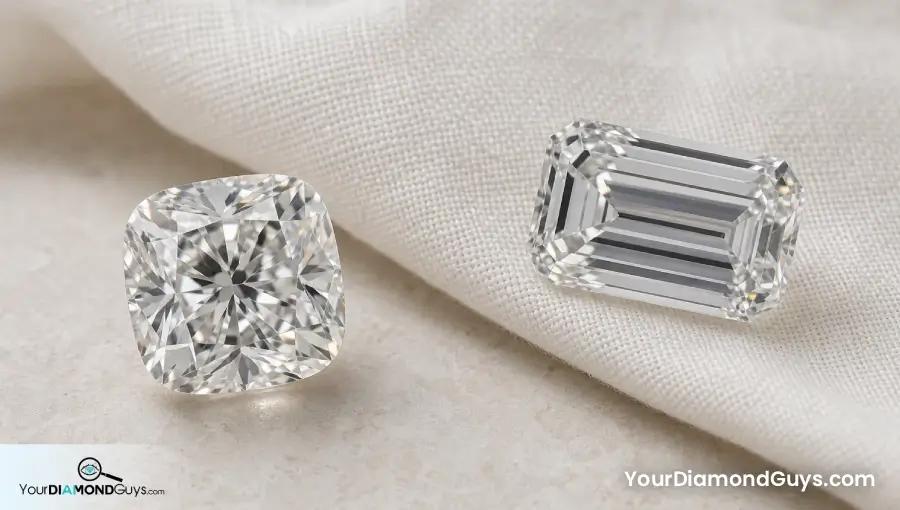
A table percentage cannot grade an oval, cushion, radiant, pear, emerald, or princess. Facet style and outline change the meaning of the same value.
A cushion with chunky main facets and a modified cushion with crushed texture can share a table percentage while looking unrelated. An emerald cut can hold a respectable table value and still show obvious windowing.
Use the number to flag outliers, then follow the fancy shape proportion limits. Watch the actual stone in neutral, diffused, and mixed lighting.
How I Pair Table In A Shortlist
I first require a GIA report for a natural round. Then I sort for Excellent cut, Excellent polish, Excellent symmetry, and none to faint fluorescence. After that, table percentage helps narrow the field.
The shortlist still has to survive crown and pavilion review, diameter review, a neutral video, and preferably light performance images. A clean table number earns inspection. It does not earn the purchase.
A Table And Crown Example
Round A has a 57 percent table, 35 degree crown, and 41.2 degree pavilion. Round B has a 58 percent table, 34.5 degree crown, and 40.8 degree pavilion.
Both table values look safe. Round A carries a steeper pavilion than I want and needs far more proof. Round B sits in a cleaner combination and gets the first video review.
Mistakes I Would Avoid
- Calling 57 percent ideal without checking the angle pair.
- Assuming a larger table always means more brightness.
- Assuming a smaller table always means more fire.
- Applying round table ranges to fancy shapes.
- Ignoring pattern, leakage, and obstruction in video or scope images.
Questions To Ask Before Buying
- What table percentage appears on the GIA report?
- How does the table pair with crown and pavilion angles?
- Does the top view show even contrast and crisp facet patterning?
- Are light performance images available?
- Does a larger table come with a lower crown or weaker fire?
Where To Compare The Proof
Affiliate disclosure: Your Diamond Guys can earn a small commission if you buy through a partner link. It does not change what you pay or which diamond we recommend.
Study proportion and light proof on Whiteflash and Brian Gavin Diamonds. Use the table value to find comparable rounds, then judge the angle combination and the actual performance images.
The Table Pair I Would Choose
Keep 56 to 58 percent as a strong round search zone. Do not turn it into a magic number.
Table, crown, pavilion, depth, finish, and pattern form one system. Buy the system that works, not the single value that fits a filter.
If you want another set of eyes on the stone, book your free consultation with Your Diamond Guys.
Make The Table Prove Its Pairing
Use the established diamond table percentage guide for the broad buying screen. This guide focuses on what the table does beside the crown and pavilion. Finish with optical precision proof when the seller claims elite symmetry.
Return to the diamond proportion relationships guide to judge table size with depth, crown, pavilion, spread, and optical proof.
Is Your Diamond's Table Percentage the Secret to Its Sparkle?
Questions? Reach out directly for a free consultation, or drop them in the Diamond Buyers Academy community — Rob and Josh answer personally.
Questions Buyers Ask Us
*Some links on our site may earn us a small commission at NO EXTRA cost to you, helping us keep our content free*