Radiant Cut Proportions, Brightness Versus Crushed Texture
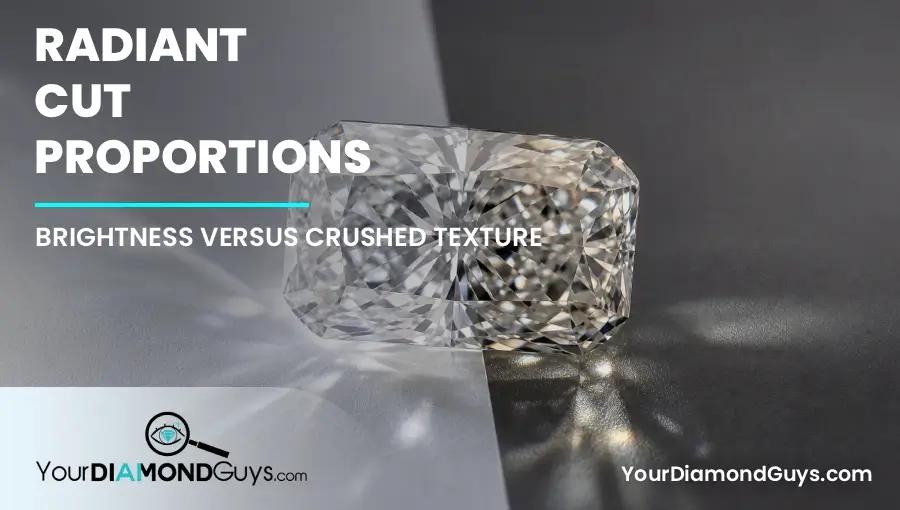
A radiant needs enough texture to sparkle without turning the center gray and mushy.
By Josh Allen, Co-Founder of YourDiamondGuys.com. Fifth generation diamantaire with 30+ years in the global diamond trade. Former supplier to Tiffany & Co., Cartier, and Harry Winston.
How we evaluate proportions: We start with ratio, millimeters, and corner shape, then watch the radiant turn slowly for bright structured texture instead of gray mush. Table and depth only start the review.
The best stones turn their fine reflections on and off across the face. Weak stones hold a mushy center that never becomes bright, no matter how good the table and depth look.
Radiants reward video discipline. Fast rotation sells motion. Slow rotation reveals whether the pattern has structure.
For natural radiants, start with GIA. GIA describes radiant proportions as highly variable and recommends seeing the stone, because the mixed cut design can hide very different patterns behind similar percentages.
The Short Answer
Square radiants usually sit near 1.00 to 1.05 ratio. Elongated radiants often sit near 1.20 to 1.40, with shorter rectangular options between those styles.
Table around 58 to 69 percent and depth around 61 to 68 percent can form a broad comparison zone. Then inspect clipped corners, parallel sides, center brightness, bow tie, spread, and whether the crushed pattern stays distinct instead of gray.
Radiant Is A Mixed Cut, Not A Number Set
Radiants combine a step style crown with a brilliant style pavilion and clipped corners. Pavilion facet arrangements vary, so virtual facet size and center texture vary too.
A seller can list two square modified brilliants with matching table and depth. One shows crisp fine sparkle. The other shows a dull center and dark corners.
Use the fancy shape limits guide before turning a proportion chart into a cut grade.
Color can concentrate differently across a radiant too. That effect can be useful in a fancy color diamond, but in a D to Z diamond you still want an even, attractive face up color appearance.
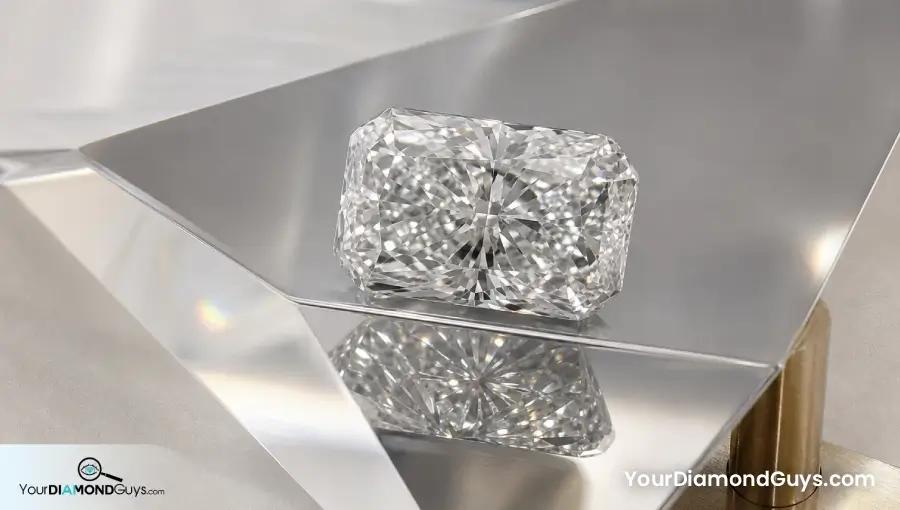
A radiant combines broad crown reflections with a brilliant pavilion. The pattern inside matters more than one percentage.
Radiant Proportion Starting Zones
Choose square or elongated first. Then compare inside a narrow ratio band so length does not hide a weak width or oversized depth.
These zones are buying filters. GIA does not assign an overall radiant cut grade.
| Radiant attribute | Practical starting zone | What to inspect |
|---|---|---|
| Square ratio | 1.00 to 1.05 | Side equality and corner match |
| Elongated ratio | 1.20 to 1.40 | Center bow tie, width, and corner balance |
| Table percentage | About 58 to 69 percent | Crown presence and contrast |
| Depth percentage | About 61 to 68 percent | Spread, bulge, and hidden weight |
| Girdle | Avoid unexplained extremes | Corner strength and face up size |
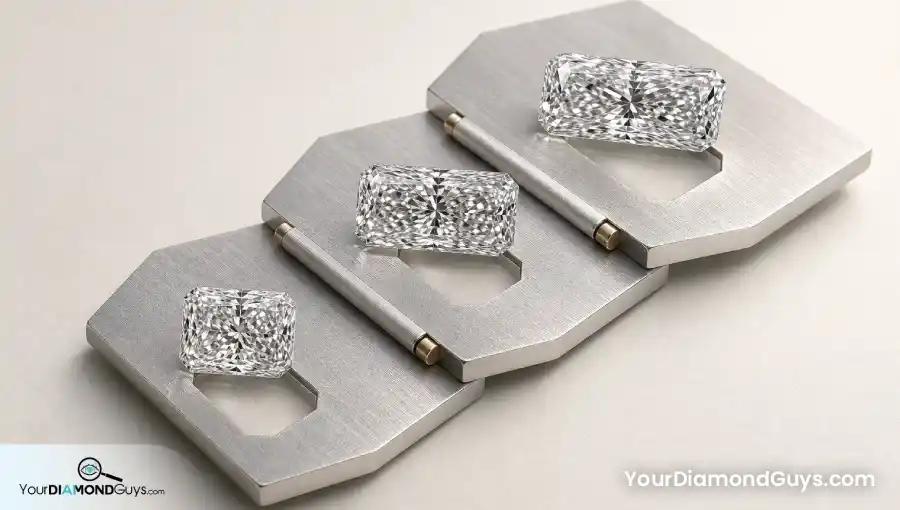
Square, short rectangular, and elongated radiants need separate comparison groups before table and depth mean much.
Crisp Crushed Texture Versus Mush
Fine reflections should still have contrast and edges. As the radiant moves, different areas should brighten. A mushy area stays low contrast, gray, or blurry through several angles.
Watch the center, then the corners. Elongated radiants can show a bow tie. Square radiants can carry dark corners or a dead central block.
Use diffused light to expose broad brightness and mixed light to see fire. Do not let one bank of spotlights turn surface flashes into a false performance grade.
Step back from the screen. At normal distance, a healthy radiant still looks bright across most of the face. A weak one collapses into a gray center surrounded by random flashes.
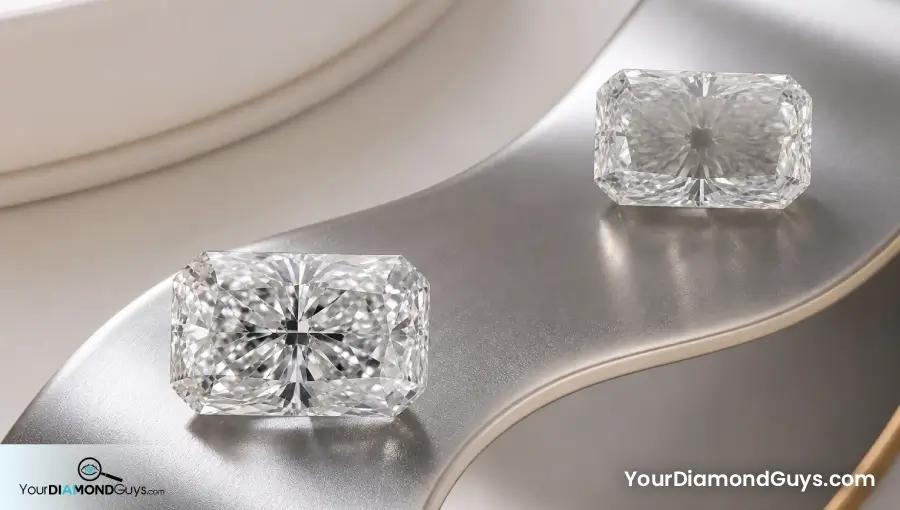
Crisp crushed texture keeps visible edges and switching contrast. Mush stays gray under several viewing angles.
Spread And Corner Shape Matter
A radiant can hide weight in a deep pavilion, thick girdle, or heavy corners. Compare length and width with radiants of the same ratio.
Clipped corners should match in size and angle. Sides should look parallel unless a deliberate taper is part of the design. The table and culet should sit on the center axis.
Use the spread score method to flag outliers, then let the video decide whether the extra footprint returns light.
A thick corner can protect the outline while a uniformly heavy girdle wastes weight. Ask where the maximum thickness occurs before treating every Thick call as the same issue.
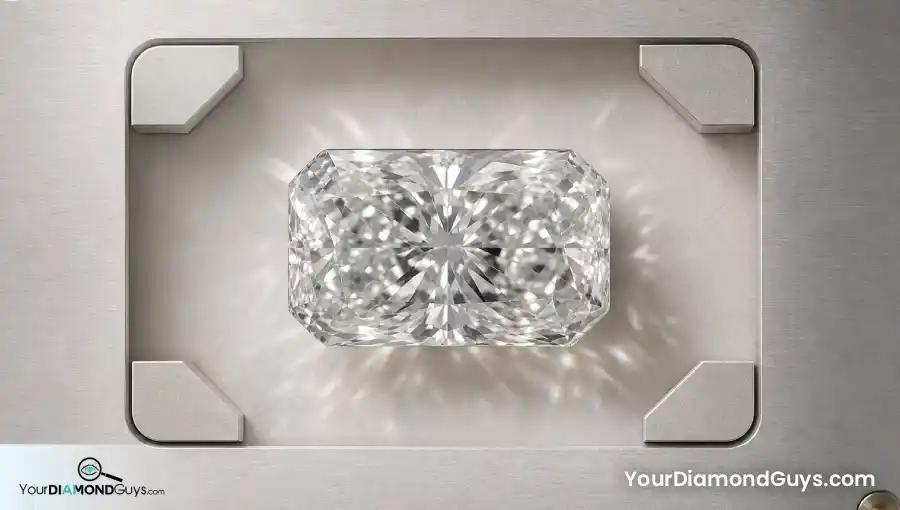
Balanced clipped corners, parallel sides, and a centered table make the radiant outline read cleanly at a glance.
How I Screen A Radiant
I choose square, short rectangle, or elongated radiant first. Then I compare center texture, corner brightness, spread, and slow rotation.
The winning radiant keeps fine activity without a permanent gray zone. It should look energetic, not chaotic or dull.
Two Radiants With Similar Numbers
Radiant A and Radiant B both have a 1.30 ratio, 65 percent table, and 66 percent depth. Radiant A shows crisp small reflections that switch across the center. Radiant B holds a gray smear under the table.
Radiant A wins. The shared proportions describe the container, not the quality of the pattern inside it.
Mistakes I Would Avoid
- Calling every crushed radiant dull.
- Calling every busy pattern bright.
- Using table and depth as an overall cut grade.
- Ignoring clipped corner mismatch or dark corners.
- Comparing radiants with very different ratios on raw footprint.
Questions To Ask Before Buying
- Does the center become bright during a slow rotation?
- Are the clipped corners even and active?
- Does an elongated radiant show a fixed bow tie?
- How does spread compare within the same ratio band?
- Can I see the stone in diffused and mixed light?
Where To Compare The Proof
Affiliate disclosure: Your Diamond Guys can earn a small commission if you buy through a partner link. It does not change what you pay or which diamond we recommend.
Compare radiant videos on Blue Nile and Ritani at the slowest available speed. Keep ratio similar, then watch the center and corners for crisp switching instead of gray blur.
The Radiant I Would Choose
Use ratio, table, and depth to build a fair radiant shortlist. Use slow movement to separate lively crushed texture from mush.
A good radiant stays bright across its face and carries weight honestly. The numbers open the door. The pattern decides who walks through it.
If you want another set of eyes on the stone, book your free consultation with Your Diamond Guys.
Finish The Radiant Review
The broad radiant cut diamond guide covers the full buying decision. Then compare ratio, the limits of the proportion ranges, and corner and outline quality.
Use the complete diamond proportions hub to connect radiant texture with ratio, spread, corners, depth, and outline quality.
Radiant Cut Diamonds: Everything You Need to Know!
Questions? Reach out directly for a free consultation, or drop them in the Diamond Buyers Academy community — Rob and Josh answer personally.
Questions Buyers Ask Us
*Some links on our site may earn us a small commission at NO EXTRA cost to you, helping us keep our content free*