Ten real diamond cases. Better checks before you buy.
A good looking stone can leave an important question unanswered. These ten published investigations show what changed the answer, and what to check in your own purchase.
Your consultation is free. Retailers can pay us a commission on qualifying referrals at no extra cost to you. Read how referrals work.
Where these cases come from
Published by GIA. Interpreted for buyers.
These are public diamond investigations published in Gems & Gemology, not Your Diamond Guys client stories. Each names the original authors and links to the investigation. GIA’s findings and our buyer recommendations appear separately. No customer savings, refunds, or purchase outcomes are claimed.
These selected unusual cases teach verification checks. They do not show how common a problem is or imply that buying a diamond is usually unsafe.
01
Report matching
A real report number. A different diamond.
3.07 carat round brilliant · GIA Antwerp · Summer 2021
The starting question
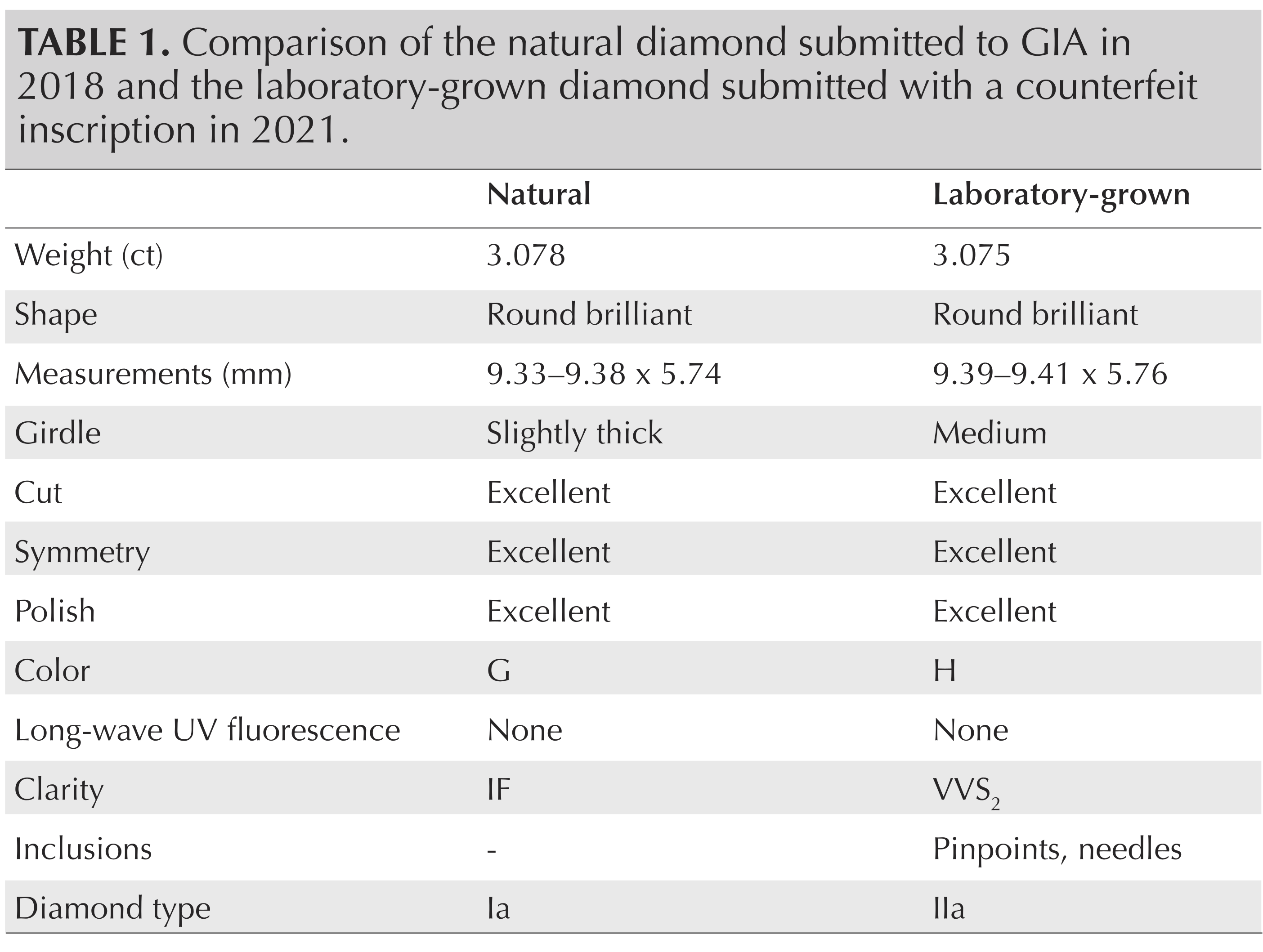
A round brilliant arrived for an update with a number belonging to a natural diamond graded in 2018. Its weight and measurements closely resembled the original.
What GIA found
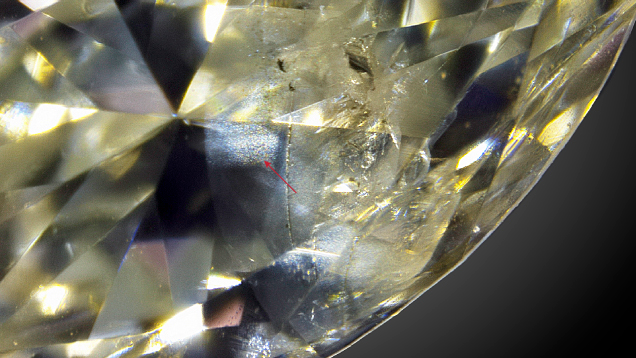
GIA found a counterfeit inscription. Microscopy, spectroscopy, and growth imaging identified a CVD laboratory grown diamond with post growth HPHT treatment. The natural report described G color and IF clarity; the submitted stone was H color and VVS2.
The documented result
GIA obscured the false number, added a laboratory grown inscription, and assigned a new report number.
See what GIA compared.
The report looked close. The laboratory evidence showed a different diamond.
Close measurements. Different identity.
The weights were 3.078 and 3.075 carats. GIA also found different color, clarity, and diamond type. Close numbers still need a stone check.
The article reports identification and inscription correction. It gives no customer purchase price, refund, or savings.
02
Material identity
The inscription said diamond. The stone was moissanite.
1.02 carat round brilliant simulant · GIA Johannesburg · Fall 2020
The starting question
A near colorless round stone carried a number belonging to an E color natural diamond of the same weight. It arrived for diamond grading.
What GIA found
GIA identified synthetic moissanite, a diamond simulant. Its measurements did not match the referenced diamond. The inscription font, visible double refraction, and laboratory spectra supplied further evidence.
The documented result
GIA identified the material and obscured the fraudulent inscription.
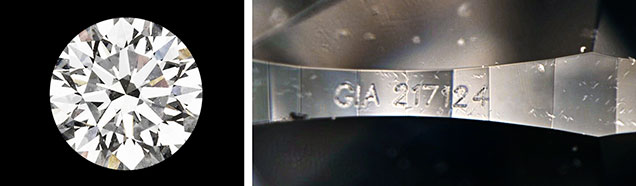
See the stone and its inscription.
The face up photo looks convincing. The inspection settled what it was.
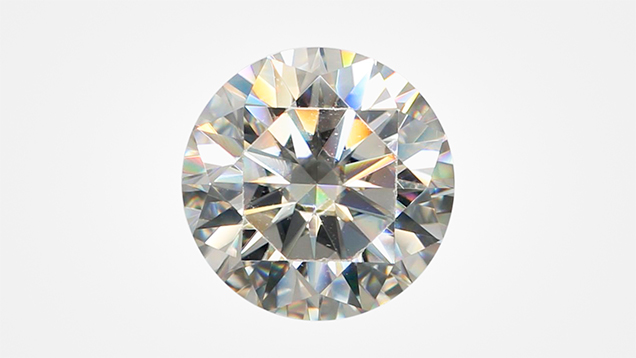
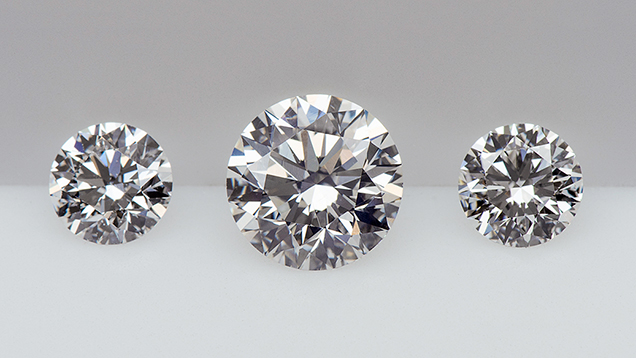
A convincing face up view.
This is the actual 1.02 carat moissanite from the investigation. GIA confirmed its material through testing. A listing photo cannot make that call.
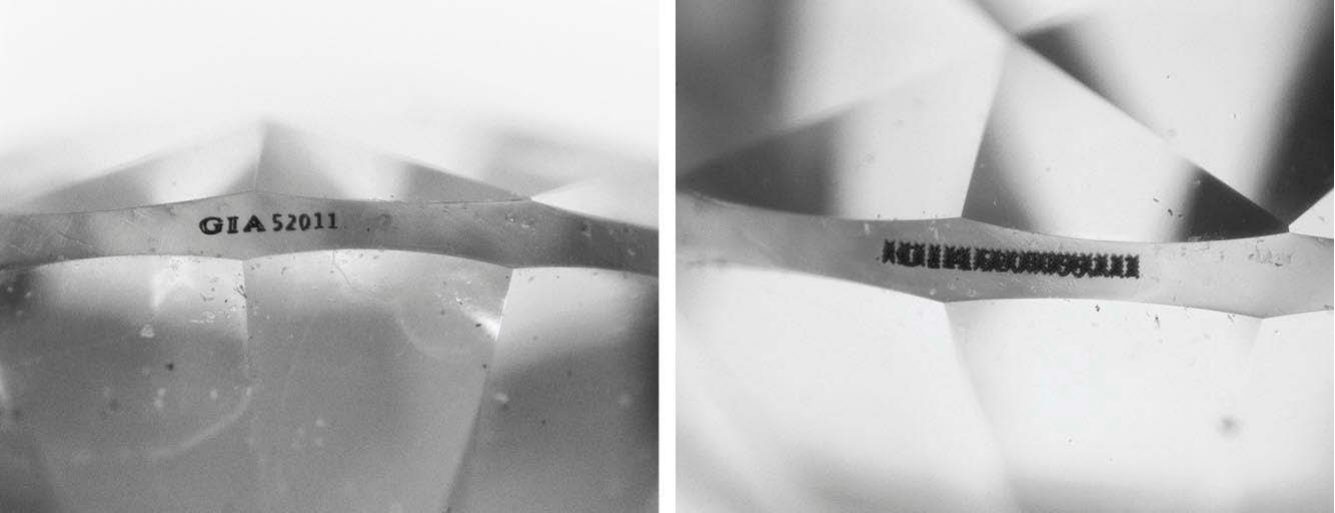
Left, the fraudulent inscription. Right, GIA obscured it. The lab also found a different font and measurements that did not match the natural diamond’s record.
The publication describes attempted misidentification. It does not document a completed buyer sale or a financial outcome.
03
Treatment disclosure
Natural origin did not mean untreated color.
Four stones with copied report numbers · GIA Dubai · Summer 2025
The starting question
Four submitted stones carried numbers associated with other natural diamonds. Their general characteristics were close enough to deserve a careful comparison.
What GIA found
GIA found that two were natural diamonds with HPHT color treatment, while two were CVD laboratory grown diamonds. All four differed from the diamonds described in the accompanying reports. Spectroscopy and growth observations established those distinctions.
The documented result
GIA crossed out the counterfeit inscriptions and assigned new report numbers.
See where the report matches broke down.
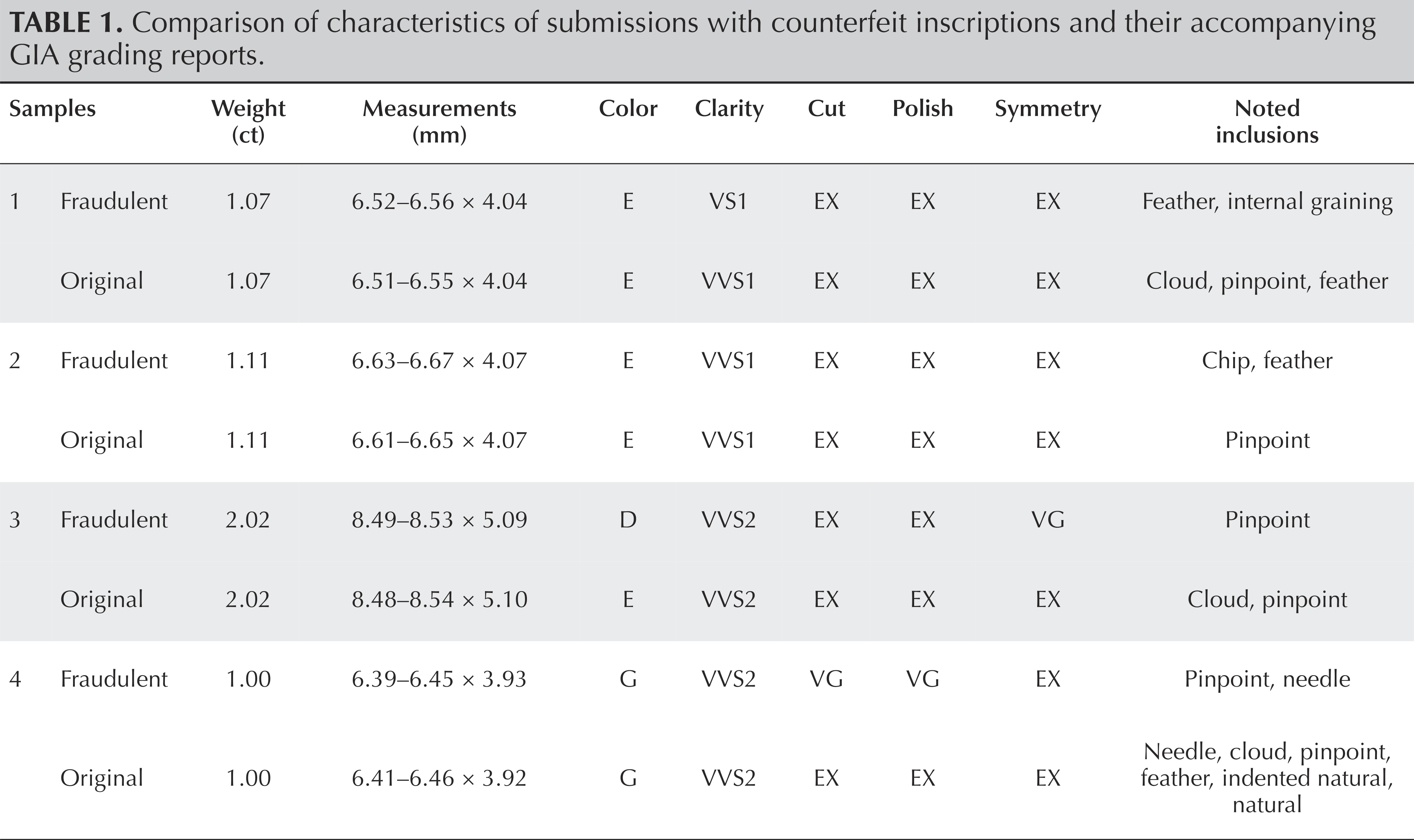
GIA checked all four stones against their records, then tested their growth and treatment history.
Four stones. Four report comparisons.
GIA compared each submitted stone with its original report. Measurements, color, finish, and inclusions exposed differences. The lab then tested origin and treatment.
This is one published investigation involving four stones. No buyer refund or price saving is documented.
04
Mounted inspection
The setting hid part of the clarity story.
A necklace and a pair of earrings · GIA Mumbai · Winter 2025
The starting question
Mounted jewelry arrived for analysis. Prongs restricted the view of the pavilion and some clarity features.
What GIA found
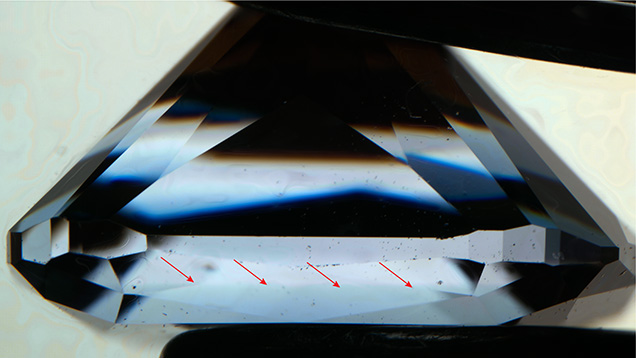
GIA confirmed natural diamond material, then identified fracture filling in two round stones and one marquise. Magnification and careful viewing angles revealed the characteristic flash effect; the marquise also showed a cloudy area consistent with filler.
The documented result
The laboratory documented the treatment. GIA does not issue grading reports for fracture filled diamonds because the filler is unstable.
See the clues inside the setting.
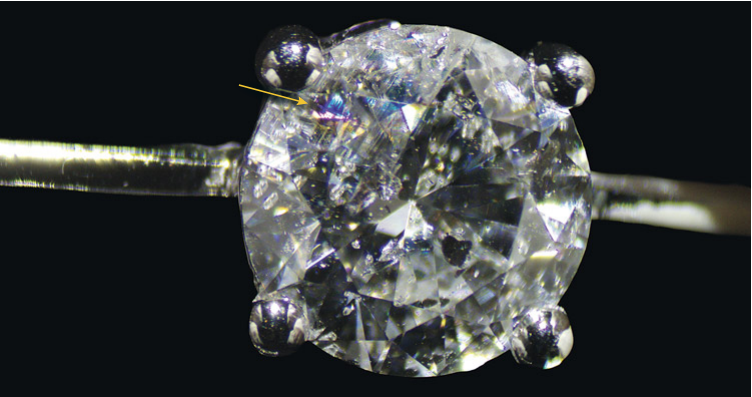
GIA’s photos show why viewing angle and magnification matter when metal limits the view.
Tilt changed what the inspector could see.
The arrow marks the flash effect in a mounted round diamond. GIA examined it under magnification and controlled lighting to identify fracture filling.
The arrow points to the cloudy area in the marquise. GIA connected it with filler inside fractures that reached the surface. Prongs restricted the inspection.
The note documents identification, not a refund, buyer recommendation, or damage that occurred after purchase.
05
Fancy color origin
One stone had two different growth stories.
0.64 carat colored cushion modified brilliant · GIA Carlsbad · Spring 2019
The starting question
A Fancy grayish greenish blue cushion contained a combination of features that called for more testing.
What GIA found
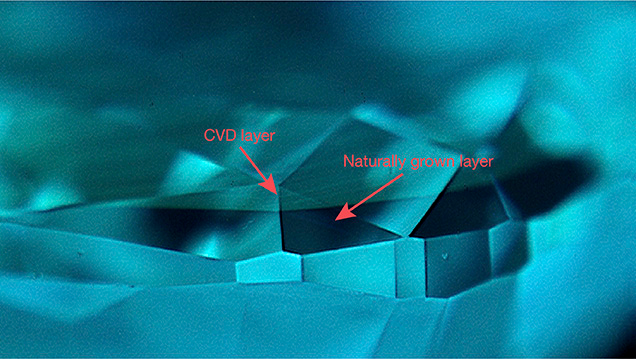
GIA identified a natural diamond substrate with a CVD grown diamond layer. Growth imaging and other tests distinguished the crown from the pavilion. The added layer measured about 200 microns thick and contributed an estimated 0.10 carat.
The documented result
The investigation established a composite of natural and laboratory grown diamond.
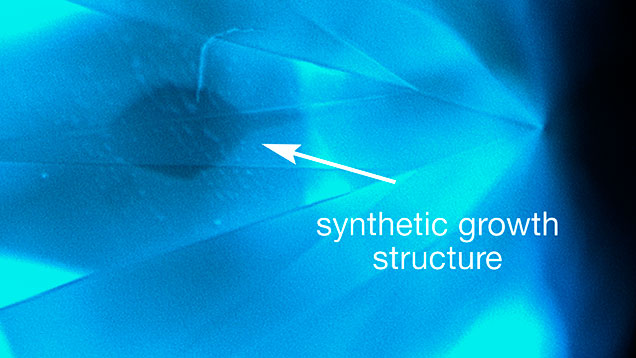
See where the growth stories meet.
The layer boundary and immersion view helped GIA explain this unusual composite.
One diamond. Two growth regions.
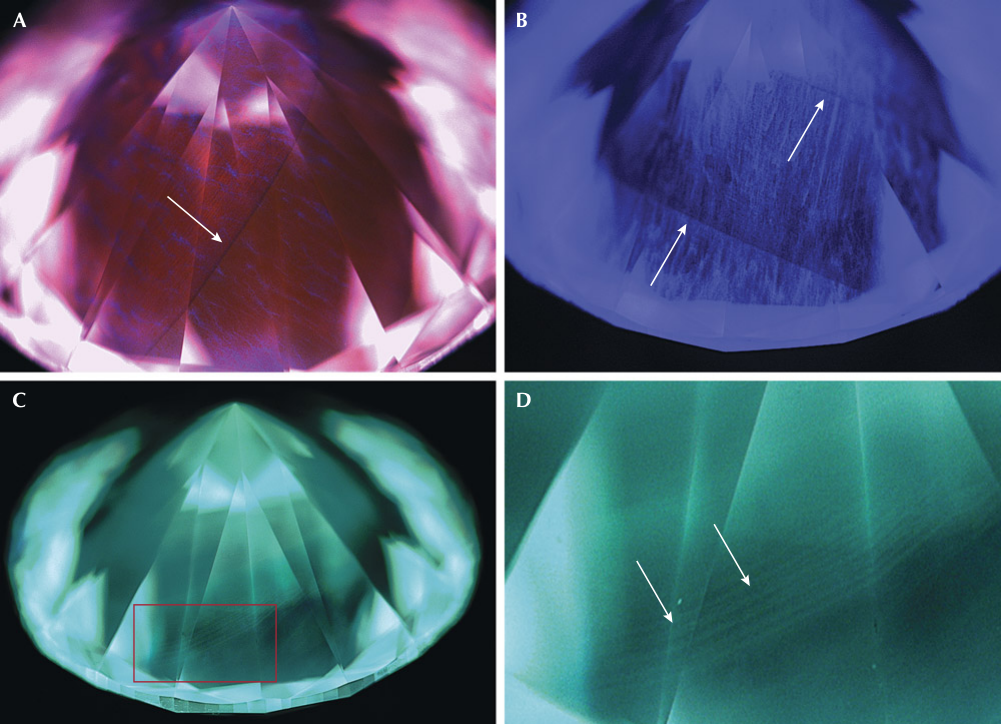
GIA’s DiamondView image shows the boundary between the CVD layer and the naturally grown substrate. The lab combined this view with other testing.
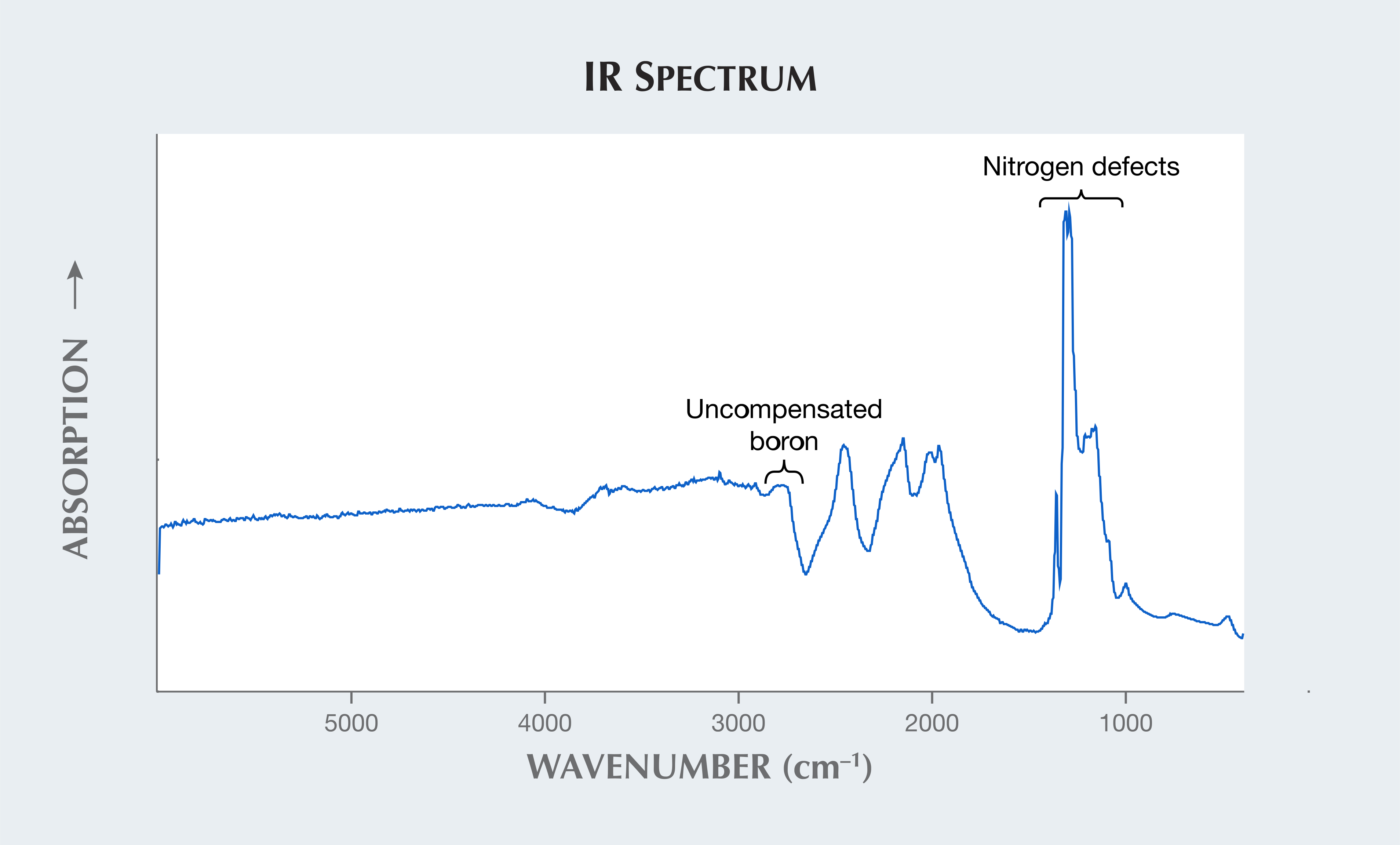
See the infrared spectrum behind the investigation
The spectrum told GIA to look deeper.
The chart shows nitrogen and boron related defects together. That unusual combination called for more testing. GIA used several methods to identify the composite.
This unusual laboratory case does not establish how common composites are. The authors did not report a buyer’s purchase or savings.
06
HPHT growth and report identity
The copied number hid a different growth method.
1.76 carat round brilliant · GIA Carlsbad · Fall 2017
The starting question
A round diamond arrived for an updated report with a number assigned to a 1.74 carat natural diamond in 2015.
What GIA found
GIA identified HPHT laboratory growth. The submitted stone was F color and VS1, compared with D and VVS1 on the original report. Growth imaging, infrared spectra, and a different inscription font exposed the mismatch.
The documented result
The investigation established that the submitted stone was a laboratory grown diamond carrying a false inscription.
See the inscription and the growth evidence.
The number was only one part of the comparison. GIA checked the stone itself.
The number belonged to another diamond.
GIA paired the submitted stone with a close view of its false inscription. The number referred to a natural diamond graded in 2015.
The note documents a false inscription and HPHT growth identification. It does not report a buyer sale, refund, or savings.
07
Green color and surface coatings
The green color sat on the surface.
6.49 carat rough diamond · GIA Carlsbad · Summer 2019
The starting question
A rough diamond with green patches arrived for colored diamond grading. Those patches resembled natural radiation stains.
What GIA found
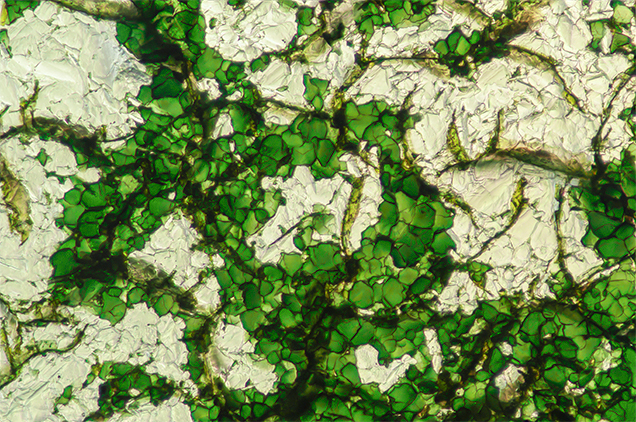
Magnification showed green crystal plates attached to the surface. X ray fluorescence detected chromium, and Raman testing identified chromium oxide. The green patches were a coating, not natural radiation stains.
The documented result
GIA identified the surface material responsible for the rough diamond’s patchy green appearance.
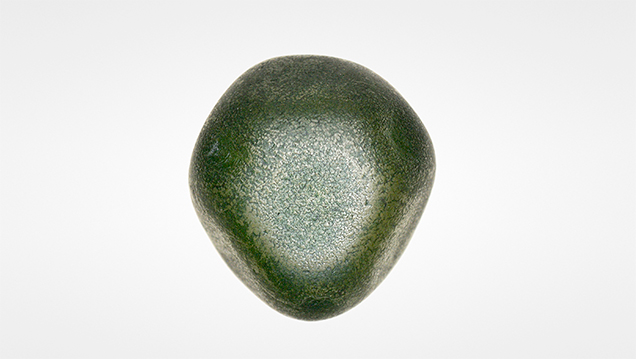
See the coating at two different scales.
The rough looked green. Magnification showed what made it green.
Green patches did not prove natural green color.
This is the 6.49 carat rough diamond examined by GIA. Its patchy green appearance came from a surface coating.
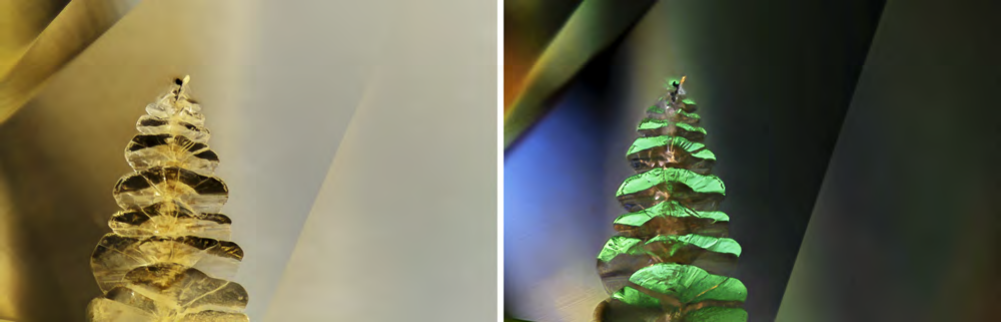
A yellow marquise submitted for color origin testing contained a large, eye visible internal feature.
What GIA found
GIA described a laser manufacturing remnant running from a star facet through the pavilion, with stacked stress fractures. Such remnants can form accidentally during laser cutting. They differ from intentional laser drilling to remove inclusions.
The documented result
The authors documented the remnant and its microscopic appearance. They explained that manufacturing remnants count as clarity characteristics.
See the remnant under two lighting methods.
The lighting changes the image. The internal feature stays the same.
Same feature. Two lighting methods.
Both views show the laser manufacturing remnant. The right uses color contrast illumination. Its green appearance comes from that imaging method. Field of view, 2.90 mm.
Photomicrographs: Jonathan Muyal, GIA, Summer 2017.
The note gives no final clarity grade, price, or color origin conclusion. Those results are not assumed here.
09
Fluorescence and actual appearance
A strong UV impression did not settle appearance.
Just over 2 carats, H color round brilliant · GIA New York · Summer 2017
The starting question
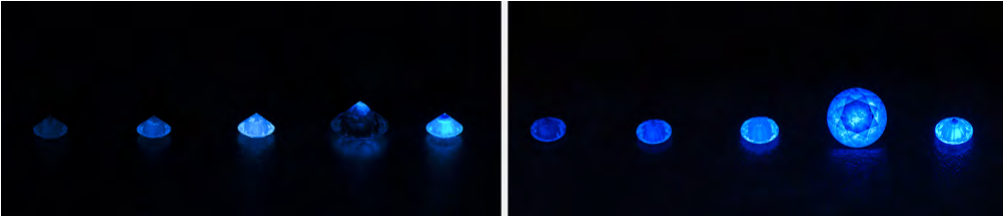
A round diamond showed medium fluorescence in a small area near its culet. Face up under UV, reflections made the reaction look much stronger.
What GIA found
Spectra supported natural diamond origin. GIA then compared the H color stone with nonfluorescent masterstones of similar color in its standard grading environment.
The documented result
GIA observed no visible difference in color or transparency in that comparison. This was a finding about this diamond.
Compare the UV reaction with the grading view.
GIA checked both the reaction and the diamond’s visible appearance.
Viewing direction changed the UV impression.
Fluorescence near the culet looked much stronger face up because of reflections. These are ultraviolet views, not ordinary viewing conditions.
GIA compared the sample with similar color masterstones under its standard grading conditions. It found no visible color or transparency difference in this diamond.
This single example does not prove that fluorescence never affects appearance. GIA evaluated the individual stone under stated conditions.
10
Treatment after an earlier report
The grades stayed the same. The treatment story changed.
16.41 to 15.73 carats, square modified brilliant · GIA Carlsbad · Spring 2024
The starting question
A CVD diamond first graded in 2022 at 16.41 carats showed no evidence of post growth treatment. It later returned at 15.73 carats.
What GIA found
The second submission showed HPHT treatment. GIA compared growth images and photoluminescence spectra from both visits. Color remained G and clarity remained VVS2.
The documented result
GIA documented new treatment evidence despite unchanged color and clarity grades, alongside a 0.68 carat weight difference.
See the stone and its before and after images.
The side by side laboratory images help explain why the earlier record was not the whole story.
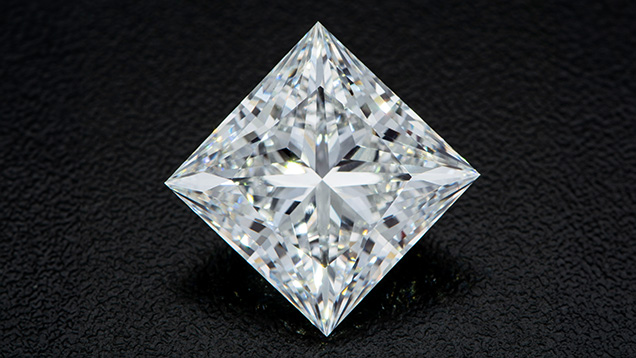
The stone returned at 15.73 carats.
This is the resubmitted CVD diamond. Its G color and VVS2 clarity matched the earlier grades, despite a change in weight and treatment evidence.
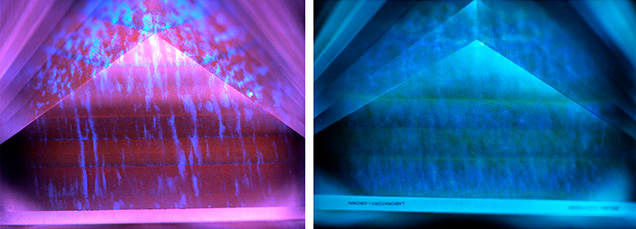
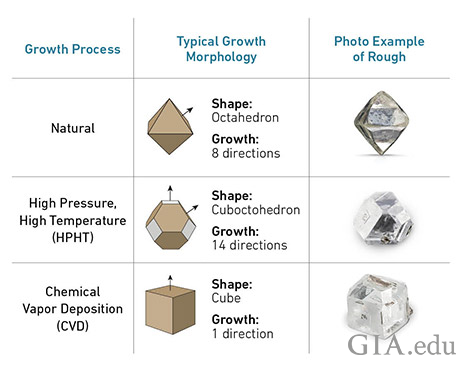
The chart shows rough crystals before cutting. It explains growth, rather than giving you a way to identify a polished diamond at home.
The laboratory images in these cases use controlled imaging conditions. Their bright colors help reveal structure. They do not show how the diamond looks across the counter.
Ask the right question first. Is it diamond? Is it natural? Has anyone treated it? Does this report belong to it?
Five checks to carry into your purchase
The lesson is to verify the right thing.
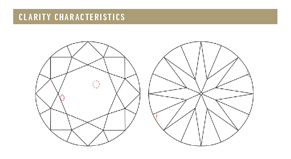
The report has a map. Use it.
GIA’s example maps clarity features in crown and pavilion views. Ask an inspector to compare the actual stone with its report and read the comments too.
Measurements and clarity features give an inspector more to compare. GIA plots identifying features when the report includes a clarity diagram, and some characteristics appear in the comments.
Compare the actual report with the actual stone. Then use appropriate laboratory testing for questions about material, origin, and treatment.
01
Report record and actual stone
A valid number does not establish that the stone matches it. Compare measurements and features, then use physical verification.
02
Diamond versus simulant
Material identity needs a suitable test. A number, screenshot, or single basic tester can leave a gap.
03
Origin and treatment
Natural origin and untreated status are separate questions. Get clear written disclosure.
04
Loose and mounted visibility
Prongs and metal can hide features. Ask what the inspector could actually see and which uncertainties remain.
05
Return window and next step
Plan verification while you can still return the purchase. An online review can identify questions; physical laboratory testing answers origin and treatment issues.
Ten cases. Ten questions to ask.
YDG buyer summary of the ten GIA investigations. Each case above links to the original evidence.
Does the report describe the stone as it is today?
Match current weight and measurements, and obtain current treatment documentation.
Straight answers
The questions buyers actually ask.
Are these Your Diamond Guys customers?
No. They are documented public laboratory cases published by GIA. We explain the buyer lesson and link to the original investigators. We do not present their work as our client results.
Can an online review prove my diamond’s origin?
No. It can flag a mismatch, explain evidence, and help you plan verification. Material, growth origin, and treatment questions can require physical testing by a qualified laboratory.
Do these cases mean copied inscriptions are common?
They show that the problem can occur. These ten selected investigations cannot tell us how common copied inscriptions are. The practical step is to verify the actual stone and keep clear purchase terms.
What should I send for a second opinion?
Send the listing, full report, asking price, available video, and the question you want answered. Include return terms if you have already bought the stone.