Cut Quality for Lab Grown Diamonds
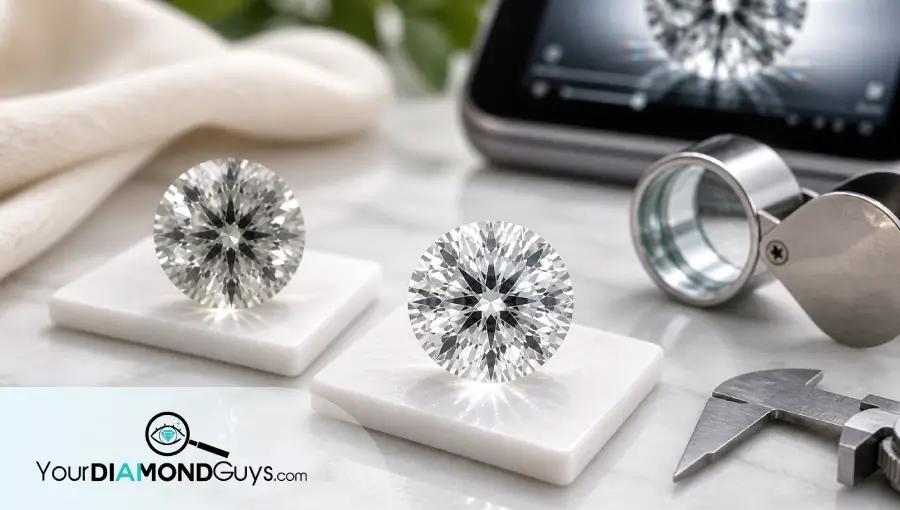
Cut is the engine. Size only helps when the stone has life.
By Rob Cornfield, Co-Founder of YourDiamondGuys.com. 35+ years of experience in the global diamond trade. Specialist in diamond cut and light performance.
Cut quality for lab grown diamonds matters more than the discount, the size jump, or the clean looking report.
Cut is still the engine.
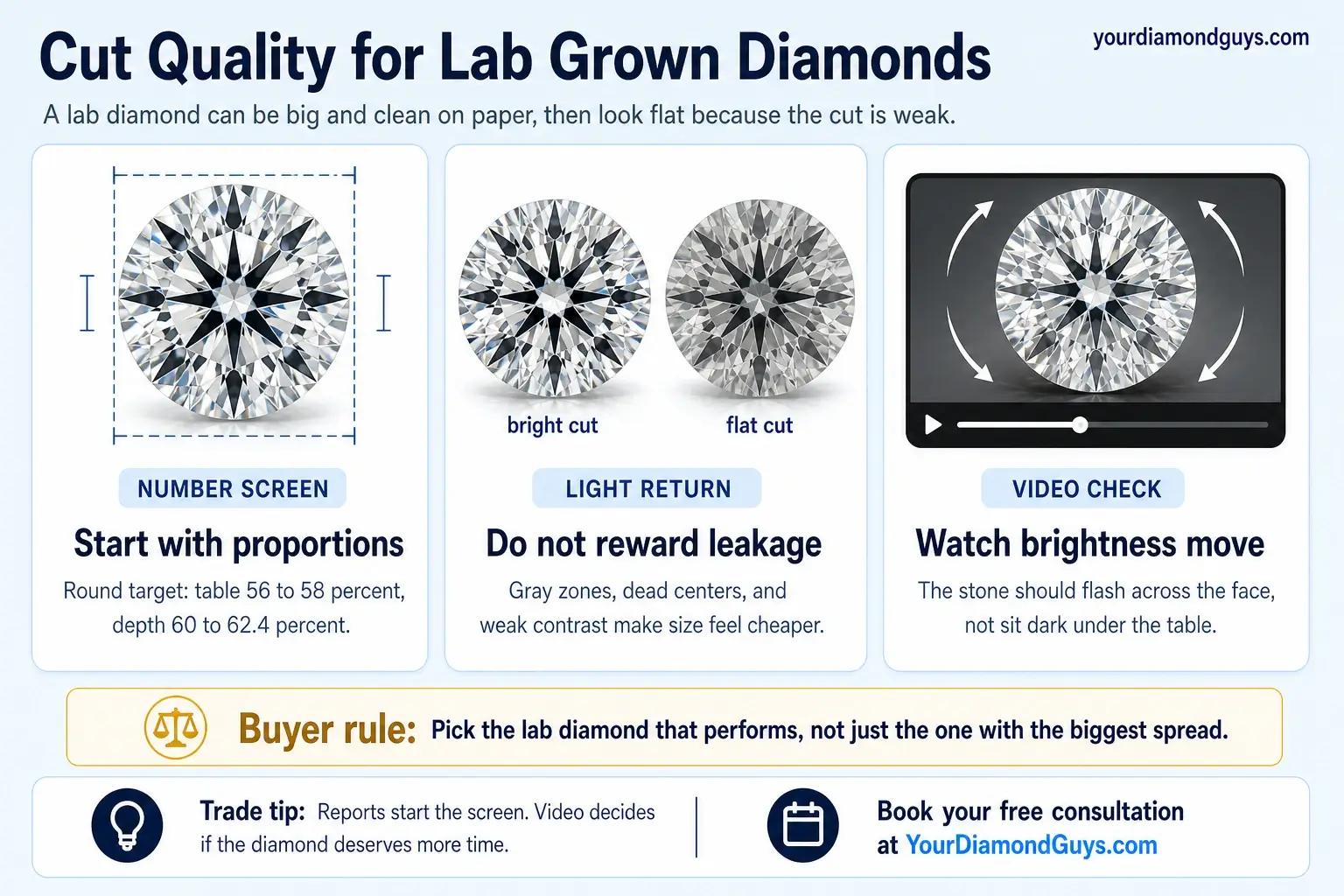
A weak lab diamond does not become lively because it was a good deal. It just becomes a larger weak diamond.
The Fast Buyer Answer
Start with cut before you compare carat size.
For round lab diamonds, my first screen is table 56 to 58 percent, depth 60 to 62.4 percent, crown angle 34 to 35 degrees, pavilion angle 40.6 to 41 degrees, Excellent polish, and Excellent symmetry.
Then I check video.
Numbers narrow the field. Video makes the decision.
Why Lab Buyers Get Tempted
Lab grown pricing lets buyers size up.
That can be smart.
But when a buyer jumps from 1.50 carats to 2.50 carats, the mistakes get bigger too. Poor proportions, leakage, tint, haze, or mushy facet pattern becomes easier to see.
The bigger the diamond, the less forgiving the stone gets.
Round Diamond Proportion Screen
Use this as a first pass for round brilliant lab diamonds.
| Cut Detail | Target Range |
|---|---|
| Table | 56 to 58 percent |
| Depth | 60 to 62.4 percent |
| Crown angle | 34 to 35 degrees |
| Pavilion angle | 40.6 to 41 degrees |
| Polish | Excellent |
| Symmetry | Excellent |
| Fluorescence | None to faint preferred when you want the cleanest decision |
These ranges are not magic.
They keep you away from a lot of weak stones before you spend time on video.
For deeper natural and round cut detail, use diamond cut quality and round proportions.
Video Proof Matters
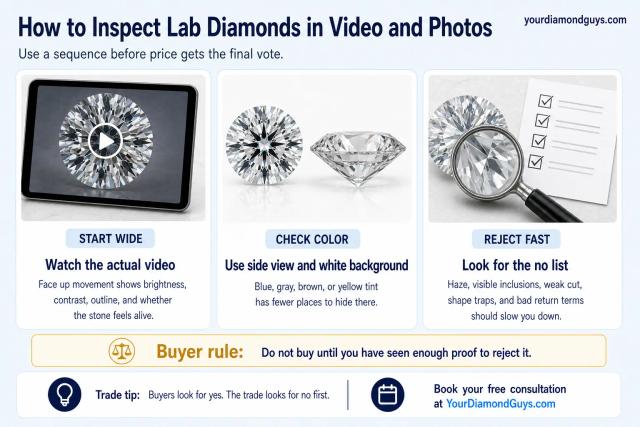
I want to see the actual diamond move.
Look for balanced brightness, crisp contrast, clean arrows in rounds, no dead center, and no dark patches that sit still while the stone turns.
If the diamond looks flat in video, the report grade does not rescue it.
The light leakage guide explains why bright paper can still lead to weak performance.
Fancy Shapes Need Their Own Rules
Fancy shapes do not get judged like rounds.
Ovals, pears, and marquise diamonds need bow tie checks. Emerald and Asscher cuts need windowing checks. Radiants and cushions need facet pattern checks so the middle does not look mushy.
Use the fancy shape lab diamond visual traps guide before buying anything elongated, step cut, or mixed cut.
Cut Can Hide Or Expose Other Issues
Strong cut can make a diamond look brighter and cleaner.
Weak cut gives your eye time to find every problem.
That includes tint, inclusions, leakage, and dead zones. A good report cannot fix weak light behavior.
Trade Insider Moment
When a parcel hits the desk, the lively stones announce themselves.
You do not need a speech.
The weak ones sit there. Same grades, same size neighborhood, totally different energy. That difference is cut doing its job or failing to do it.
My Buyer Recommendation
Spend your lab grown budget on the best looking diamond, not the largest certificate.
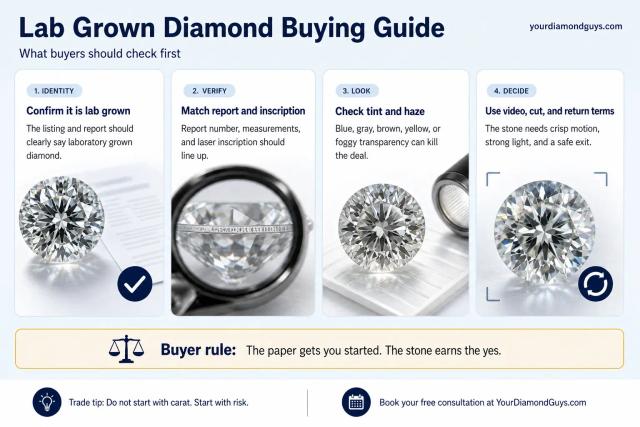
If you want size, fine. I like size too. Just make the stone earn it with strong proportions, clean video, crisp transparency, and a return policy that lets you verify the ring in real light.
Mistakes I Would Avoid
- Do not buy size before cut.
- Do not trust Excellent polish and symmetry as the whole cut story.
- Do not ignore leakage in video.
- Do not compare carat weight without face up measurements.
- Do not accept a dull stone because the price looks easy.
What To Ask Before Buying
- What are the table and depth percentages?
- What are the crown and pavilion angles?
- Does the video show crisp light return?
- Are there dead areas under the table?
- Does the diamond face up well for its carat weight?
- Can I compare it against a better cut stone?
Reach out to Rob or me at YourDiamondGuys.com if you want a cut review before buying.
Where I Would Compare Cut Proof
Use these sites as comparison tools, not automatic recommendations. For cut proof comparison, I would review similar stones on Whiteflash and Brian Gavin Diamonds, then make the video and light behavior earn the yes.
Cut Matters More Than You Think
Questions? Reach out directly for a free consultation, or drop them in the Diamond Buyers Academy community — Rob and Josh answer personally.
Questions Buyers Ask Us
Related Lab Grown Diamond Guides
Keep the full buying path close. These are the next checks that usually affect this decision.
*Some links on our site may earn us a small commission at NO EXTRA cost to you, helping us keep our content free*