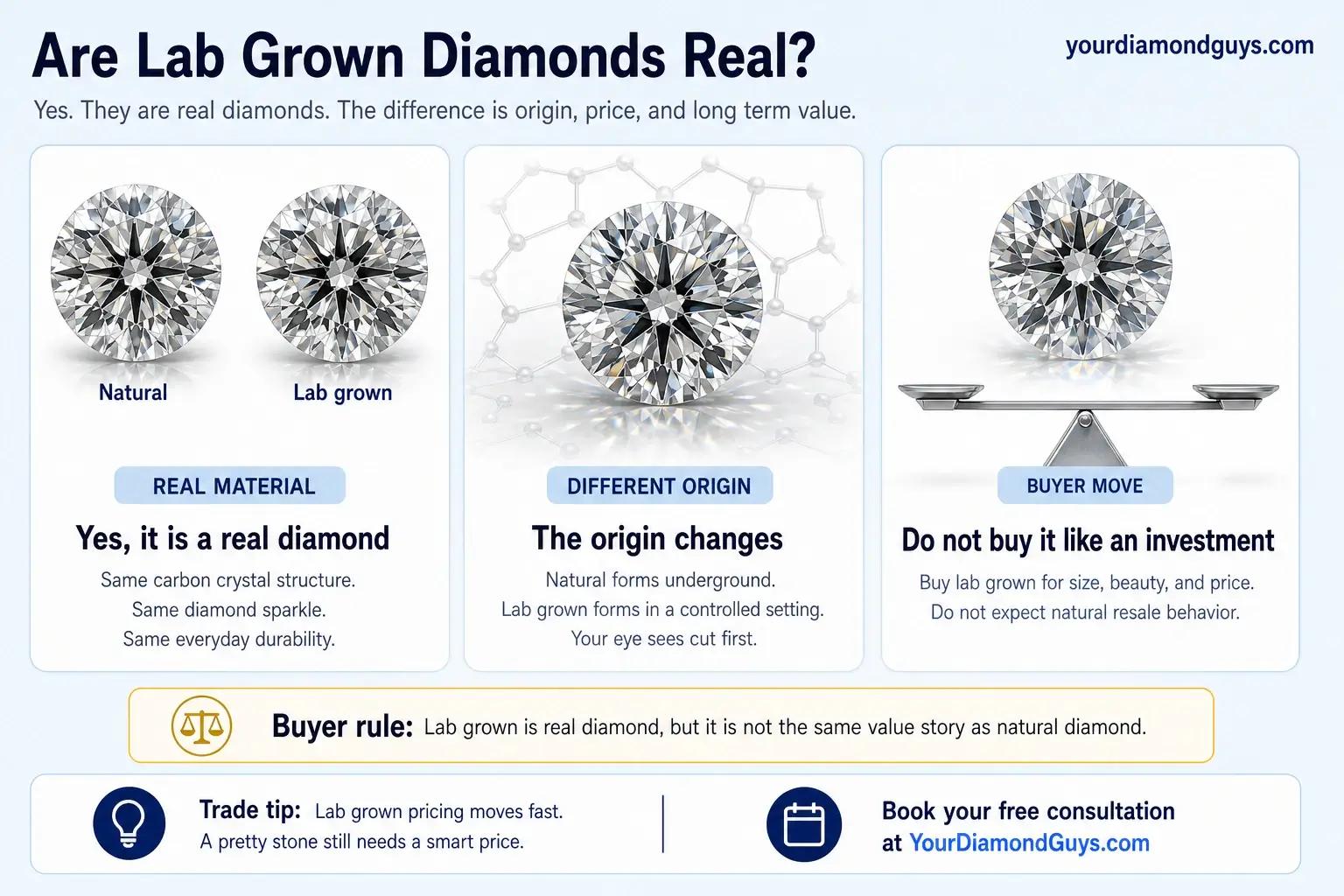
Are Lab Grown Diamonds Real?
Start here if you want the plain answer. Lab grown can be real diamond, but the report and listing language still have to prove it.
Free expert guidance by email or video chat.
No pressure, No sales pitch. Just honest help from diamond experts.
Start with proof, not the price.
By Josh Allen, Co-Founder of YourDiamondGuys.com. Fifth generation diamantaire with 25 years of experience in the global diamond trade. Former supplier to Tiffany & Co., Cartier, and Harry Winston.
Lab grown diamonds can be a smart buy, but only when the actual stone checks out. Start with proof, not the price.
The report tells you what the diamond claims to be. The video tells you whether you should keep looking. That difference saves buyers a lot of money.
On a dealer desk, lab grown diamonds get sorted fast. Real diamond is only the first answer. After that, I want report clarity, growth method, tint check, transparency, cut, inscription, return policy, and a video that does not hide the truth.
| Buyer check | Why it matters |
|---|---|
| Identity | Confirm it is lab grown diamond, not moissanite, CZ, or vague listing language. |
| Report | Check growth method, measurements, comments, treatment, inscription, fluorescence, and proportions. |
| Visual quality | Look for tint, haze, milkiness, weak transparency, bow tie, leakage, and distracting inclusions. |
| Cut | For rounds, start near table 56 to 58 percent, depth 60 to 62.4 percent, crown 34 to 35 degrees, and pavilion 40.6 to 41 degrees. |
| Protection | Return window, restocking fees, insured shipping, warranty terms, upgrade policy, and verification timing matter before payment. |
This page is the starting point for the whole lab grown diamond buying path. Use it to decide which risk you are trying to solve, then move into the guide that matches that exact decision.
If you are still asking whether lab grown diamonds are real, start there. If you are comparing actual listings, go to reports, CVD vs HPHT, tint, haze, cut, and video inspection. If you are close to buying, finish with verification, return policy, warranty, resale expectations, and engagement ring fit.
Start broad, then narrow the check. The right page depends on what could make the specific diamond a yes or a no.
Use these first if you are still sorting out what lab grown means and how the stone was made.
Start here if you want the plain answer. Lab grown can be real diamond, but the report and listing language still have to prove it.
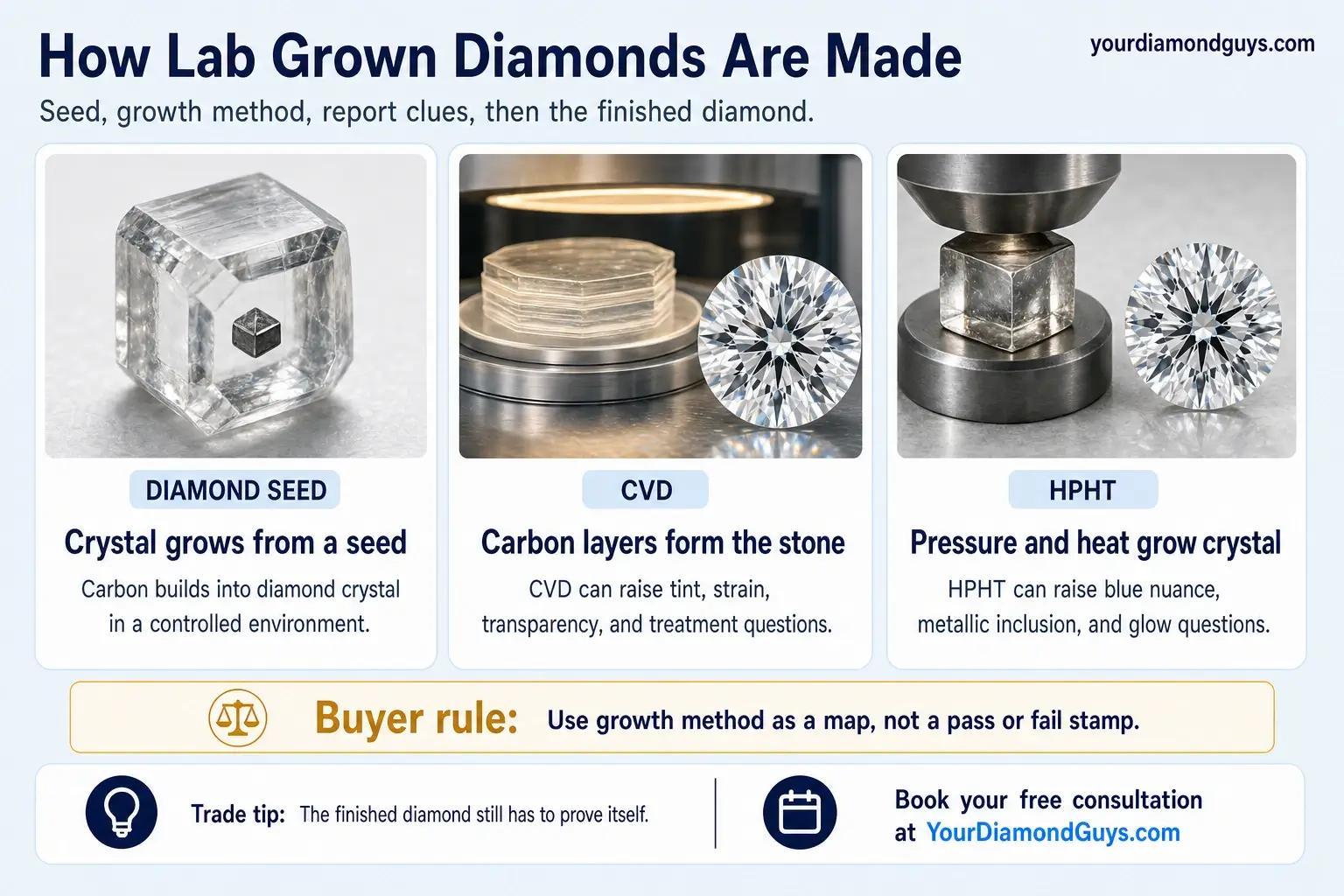
Use this when CVD, HPHT, seed crystal, and growth chamber language starts to blur together. The buyer checks stay simple.
Use these when the report, growth method, grading lab, or treatment language decides whether the diamond deserves more attention.
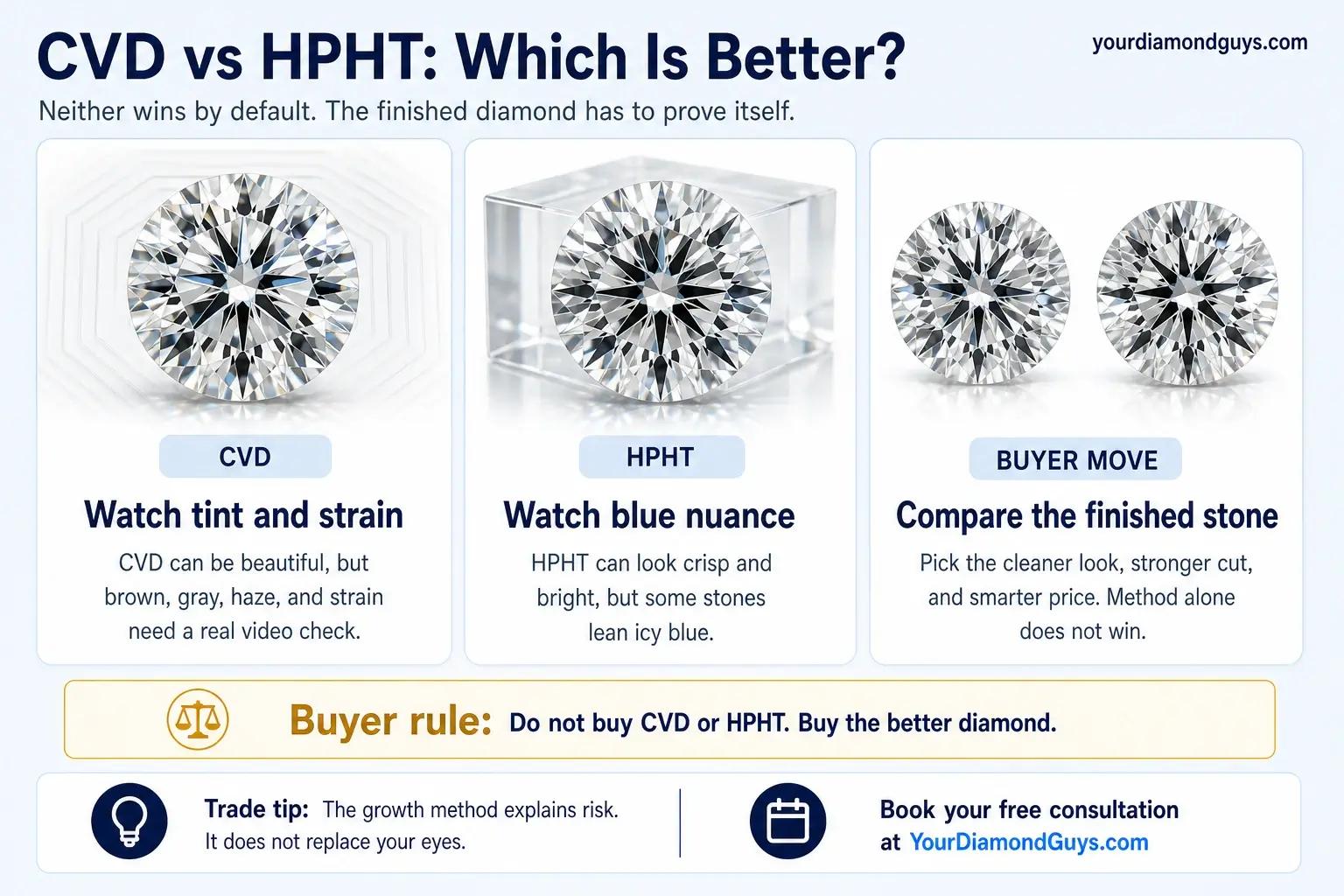
Use this before treating growth method like a quality grade. CVD and HPHT both need report, tint, transparency, and video proof.
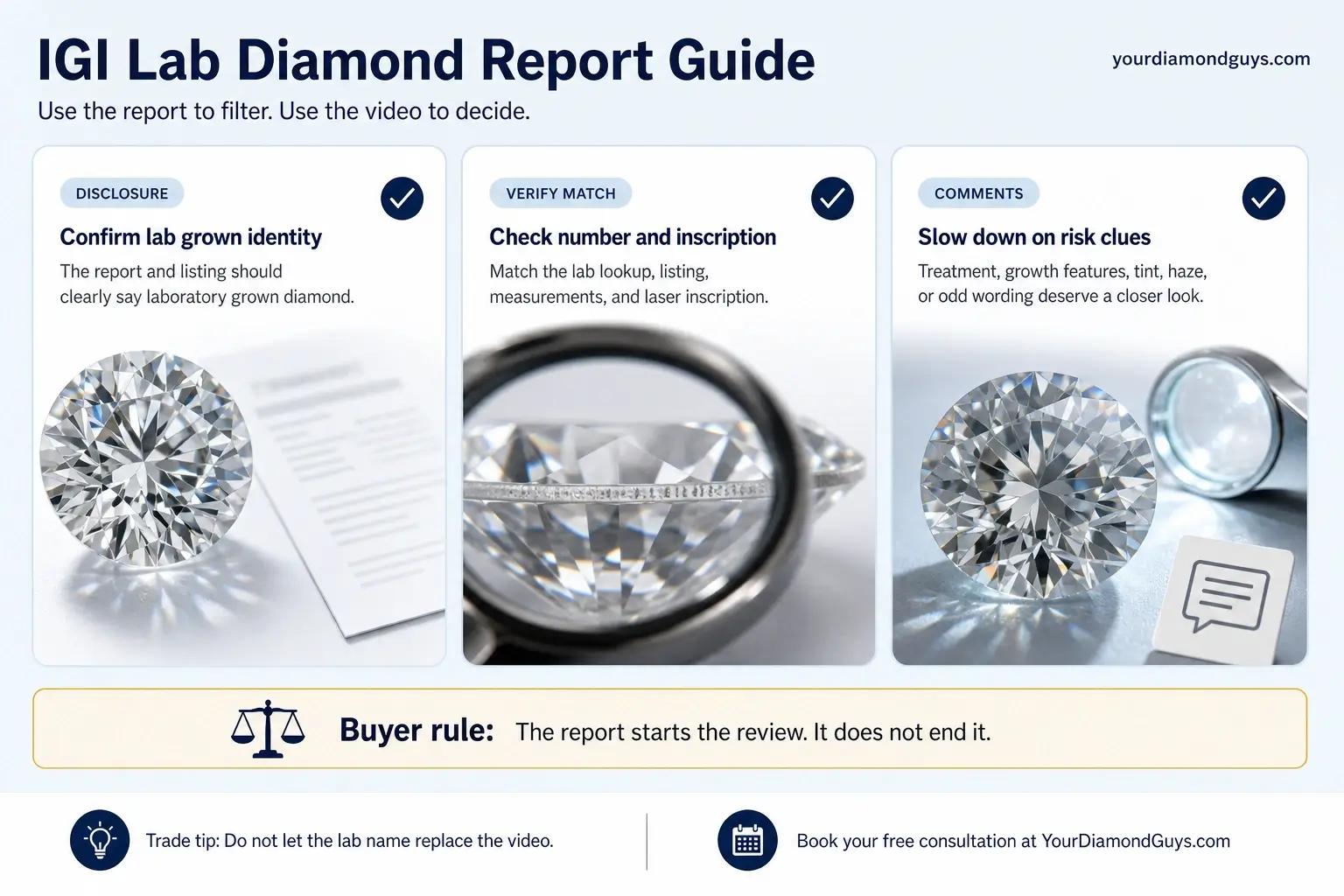
Start here when the report looks clean but you are not sure which fields matter. Comments, treatment, measurements, and inscription do real work.
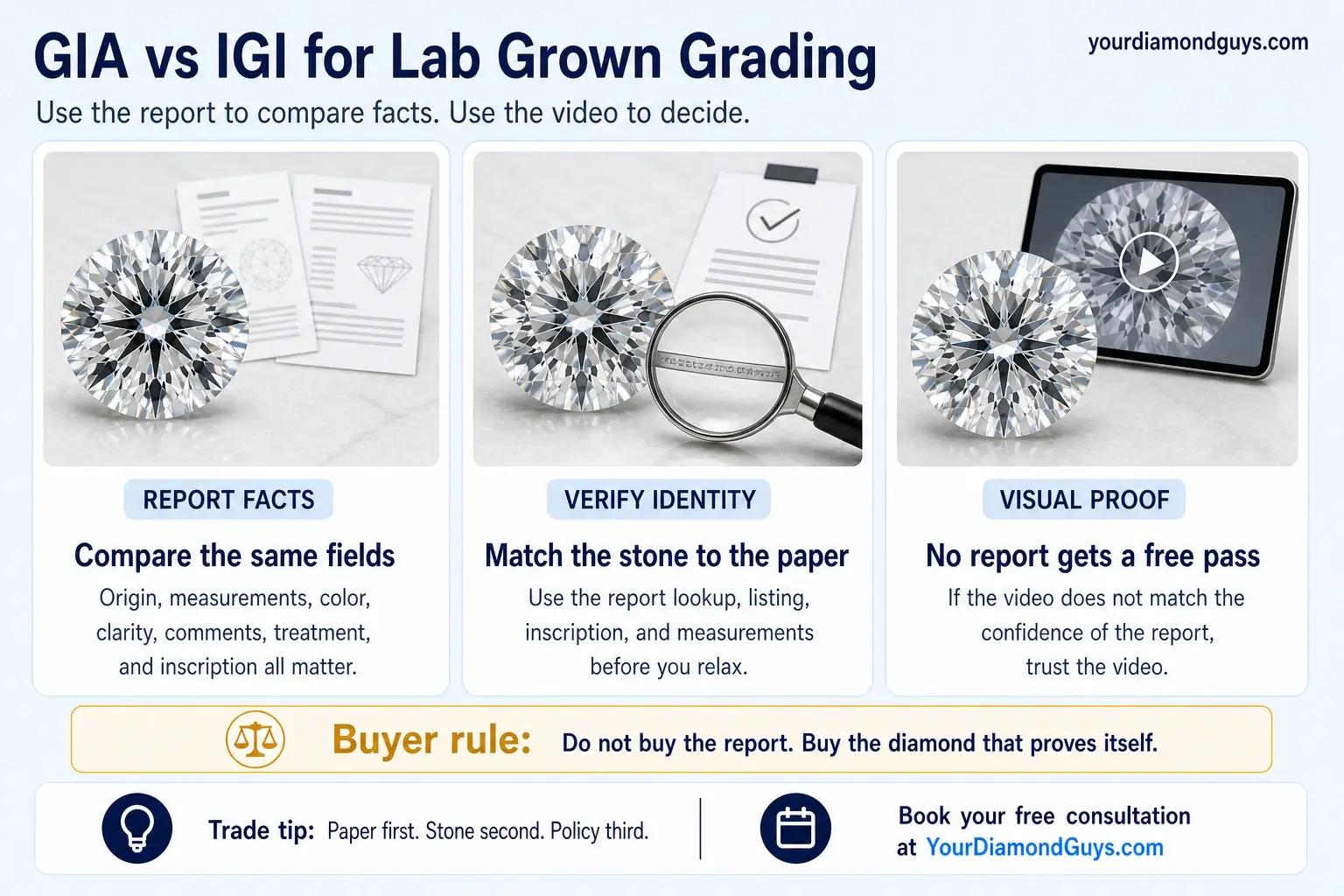
Use this to compare lab reports without overtrusting the lab name. For natural diamonds, start with GIA. For lab grown, still demand visual proof.
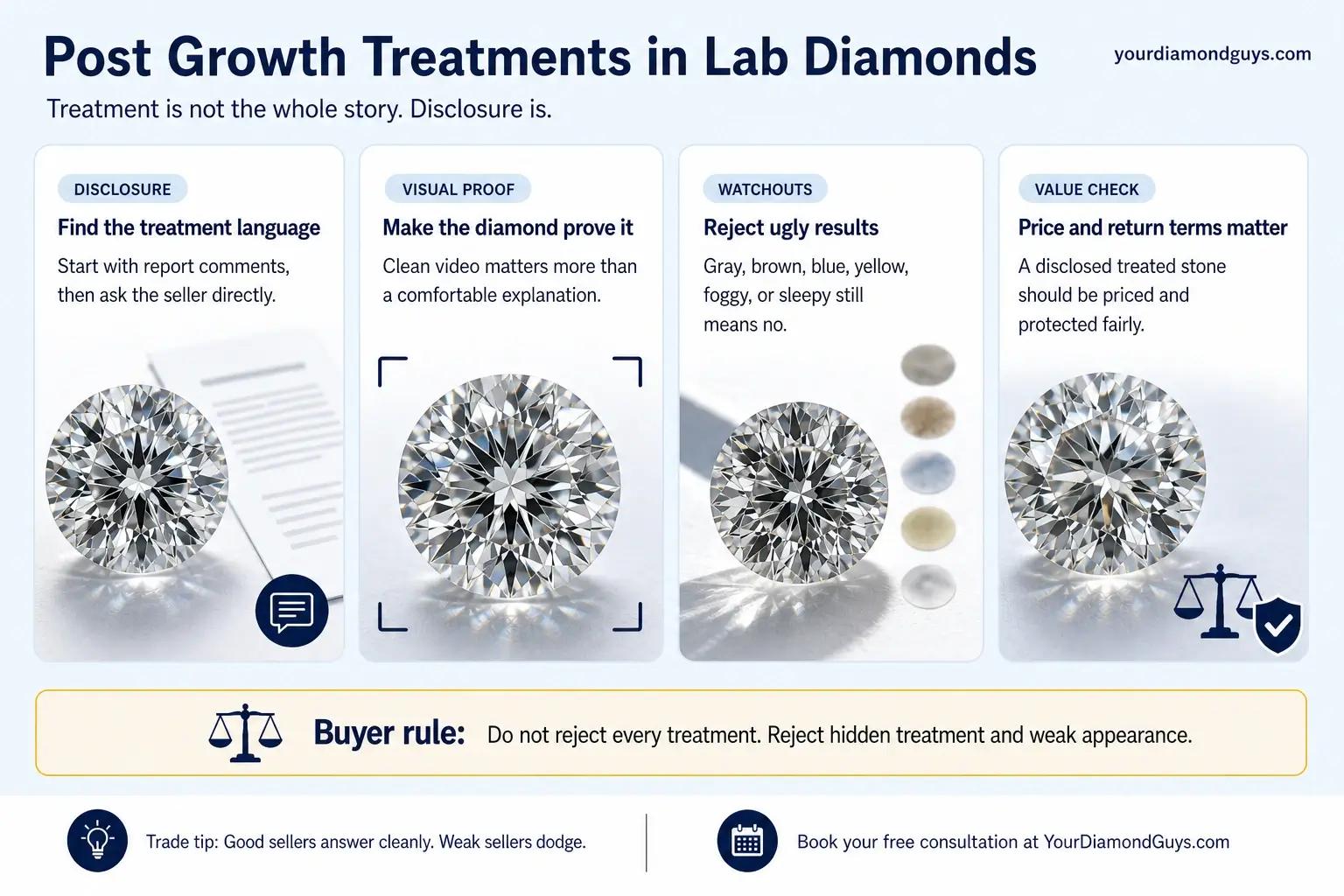
Use this when a report mentions treatment or processing. Treatment is not always a deal breaker, but unclear disclosure should slow you down.
Use these before price or carat weight talks you into a diamond with tint, haze, weak cut, or a bad shape issue.
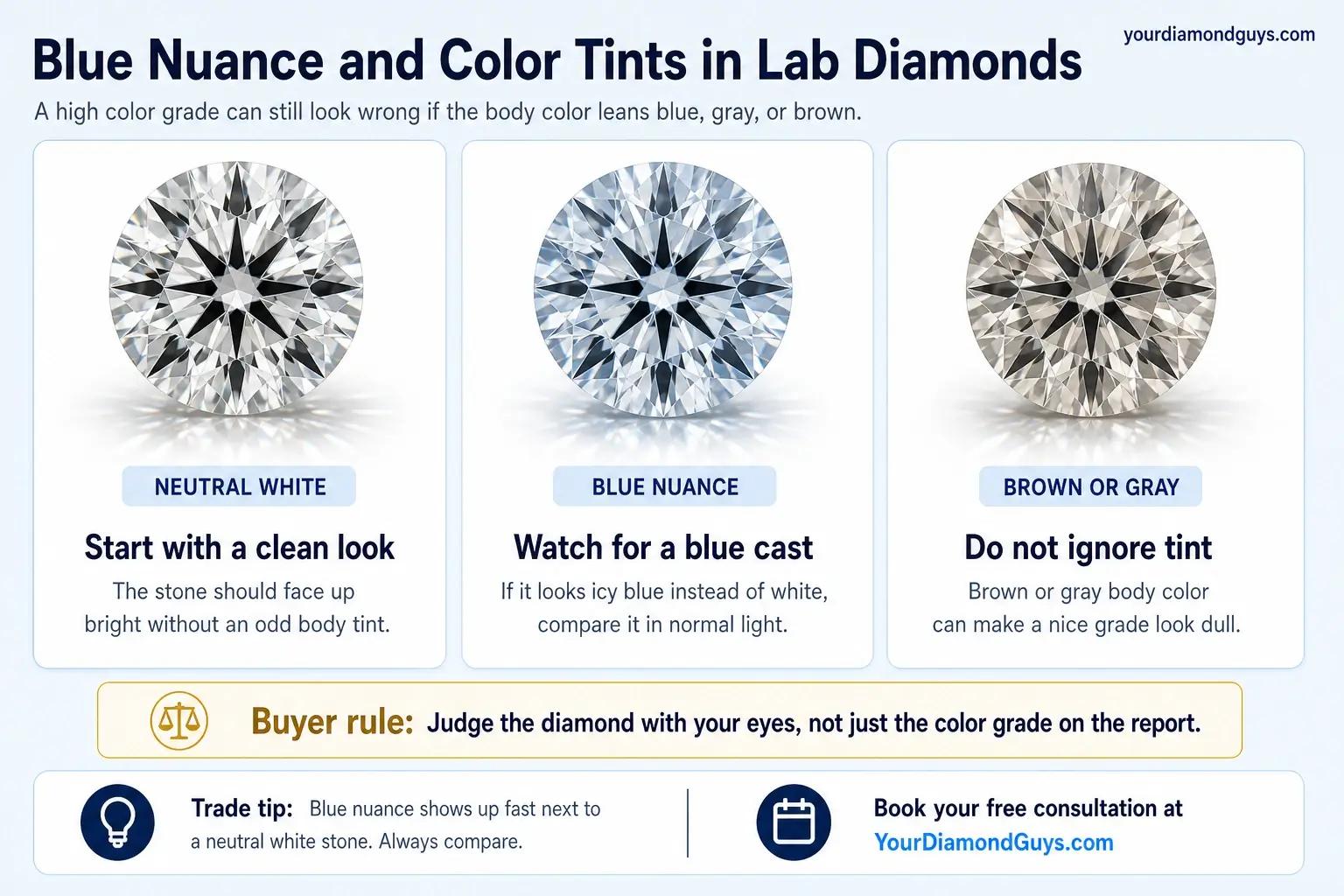
Use this before buying a high color lab diamond that still looks blue, gray, or brown. The letter grade does not tell the whole story.
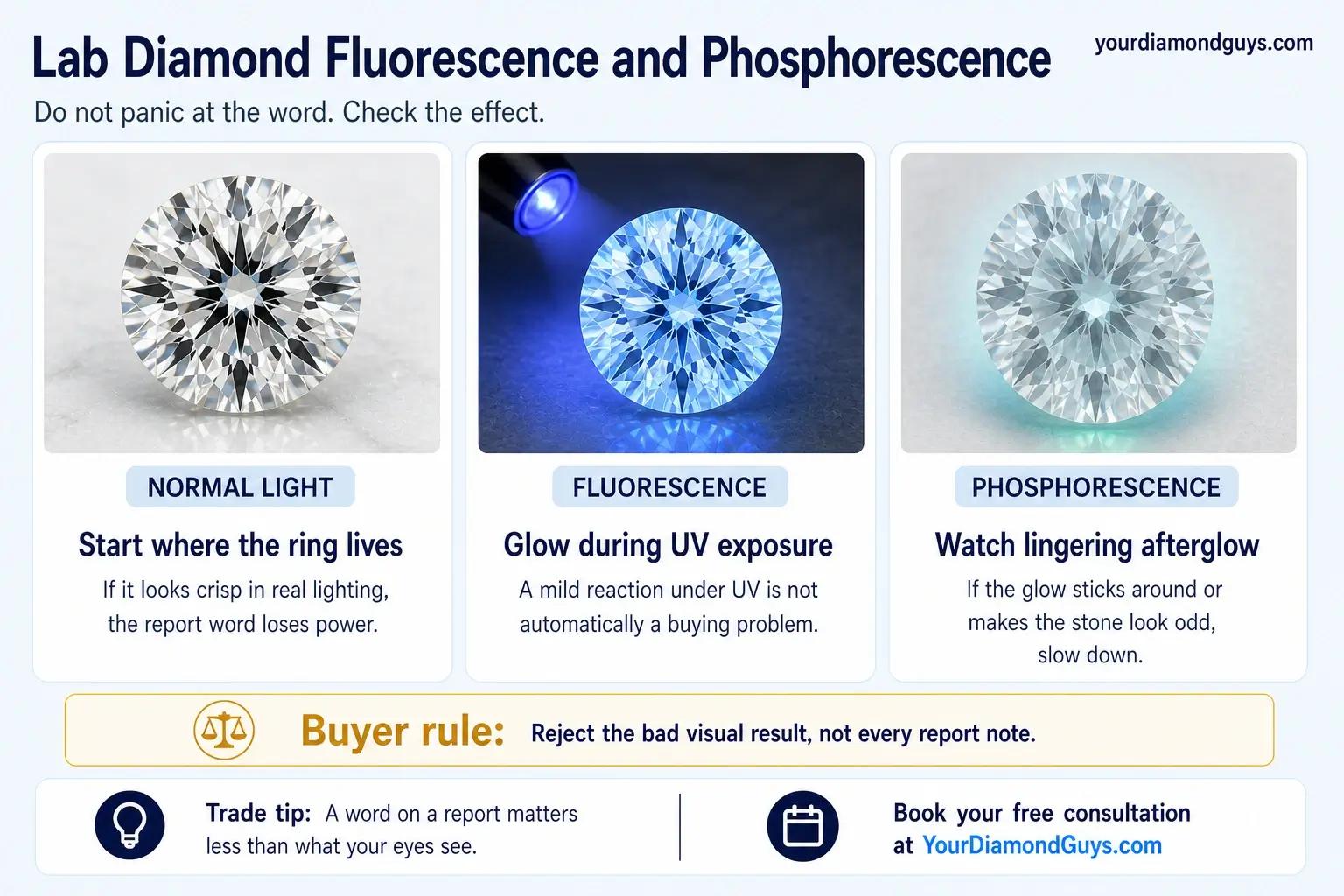
Use this when glow shows up in the report or video. Fluorescence is not scary by default, but lingering afterglow deserves a closer look.
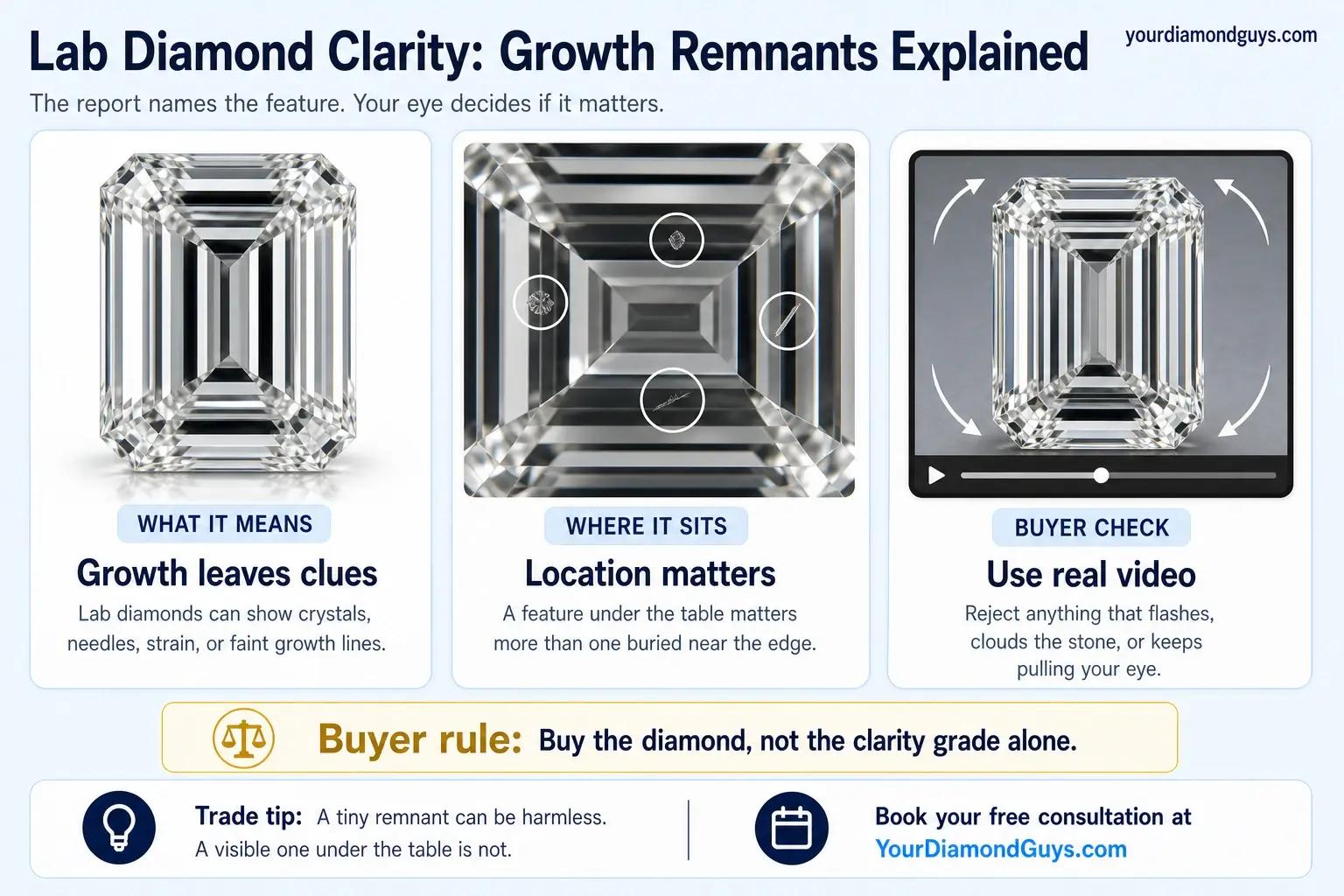
Use this to understand growth remnants, strain, metallic inclusions, clouds, and which clarity comments are just cosmetic.
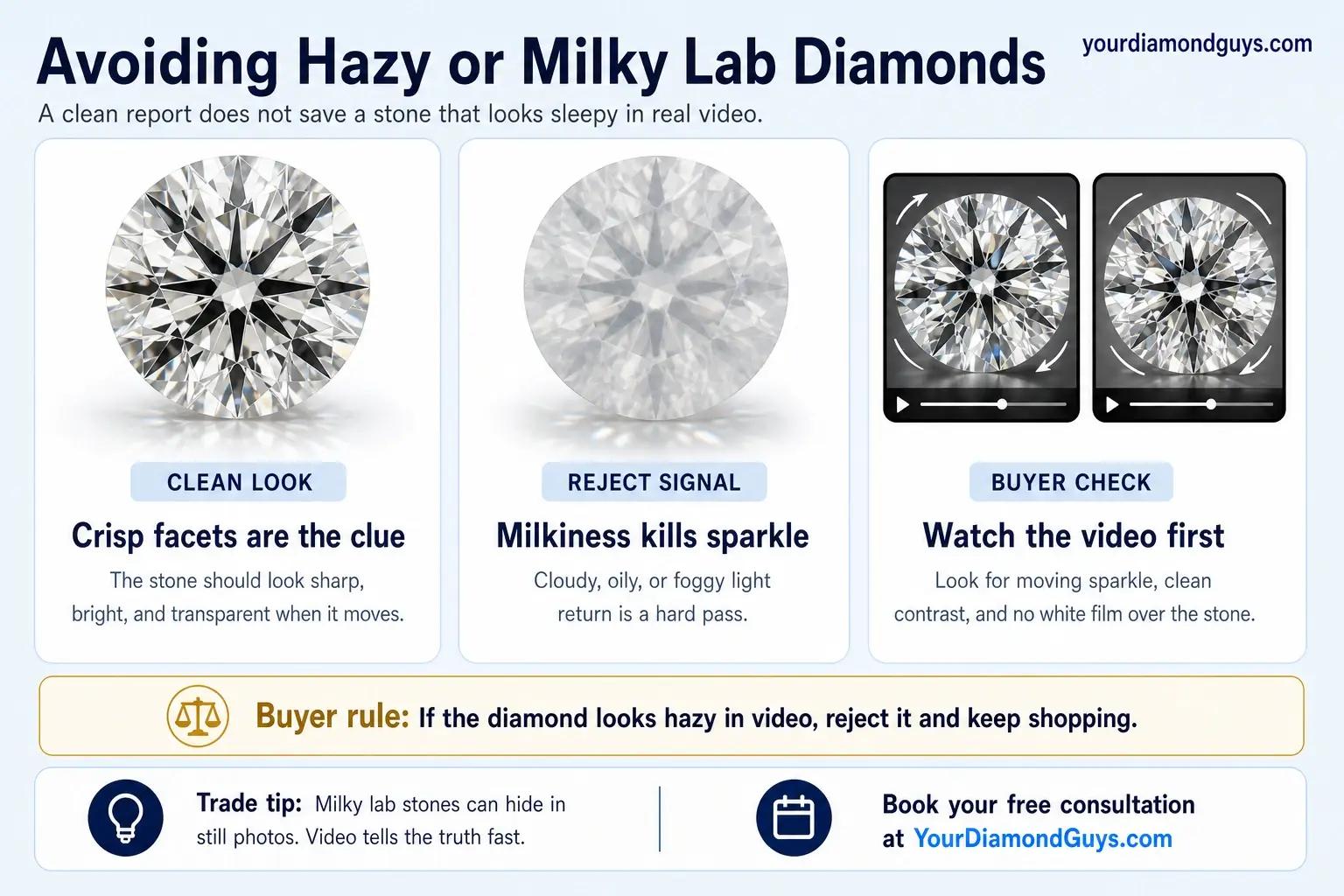
Use this before you talk yourself into a foggy stone because the price looks good. True haze is a walk away problem.
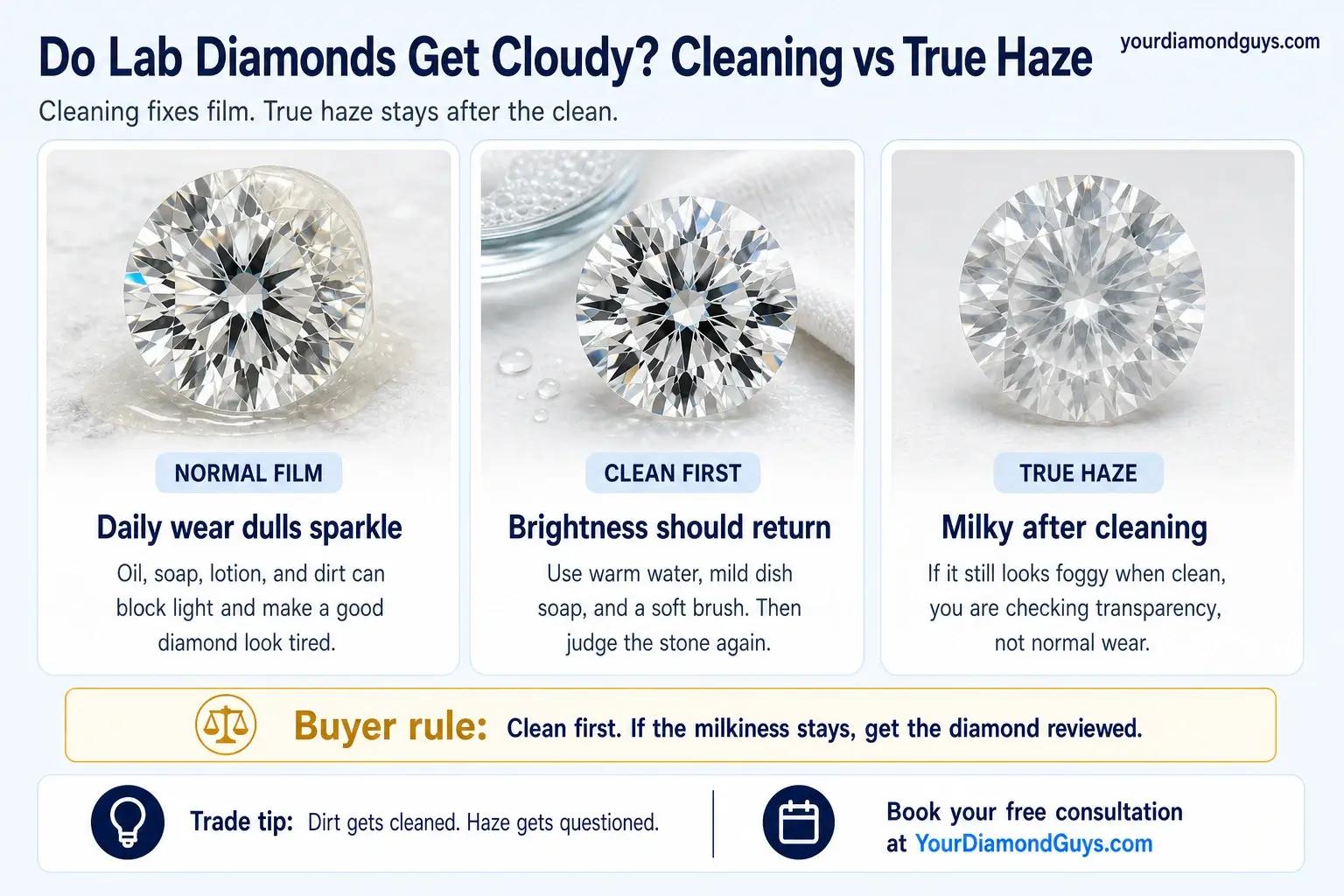
Use this after ownership questions come up. Normal oil and soap film clean off. True haze is a different issue.
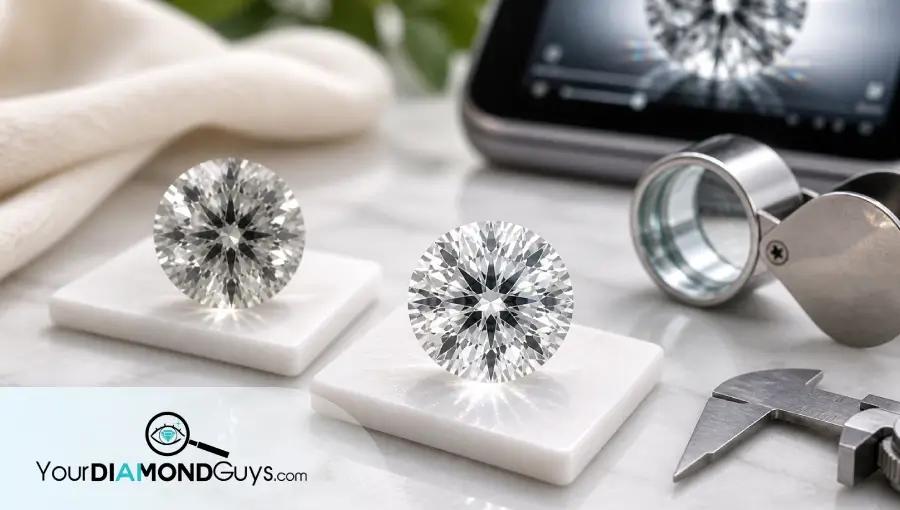
Use this before chasing size. Lab grown value makes it tempting to go bigger, but weak cut still kills the diamond.
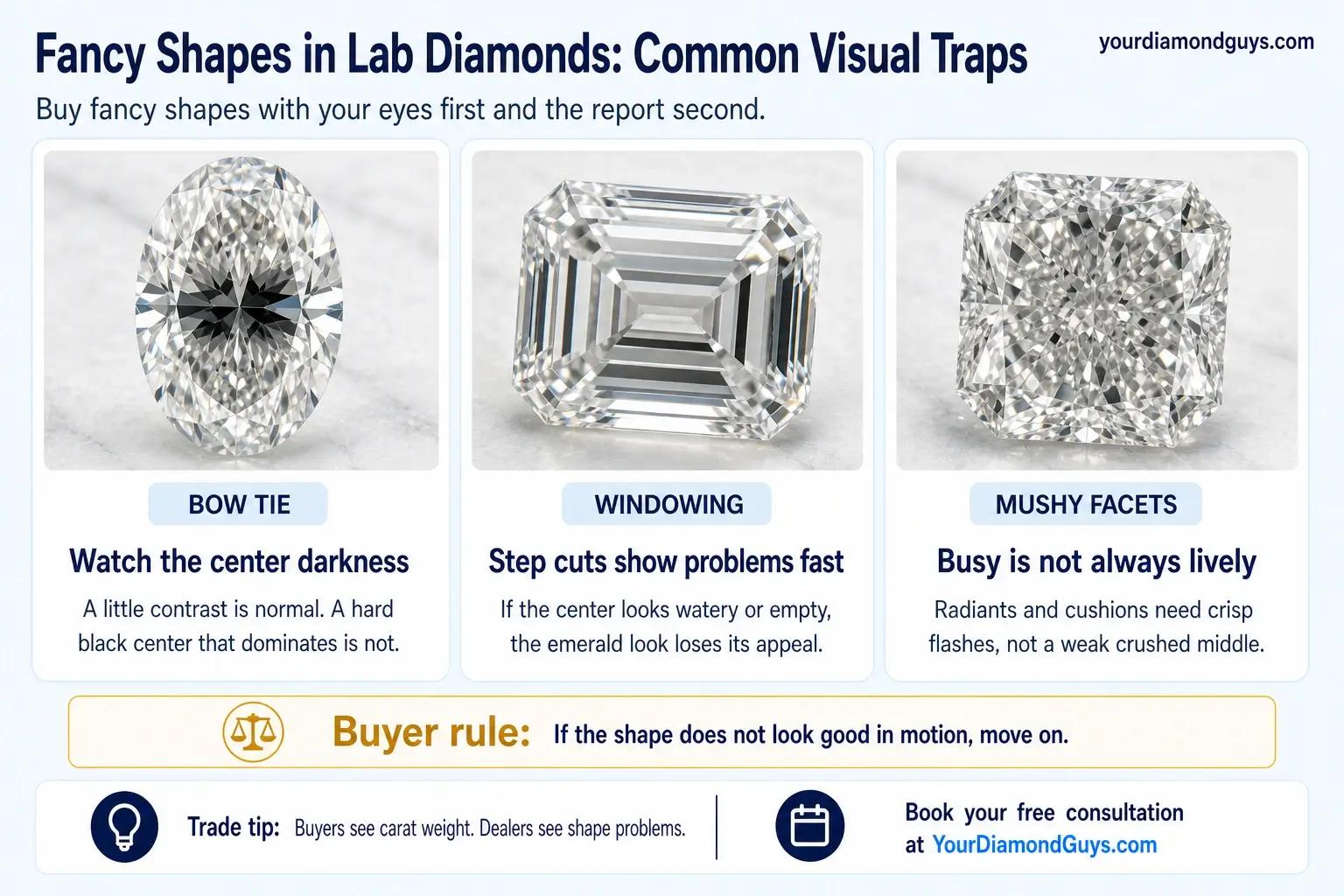
Use this for oval, pear, marquise, emerald, cushion, radiant, and other shapes. Bow tie, windowing, outline, and mushy facets decide fast.
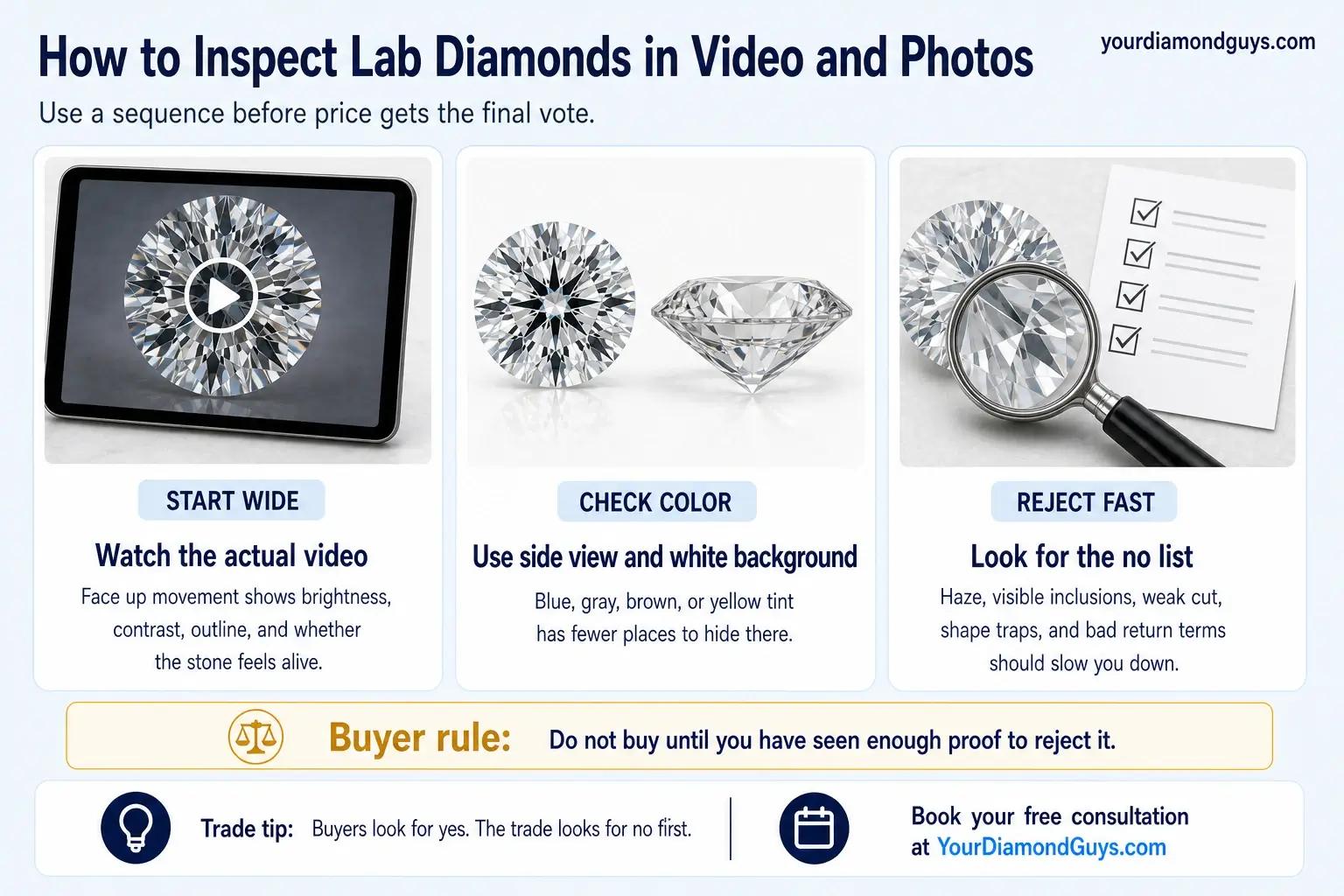
Use this as the practical online checklist. White background, side view, face up video, tint, haze, inclusions, and leakage all matter.
Use these when you are close to buying, checking delivery, or deciding whether the policy protects you if the stone is not right.
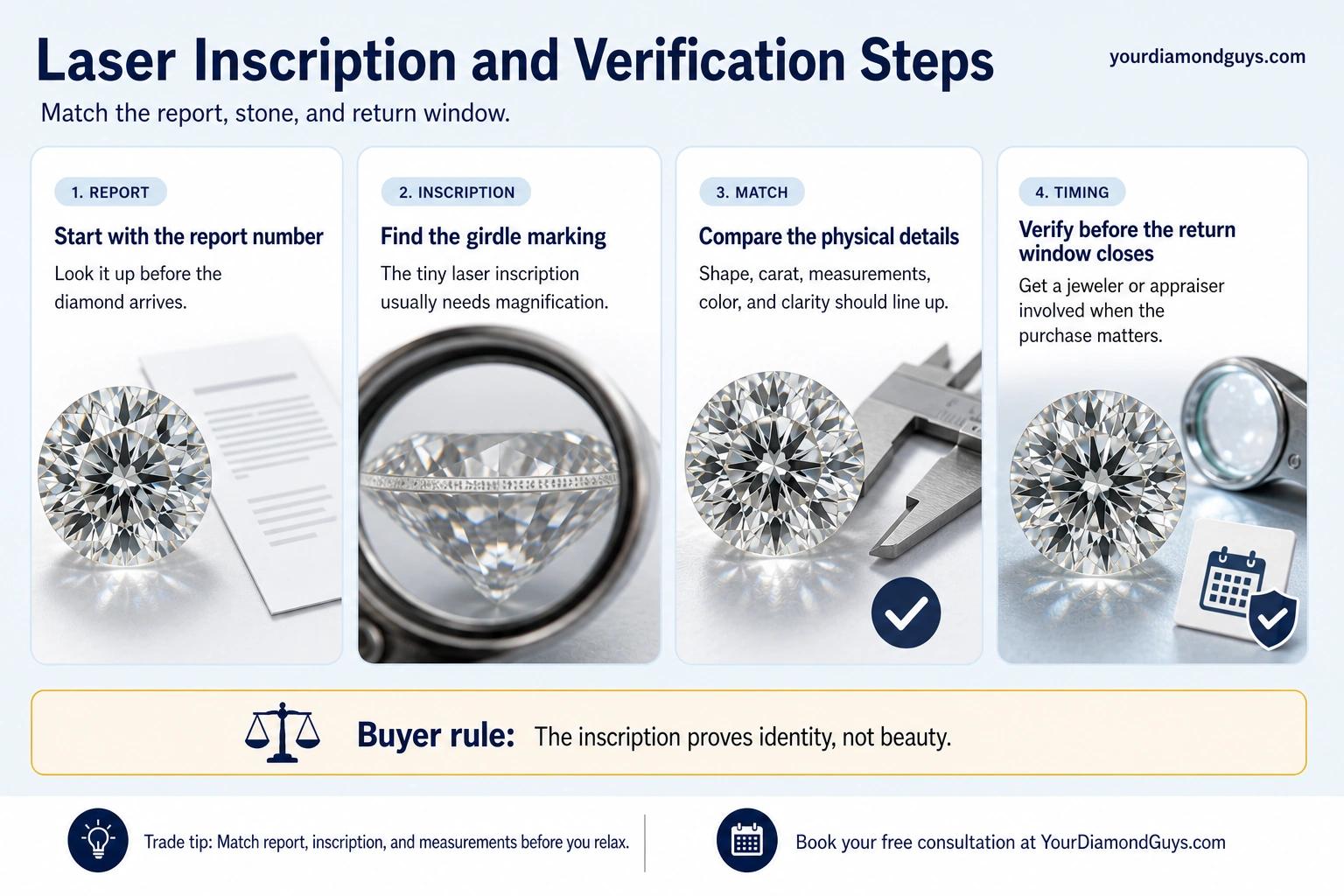
Use this before the return window closes. Match the inscription, report number, listing, and delivery paperwork before you relax.
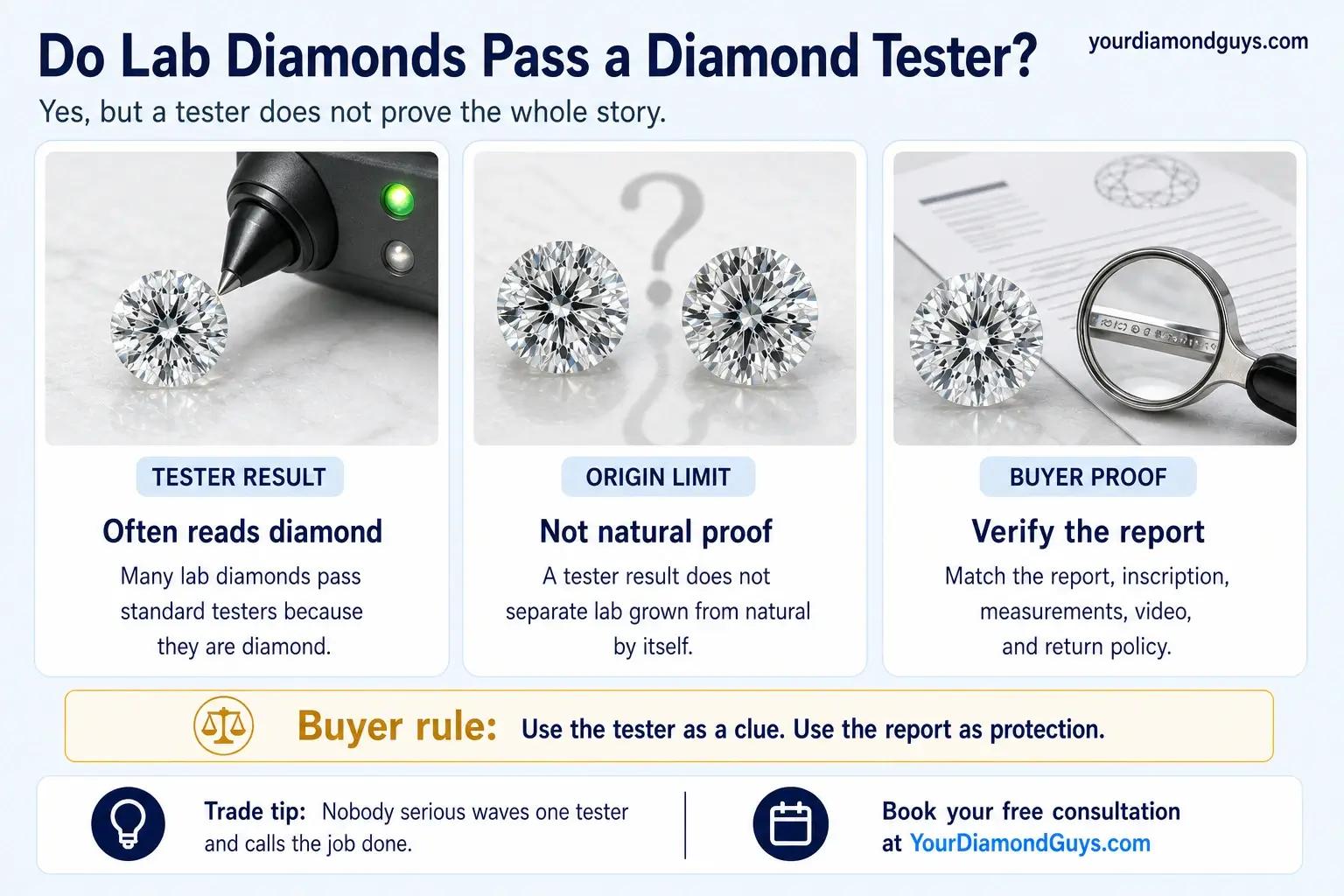
Use this when someone says a tester proves everything. A tester can separate many simulants, but it does not prove natural origin.
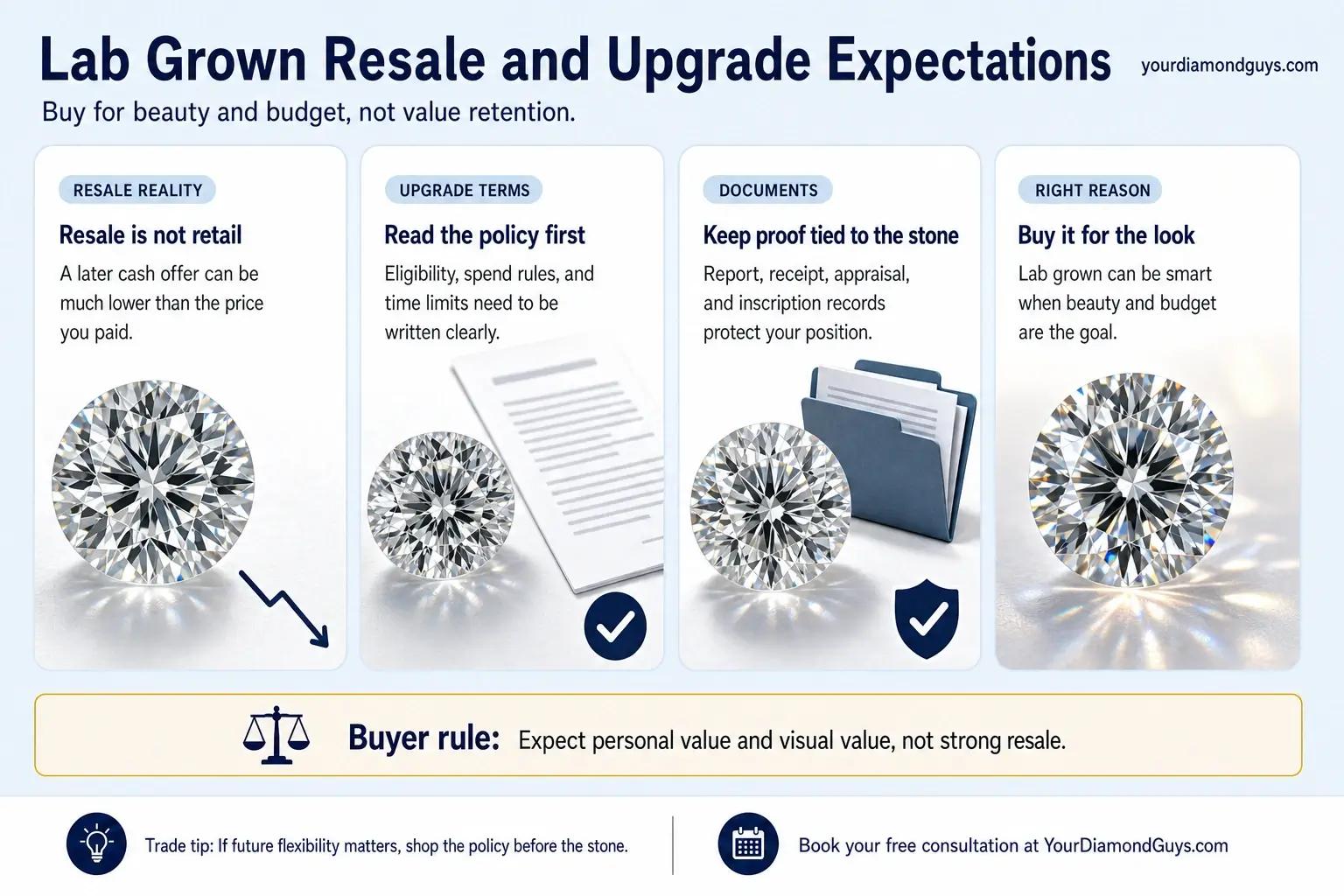
Use this before treating a lab diamond like an investment. Buy it for the ring, not for resale fantasy.
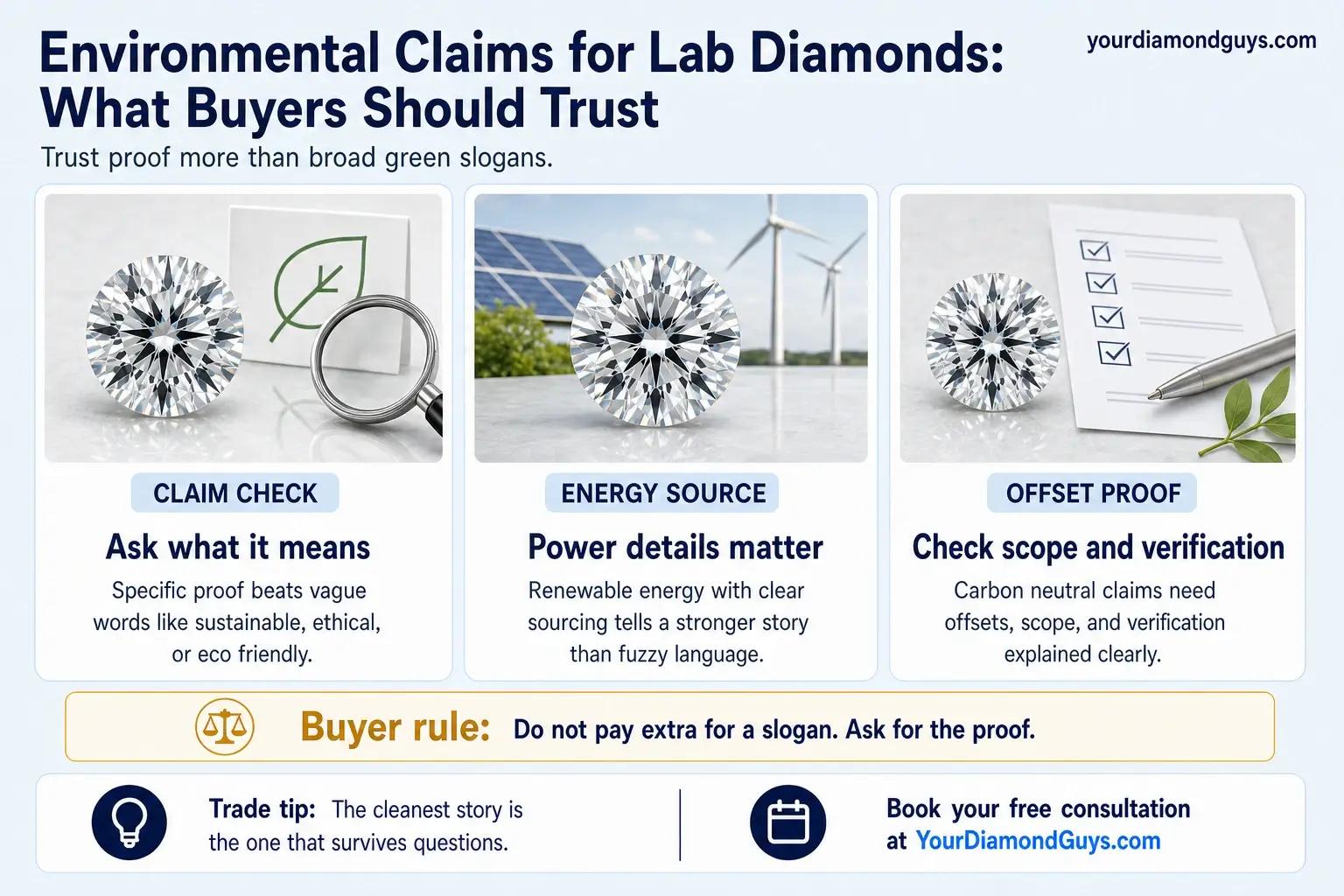
Use this when marketing claims sound too clean. Ask about energy mix, offsets, disclosure quality, and what the seller can actually document.
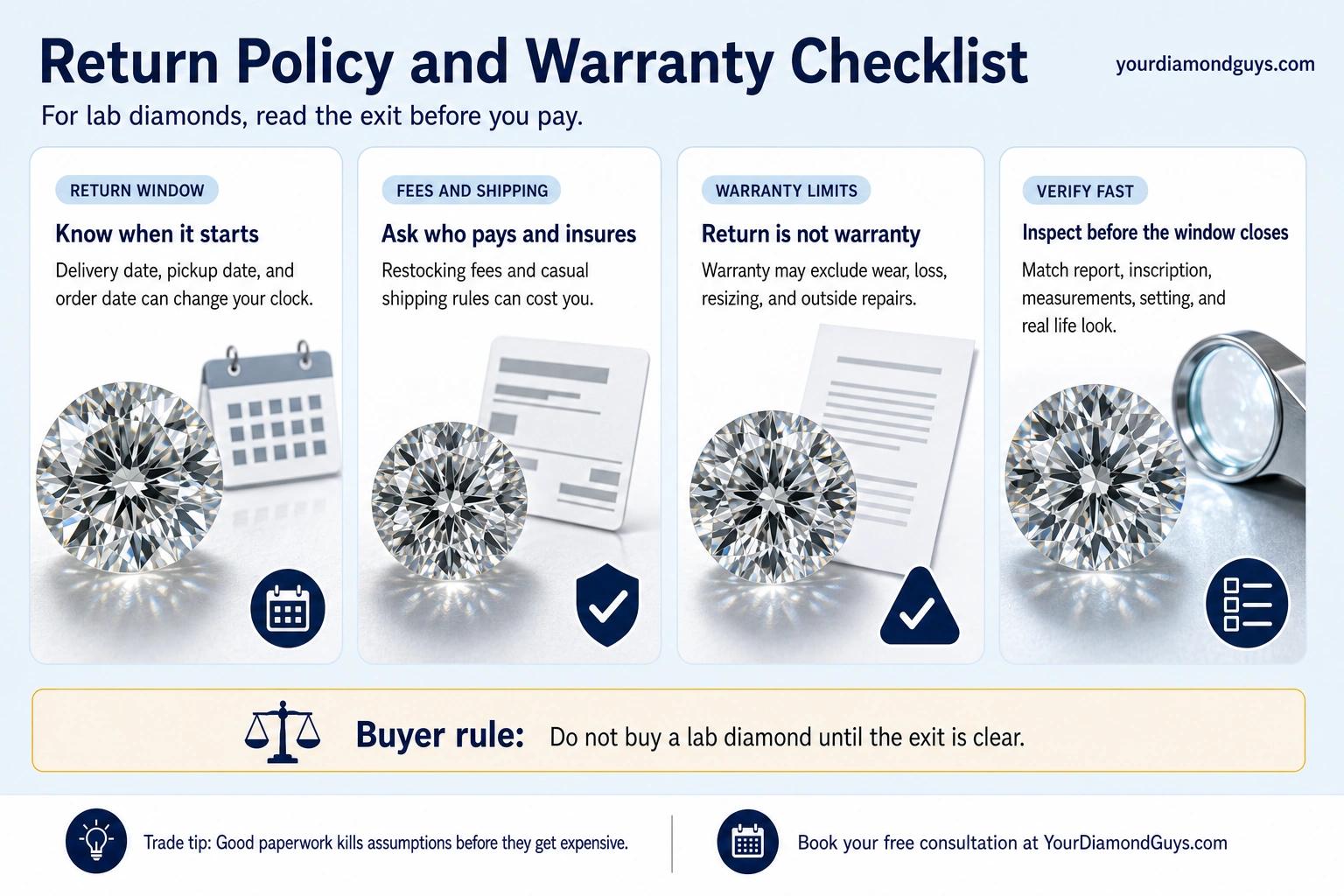
Use this before payment. Return window, restocking fee, insured shipping, resizing, warranty limits, and upgrade terms need to be in writing.
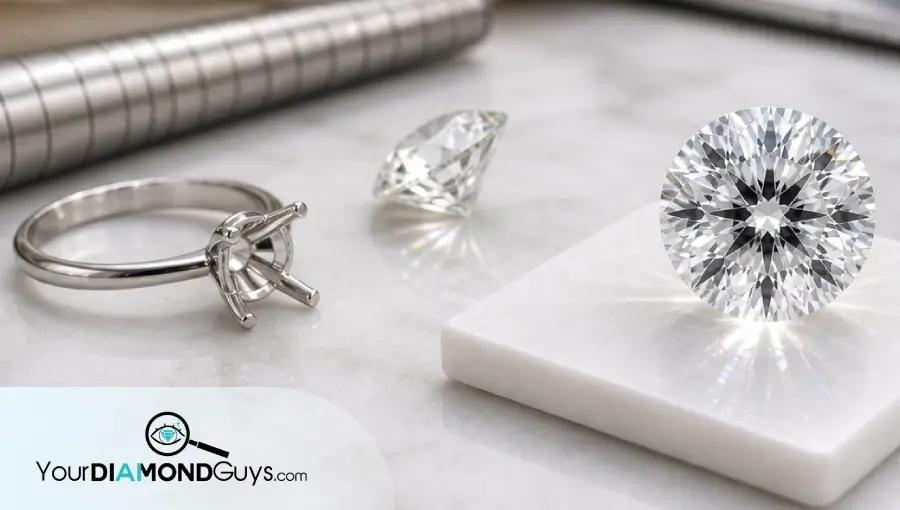
Use this when you are choosing specs for a real ring. Size, cut, color, clarity, setting, daily wear, and policy all work together.
Questions? Reach out directly for a free consultation, or drop them in the Diamond Buyers Academy community — Rob and Josh answer personally.
*Some links on our site may earn us a small commission at NO EXTRA cost to you, helping us keep our content free*