IGI Lab Diamond Report Guide
The report starts the review. It does not end it.
By Rob Cornfield, Co-Founder of YourDiamondGuys.com. 35+ years of experience in the global diamond trade. Specialist in diamond cut and light performance.
An IGI lab diamond report is a starting point, not a permission slip to buy the stone.
Read it fast.
Then slow down.
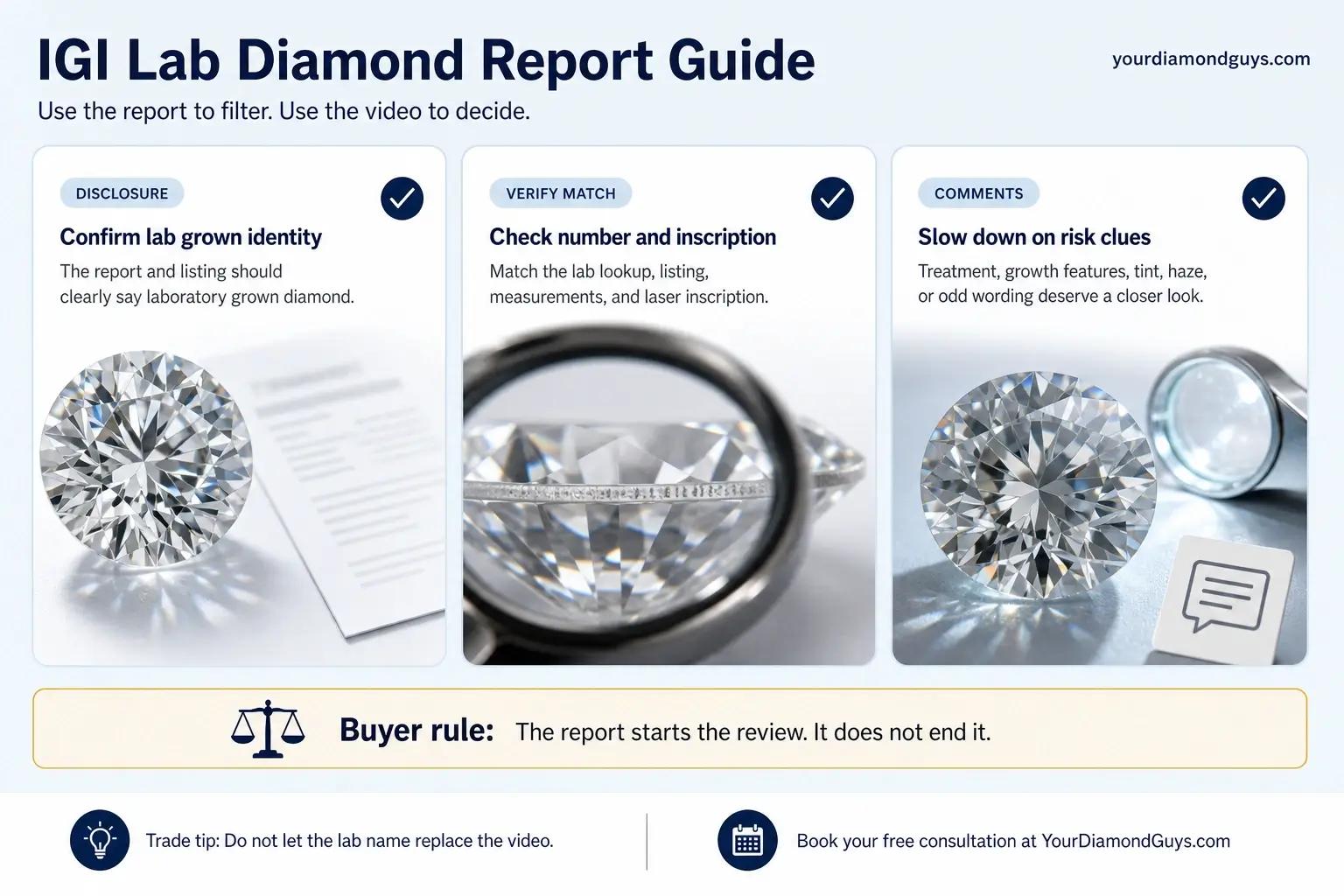
The report tells you what the lab recorded. It does not show whether the diamond looks neutral, crisp, bright, or sleepy in real video.
What To Confirm First
Start with identity.
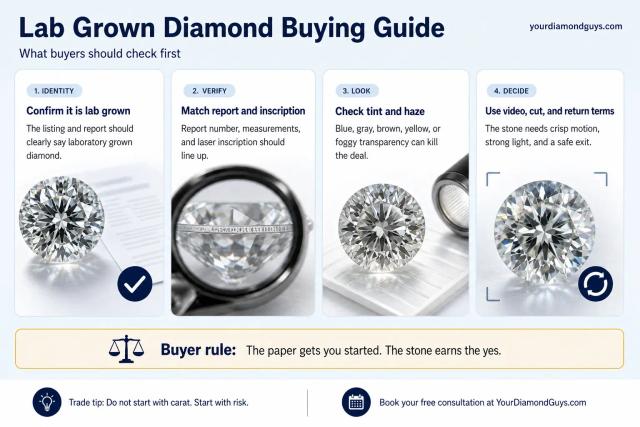
The report should clearly say the diamond is laboratory grown. Then match the report number to the listing, the lab lookup, and the laser inscription when the stone arrives.
If identity feels vague, stop there.
That is not a small detail.
Use the laser inscription verification guide after you understand the report.
The Sections That Matter
| Report Area | What It Tells You | Buyer Move |
|---|---|---|
| Report number | Document identity | Verify it on the lab site |
| Lab grown disclosure | Origin | Confirm it matches the listing |
| Shape and measurements | Face up size and outline | Compare spread, not only carat |
| Color and clarity | Grade range | Check video because grades do not show everything |
| Cut and proportions | Light performance clues | Use numbers as a first screen |
| Fluorescence | UV reaction | Check for visible glow issues |
| Comments | Special notes | Slow down on treatment or clarity warnings |
| Inscription | Stone identity | Match it after delivery |
This is not busywork.
This is how you keep a listing from doing the thinking for you.
4Cs Still Need Visual Proof
The report gives carat, color, clarity, and cut data. Good.
Now look at the diamond.
A lab diamond can have a nice color grade and still show blue, gray, brown, or yellow body color. It can have a nice clarity grade and still look hazy if transparency is weak.
The video and photo inspection checklist should sit next to the report while you shop.
Proportions Deserve A Real Look
For round lab diamonds, I like a starting screen of table 56 to 58 percent, depth 60 to 62.4 percent, crown angle 34 to 35 degrees, pavilion angle 40.6 to 41 degrees, Excellent polish, and Excellent symmetry.
That narrows the field.
It does not finish the job.
A stone can pass the number screen and still leak light or look dark in motion. The lab diamond cut quality guide explains the next step.
Comments Can Change The Decision
Do not skim the comments.
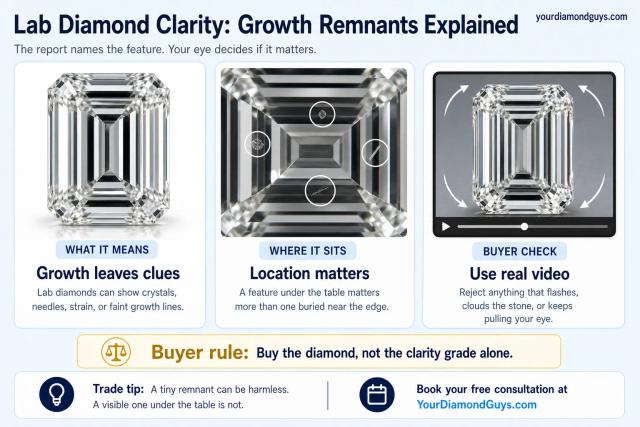
That is where you can see treatment language, clarity notes, or wording that points to growth features.
Post growth treatment is not an automatic rejection. But it should affect your questions, your price judgment, and sometimes your willingness to move forward. Read the post growth treatment guide if treatment shows up.
Inside the trade, comments get read because they can explain why two stones with the same headline grades do not sell the same way.
IGI vs GIA Context
IGI has a major role in lab grown diamond grading. GIA also grades lab grown diamonds.
For natural diamonds, I start with GIA. For lab grown diamonds, I still want strong documentation, but I never let the lab name replace the video.
If you are comparing reports across labs, use the GIA vs IGI lab grown guide.
My Buyer Recommendation
Use the IGI report to filter.
Then make the diamond prove itself.
I want clear lab grown disclosure, a verifiable report number, matching inscription, strong proportions, clean comments, neutral color, crisp transparency, and a return policy that lets you inspect the actual stone.
What To Ask Before Buying
- Does the report clearly say laboratory grown diamond?
- Can I verify the report number?
- Does the inscription match the report?
- Do the comments mention treatment or unusual clarity features?
- Do the proportions support good performance?
- Does the video support the report grade?
Book your free consultation if you want Rob or Josh to read the report with you.
Where I Would Compare Report Details
Use these sites as comparison tools, not automatic recommendations. For live listing comparison, I would check similar lab diamonds on Ritani and Blue Nile, then judge the report, video, tint, and return terms before the price gets the final vote.
Choosing Your Perfect Diamond
Questions? Reach out directly for a free consultation, or drop them in the Diamond Buyers Academy community — Rob and I answer personally.
Questions Buyers Ask Us
Related Lab Grown Diamond Guides
Keep the full buying path close. These are the next checks that usually affect this decision.
*Some links on our site may earn us a small commission at NO EXTRA cost to you, helping us keep our content free*