Princess Cut Proportions, Corner Strength, And Fire
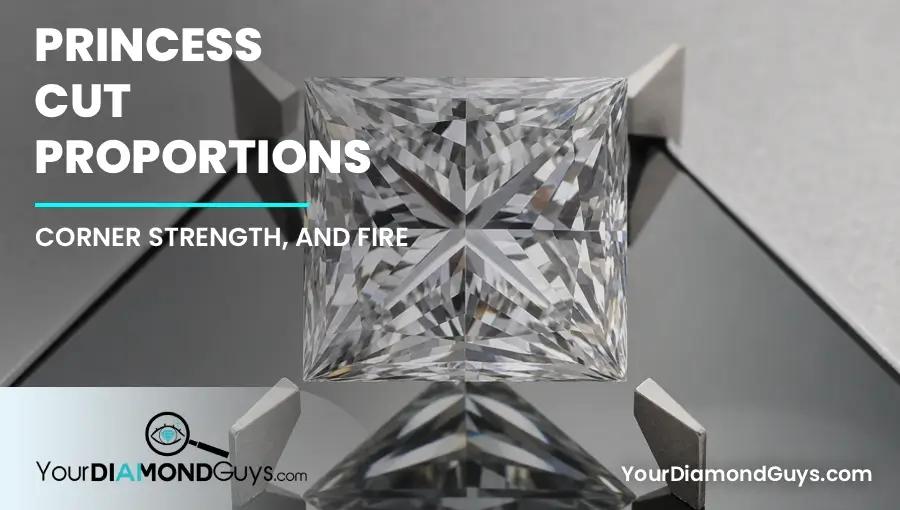
Princess corners need protection, and the pavilion still needs to earn its fire.
By Josh Allen, Co-Founder of YourDiamondGuys.com. Fifth generation diamantaire with 30+ years in the global diamond trade. Former supplier to Tiffany & Co., Cartier, and Harry Winston.
How we evaluate proportions: We check the square outline and all four corners, then compare depth, spread, pavilion bulge, and fire in motion. The stone has to stay bright without carrying costly weight below the face.
Here is the princess cut balance, strong proportions protect face up spread, keep the facet pattern bright, and leave enough strength at all four corners for daily wear.
That depth can support a lively pattern or simply make the stone look small. Sharp corners add another decision because beauty and durability meet at four vulnerable points.
A square report label does not guarantee a square looking stone. We check all four sides before we check the price.
For natural princess cuts, start with GIA. GIA warns that princess cuts can hide weight in a deep pavilion and recommends checking square shape, symmetry, contrast, and pavilion bulge.
The Short Answer
For a square princess, keep length to width at 1.00 to 1.05. Table around 65 to 75 percent and depth around 68 to 75 percent can form a practical search zone, but facet arrangement and pavilion bulge can change the result.
Inspect side equality, corner condition, even contrast, center brightness, spread, girdle at the corners, and the side profile. GIA does not provide an overall princess cut grade.
Square Outline And Corner Match Come First
A square princess should have four sides that look equal and four corners that align. Ratios above 1.05 begin to read rectangular unless that is the intended style.
Use a straight top view. Check for taper, a trapezoid shape, one clipped or damaged corner, and a table that looks off center.
The outline quality guide provides the same centerline test used for other fancy shapes.
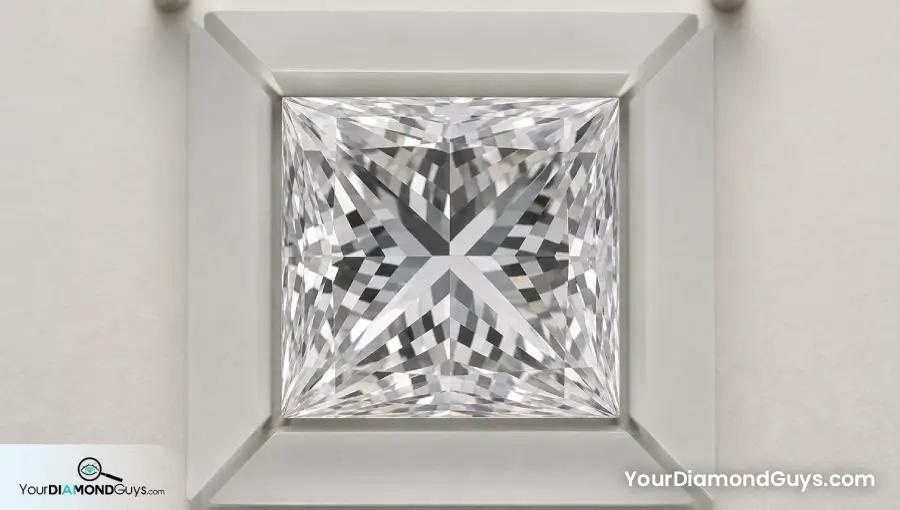
Equal sides, aligned corners, and a centered table make a princess cut look truly square.
Princess Proportion Starting Zones
Princess facet patterns vary by pavilion chevron count and manufacturer design. The ranges below organize the search. They do not grade fire or brightness.
Depth often runs higher than a round. Compare only princess cuts with similar outlines and inspect the side profile for extra bulge.
| Princess attribute | Practical starting zone | What to inspect |
|---|---|---|
| Length to width ratio | 1.00 to 1.05 | Square appearance and equal sides |
| Table percentage | About 65 to 75 percent | Crown presence and pattern balance |
| Depth percentage | About 68 to 75 percent | Spread and pavilion bulge |
| Girdle | Avoid very thin corners | Corner durability and hidden weight |
| Polish and symmetry | Excellent or Very Good | Centered facets and even outline |
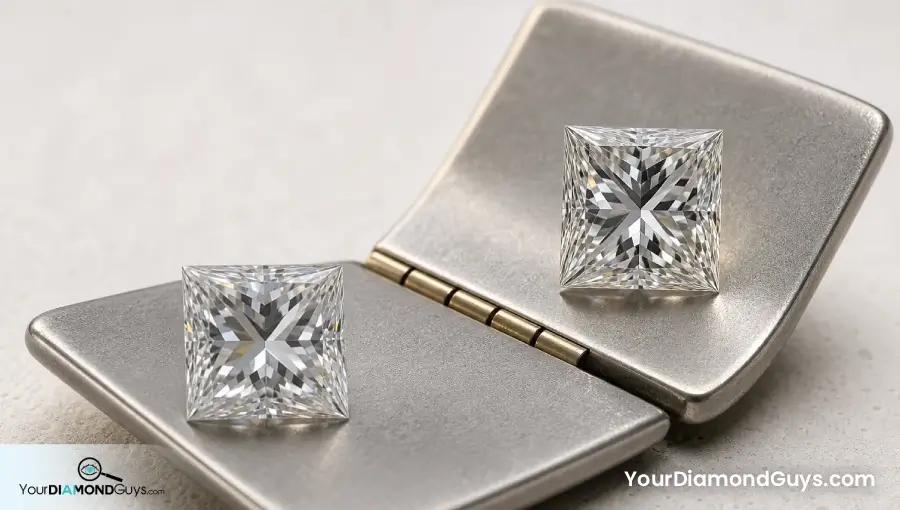
Fewer chevrons create broader flashes. More chevrons create finer scintillation across the face.
Pavilion Bulge And Small Face Up Size
A steep side profile can carry a pavilion bulge that adds weight without adding top area. Compare length and width with nearby princess cuts at the same carat.
A deep percentage does not prove bulge, and a moderate percentage does not remove the risk. The side view and actual millimeters expose it.
Use the spread score method for peer comparison. A smaller footprint needs exceptional pattern or a lower price to make sense.
Count the chevron pattern only after the size check. More chevrons can create finer scintillation, while fewer chevrons can create broader flashes. Neither pattern refunds missing face up area.
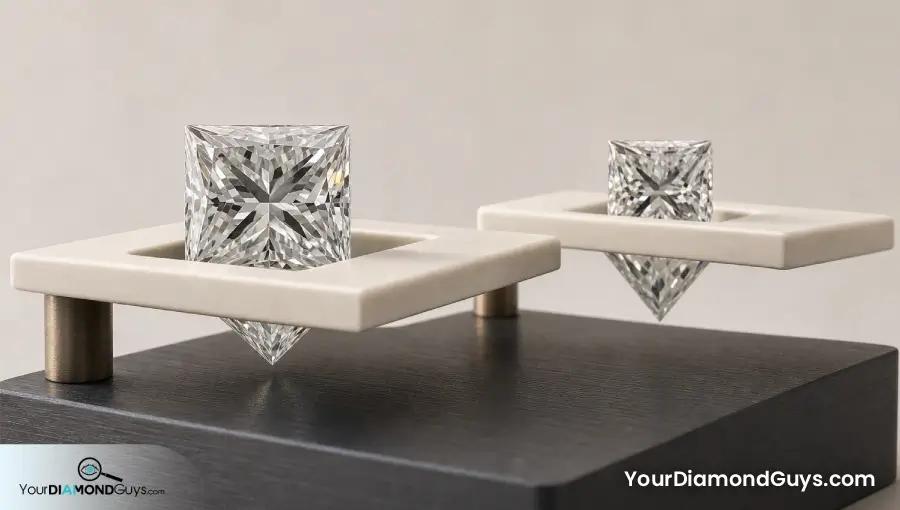
Two one carat princess cuts can hide very different amounts of weight below the face.
Corners Need Protection Without Hiding The Pattern
Princess corners sit near cleavage directions and can chip when exposed. Avoid a chip, bruise, cavity, knot, etched channel, or indented natural at a corner, especially with a very thin girdle.
V prongs protect the points well when the setting fits the exact stone. A bezel can add security but changes the visible edge and style.
The internal pattern should show a balanced mix of light and dark. A uniformly dark center or dead corners do not become lively after mounting.
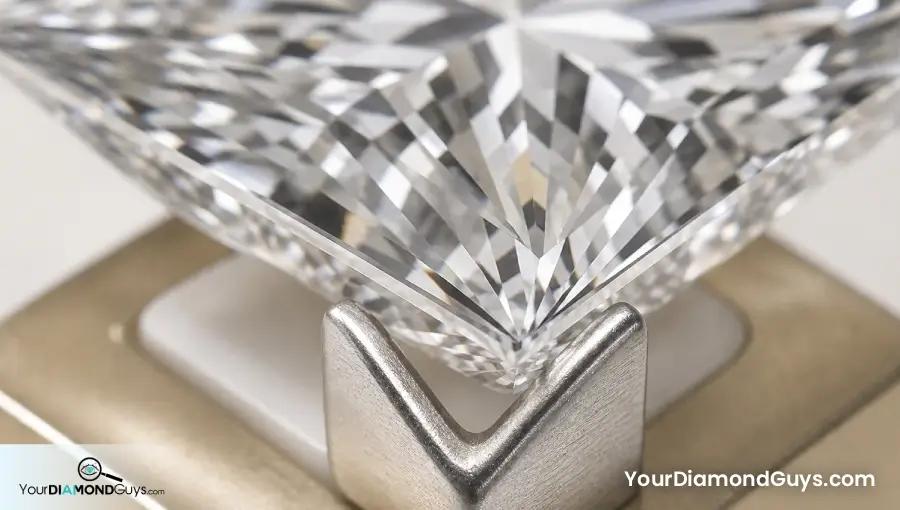
A fitted V prong protects the point while leaving the nearby chevron pattern visible.
How I Screen A Princess Cut
I check square outline, measurements, and corner integrity first. Then I compare the side profile, pattern, spread, and setting plan.
A princess stays when the face looks large enough for the weight, the center switches cleanly, and all four corners can be protected without awkward prong placement. I compare it at normal hand distance before approving the finer pattern.
A Corner And Pavilion Example
Princess A and Princess B both weigh 1.25 carats and have a 1.02 ratio. Princess A measures 6.10 × 5.98 mm. Princess B measures 5.82 × 5.70 mm and shows a steep pavilion bulge.
Princess A gives the stronger footprint. I still compare pattern and corners, but Princess B needs a major beauty or price advantage to justify invisible weight.
Mistakes I Would Avoid
- Using square modified brilliant as proof of a balanced square outline.
- Ignoring pavilion bulge and small millimeter spread.
- Buying a very thin or damaged corner.
- Choosing a stock setting before checking exact corner geometry.
- Approving the cut from table and depth alone.
Questions To Ask Before Buying
- Are all four sides and corners visually balanced?
- Does the side profile show pavilion bulge?
- How does the footprint compare with similar princess cuts?
- Do the center and corners switch between light and contrast?
- Will V prongs protect every corner without stress?
Where To Compare The Proof
Affiliate disclosure: Your Diamond Guys can earn a small commission if you buy through a partner link. It does not change what you pay or which diamond we recommend.
Compare princess measurements, side views, and videos on Brilliant Earth and Blue Nile. Keep ratio and carat close, then look for pavilion bulge and weak corner pattern before price.
The Princess Cut I Would Choose
Keep a square princess at 1.00 to 1.05 ratio and use the broad table and depth zones only for triage. The side profile and video decide the cut.
Buy strong corners, fair spread, and an active pattern. A carat label cannot recover a small dark face.
If you want another set of eyes on the stone, book your free consultation with Your Diamond Guys.
Protect The Corners Without Losing The Pattern
The broad princess cut diamond guide covers the full buying decision. Then test square ratio, girdle and corner durability, and the limits of table and depth ranges.
Return to the diamond proportions screening guide to connect princess depth and fire with spread, outline, girdle, and corner durability.
Looking for an Affordable Diamond Shape?
Questions? Reach out directly for a free consultation, or drop them in the Diamond Buyers Academy community — Rob and Josh answer personally.
Questions Buyers Ask Us
*Some links on our site may earn us a small commission at NO EXTRA cost to you, helping us keep our content free*